
Align your investment portfolio with your values by screening potential investments against environmental, social, and governance (ESG) criteria before committing your money. Start by reviewing your superannuation fund’s investment strategy—many Australians hold their largest pool of investment capital in super, yet fewer than 15% actively choose where it’s invested. Switch to industry super funds offering specific ethical investing options that exclude fossil fuels, weapons manufacturing, and companies with poor environmental track records.
Research companies’ sustainability reports and third-party ESG ratings to understand their real-world impact beyond marketing claims. Look for Australian businesses actively reducing carbon emissions, supporting renewable energy transitions, or protecting local ecosystems. Tools like the Responsible Investment Association Australasia’s certification program help identify genuinely sustainable investment options versus those merely greenwashing their practices.
Consider the broader ripple effects of your financial decisions. Every dollar invested sends a signal about what kind of economy you want to support. When enough Australians direct their capital toward sustainable enterprises, we collectively shift markets toward environmental responsibility. Your investment choices today shape the business practices of tomorrow, creating accountability for corporations while building the clean economy our communities need.
These nine strategies will equip you with practical frameworks for making investment decisions that honour both your financial goals and environmental values, proving that profit and planet protection aren’t mutually exclusive paths.
What Makes an Investment Truly Ethical?
Ethical investment in Australia has evolved far beyond simply avoiding ‘sin stocks’ like tobacco or gambling. Today, it’s about actively choosing where your money goes and understanding the real-world impact of those decisions. For Australian investors seeking to align their portfolios with their values, this means getting familiar with a framework that’s transforming how we think about returns.
At the heart of ethical investing lies ESG criteria: Environmental factors examine how companies manage their carbon footprint, water usage, and waste. Social considerations look at labour practices, community relations, and diversity. Governance assesses leadership transparency, executive pay, and shareholder rights. Think of ESG as a triple-lens approach to evaluating whether a company is genuinely sustainable or just greenwashing.
There are two main approaches to ethical investing that Australian investors should understand. Ethical screening involves filtering out companies that don’t meet your values, whether that’s fossil fuel producers, manufacturers of controversial weapons, or businesses with poor labour records. Impact investing goes further, actively seeking companies and projects creating measurable positive change, like renewable energy infrastructure across regional Australia or Indigenous-led conservation initiatives.
Here’s the encouraging news: ethical investing isn’t just good for your conscience. Recent analysis from the Responsible Investment Association Australasia shows that ESG-focused portfolios have consistently matched or outperformed traditional investments over the past decade. Companies managing environmental and social risks well tend to be better managed overall, reducing your exposure to regulatory penalties, reputational damage, and the increasingly tangible costs of climate change.
For Australian investors, this creates a powerful opportunity to support the transition to a sustainable economy while building financial security. Your investment choices send signals about the future we’re collectively building.
Strategy 1: Know Where Your Super Actually Goes
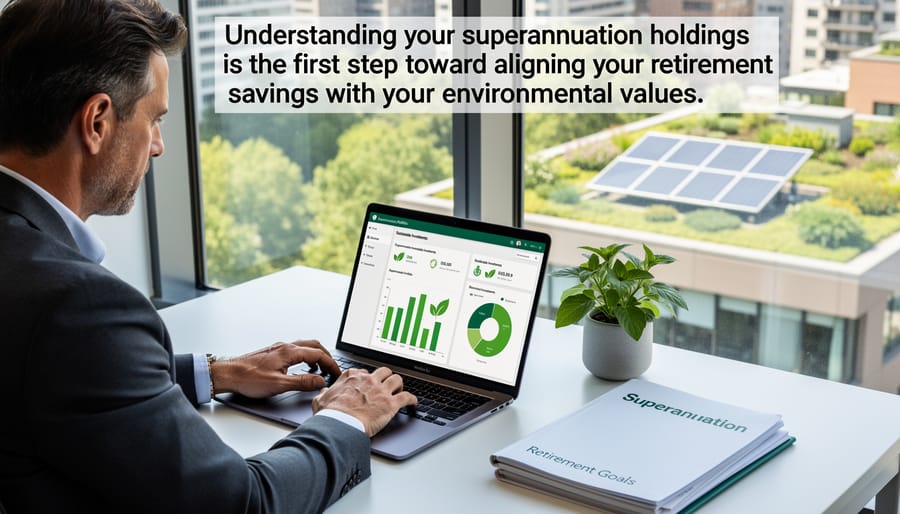
For most Australians, superannuation represents the single largest investment they’ll ever make, yet surprisingly few of us know exactly where that money is actually going. With over $3 trillion pooled in Australian super funds, these investments wield enormous power in shaping our environmental future. The good news? You have more control than you might think.
Start by investigating your current super fund’s holdings. Most major funds now publish their investment portfolios online, though you might need to dig a little. Log into your super account and look for sections labelled “investments,” “holdings,” or “where we invest.” If this information isn’t readily available, don’t hesitate to call and ask directly. You have every right to know where your retirement savings are being invested.
What you discover might surprise you. Many traditional super funds still hold significant stakes in fossil fuel companies, despite their marketing suggesting otherwise. Learning to identify fossil fuel investments in your portfolio is the crucial first step toward making ethical changes.
The solution? Australia now has several dedicated ethical super options. Funds like Australian Ethical, Future Super, and Cruelty Free Super explicitly exclude fossil fuels and other harmful industries from their portfolios. These aren’t just feel-good choices either. Australian Ethical, for instance, has consistently delivered competitive returns while investing in renewable energy, sustainable agriculture, and healthcare.
Switching super funds is remarkably straightforward. The process typically takes just 15 minutes online, and your new fund will handle the transfer for you. With decades until retirement for most workers, this single decision can redirect hundreds of thousands of dollars away from environmental harm and toward a sustainable future.
Strategy 2: Apply Negative Screening to Eliminate Harmful Industries
Negative screening is one of the most straightforward ways to align your investments with your values. Think of it as drawing a line in the sand – identifying industries you simply won’t support with your money, no matter the potential returns. For environmentally conscious Australians, this strategy creates immediate impact by redirecting capital away from harmful sectors.
The most commonly excluded industries include fossil fuels (coal, oil, and gas), tobacco, weapons manufacturing, gambling, and companies involved in deforestation or habitat destruction. In the Australian context, this often means avoiding major coal exporters and companies clearing land for intensive agriculture. You might also consider excluding businesses with poor animal welfare records or those contributing to the Great Barrier Reef’s decline through harmful practices.
Here’s where it gets tricky: many companies have hidden connections to these industries. A bank might appear clean on the surface but heavily finance coal projects. A supermarket chain could source products from suppliers engaged in land clearing. This is why digging deeper matters.
Practical screening tools make this easier. The Market Forces website specifically tracks Australian banks and super funds, revealing their fossil fuel investments. The Ethical Consumer Guide offers ratings on Australian companies across various sectors. Many online brokers now include ethical screening filters, letting you exclude specific industries from your portfolio searches.
When screening your current investments, start with your superannuation – it’s likely your largest investment. Check if your fund offers a fossil fuel-free option. For individual shares, review each company’s annual reports and look for revenue breakdowns. Even owning 5% of shares in a harmful industry means your money supports that sector.
Remember, negative screening isn’t about perfection. It’s about making conscious choices that reflect the future you want to create. Every dollar redirected from destructive industries weakens their hold on our economy and environment.
Strategy 3: Prioritise Positive Impact Through Green Investments
While avoiding harmful industries matters, the real excitement in ethical investing comes from actively supporting businesses creating positive environmental change. Rather than simply screening out the bad, positive screening means deliberately seeking out companies and funds driving Australia’s transition to a sustainable future.
This strategy transforms your investment portfolio into a powerful force for environmental good. When you invest in renewable energy companies, sustainable agriculture ventures, or circular economy innovators, you’re channeling capital toward solutions the planet urgently needs. It’s about being part of the answer.
Australian investors have remarkable opportunities to back homegrown sustainability leaders. Companies like Infigen Energy are powering homes with wind and solar, while Costa Group is advancing sustainable farming practices across the country. In clean technology, businesses developing water-saving innovations and waste reduction solutions are creating both environmental impact and strong returns.
The circular economy sector offers particularly exciting prospects. Australian companies focused on recycling infrastructure, product-as-service models, and waste-to-resource technologies are reimagining how we produce and consume. These businesses aren’t just reducing environmental harm—they’re building entirely new sustainable systems.
Several Australian managed funds specialise in positive impact investing. The Australian Ethical Managed Funds actively seek companies contributing to climate solutions, while Future Super directs investments toward renewable energy projects and sustainable infrastructure. These funds make it straightforward for everyday investors to support transformative change.
Community renewable energy projects represent another avenue for direct positive impact. Across Australia, local solar farms and wind cooperatives allow residents to invest in clean energy generation within their own regions, creating both environmental benefits and community ownership.
Start by identifying environmental issues you’re most passionate about—whether that’s renewable energy, regenerative agriculture, or waste reduction—then research investment options specifically targeting those solutions. This focused approach ensures your money actively builds the sustainable future you want to see.

Strategy 4: Research Company Environmental Track Records
Before you invest a dollar, it’s worth knowing whether the companies you’re supporting are genuinely committed to environmental protection or simply spinning a good story. In Australia, we’ve seen our fair share of businesses making grand environmental promises while their actual practices tell a different story.
Start by examining company sustainability reports, which publicly listed companies are increasingly required to publish. Look beyond the glossy photos of wind farms and recycled packaging. Focus on specific metrics: emissions reductions with actual numbers, waste diversion rates, water usage trends, and concrete targets with timelines. The best reports include third-party verification and acknowledge challenges alongside achievements.
Check for recognised certifications that require rigorous independent assessment. B Corp certification is particularly valuable, as it evaluates a company’s entire social and environmental performance, not just one aspect. In Australia, Climate Active certification demonstrates a genuine commitment to carbon neutrality with government-backed standards. Look for companies certified by the Responsible Investment Association Australasia (RIAA) too.
Use Australian resources designed to help you separate green claims versus greenwashing. The ACCC’s environmental claims guidelines provide a helpful framework for assessing marketing messages. Choice.com.au regularly investigates company claims, while the Australian Conservation Foundation’s “Corporate Climate Scorecard” ranks major companies on climate action.
Don’t hesitate to dig deeper. Search for recent news articles about environmental controversies, check the company’s track record with environmental regulators, and look at their political donations and lobbying positions. A company truly committed to sustainability will demonstrate consistency between their public statements, business practices, and political advocacy.
Remember, this research isn’t about finding perfect companies—they don’t exist. It’s about supporting businesses making genuine progress and holding themselves accountable for continuous improvement.
Strategy 5: Diversify Across Sectors Without Compromising Values
One of the most persistent myths about ethical investing is that you’ll end up with all your eggs in one basket. The reality? You can build a robust, diversified portfolio while staying true to your environmental values, and Australian investors are proving this every day.
Think of ethical diversification like planning a balanced meal from sustainable sources. You wouldn’t eat only vegetables from one farm, just as you wouldn’t invest solely in solar energy companies. The key is spreading your investments across multiple sectors that all contribute to a healthier planet.
Australia’s green economy offers remarkable diversification opportunities. Renewable energy remains a cornerstone, with companies operating wind farms in Tasmania, solar installations across Queensland, and emerging hydrogen projects in Western Australia. But that’s just the beginning. Sustainable agriculture ventures are transforming how we grow food, from regenerative farming practices in the Murray-Darling Basin to innovative aquaculture projects along our coastline.
Green transport is another growth sector, encompassing electric vehicle infrastructure, sustainable logistics companies, and even businesses developing cycling and public transport solutions for Australian cities. Waste management and circular economy enterprises are turning trash into treasure, while conservation technology companies are developing everything from reef restoration tools to wildlife monitoring systems.
Consider the Melbourne-based investor who diversified across these five sectors, allocating 30 percent to renewables, 20 percent to sustainable agriculture, 20 percent to green transport, 15 percent to waste management, and 15 percent to conservation tech. Over three years, when renewable energy faced temporary headwinds, strong performance in waste management and agriculture kept the portfolio stable.
This balanced approach doesn’t just manage risk, it captures opportunities across Australia’s entire sustainability transformation. You’re not limiting your options by investing ethically; you’re accessing a dynamic, growing segment of the economy while building the future we all want to see.
Strategy 6: Use Your Shareholder Voice for Environmental Advocacy
Your shares represent more than financial value—they’re a powerful tool for environmental change. As a shareholder, you have the right to influence how companies operate, and increasingly, Australian investors are using this voice to drive meaningful environmental action.
Shareholder activism works through several practical channels. The most accessible is proxy voting, where you vote on company resolutions, including those proposing stronger environmental policies or climate action. Many Australian shareholders don’t realise they can vote on these matters, yet it’s often as simple as completing an online form sent by your share registry. When thousands of shareholders vote together, companies take notice.
Attending Annual General Meetings offers another avenue for direct engagement. You can ask questions about environmental practices, carbon emissions, or supply chain sustainability. In 2022, Santos faced persistent shareholder questions about its climate transition plans at their AGM, demonstrating how individual voices can create accountability.
Supporting environmental resolutions amplifies your impact further. Market Forces, an Australian environmental advocacy group, coordinates shareholder campaigns targeting banks and fossil fuel companies. Their 2023 campaign saw record support for a climate resolution at Commonwealth Bank, with over 20 percent of shareholders backing stronger emissions reduction targets.
Community groups make participation easier for everyday investors. The Australasian Centre for Corporate Responsibility helps shareholders file resolutions and provides guidance on engaging with companies. Many community investment groups pool their collective shareholding power, making their voice impossible for boardrooms to ignore.
Even modest shareholdings matter. When combined with thousands of other concerned investors, your vote becomes part of a movement reshaping corporate Australia toward genuine environmental responsibility. This isn’t activism from the sidelines—it’s using your rightful position as a company owner to demand better.

Strategy 7: Support Local and Community-Based Environmental Projects
Sometimes the most powerful environmental investments aren’t found on the stock exchange – they’re happening right in your neighbourhood. Supporting local and community-based environmental projects offers a direct, tangible way to create positive change while knowing exactly where your money goes and what impact it’s making.
Community renewable energy cooperatives are flourishing across Australia, allowing everyday people to collectively own and benefit from solar farms and wind projects. These cooperatives typically offer membership shares starting from just a few hundred dollars, making clean energy investment accessible to most Australians. Unlike distant corporate investments, you can often visit these projects, see the panels generating power, and directly measure the carbon emissions avoided. Groups like Repower Shoalhaven and Community Power Agency connect people with local renewable initiatives throughout the country.
Community solar programs provide another excellent option, particularly for renters or apartment dwellers who can’t install rooftop panels. By purchasing a share in a larger solar array, you receive credits on your electricity bill while supporting local renewable infrastructure. Many councils and community organizations now facilitate these arrangements, creating win-win outcomes for participants and the environment.
Ethical credit unions and community banks represent a powerful alternative to traditional banking. Unlike major banks that may fund fossil fuel projects, institutions like Bank Australia and community credit unions across the country explicitly commit to environmental and social responsibility. Your everyday banking becomes an environmental statement, with deposits supporting local sustainable businesses and green loans.
Local conservation initiatives – from tree planting programs to waterway restoration projects – often welcome financial supporters. These grassroots efforts create immediate, visible improvements in your local environment while building community connections. Just as choosing sustainable partners matters in business, supporting local environmental projects amplifies collective impact and strengthens community resilience against climate challenges.

Strategy 8: Balance Financial Returns With Environmental Impact
One of the biggest concerns holding Australians back from ethical investing is the fear they’ll sacrifice returns for values. Here’s the encouraging news: research consistently shows ethical investments perform competitively with traditional portfolios, and often outperform them.
A 2023 analysis by the Responsible Investment Association Australasia found that over a ten-year period, sustainable investment funds delivered returns on par with or exceeding conventional funds. The Australian Ethical Managed Funds, for instance, have demonstrated strong performance while screening out fossil fuels entirely. Why? Companies focused on sustainability often demonstrate better risk management, innovation, and long-term thinking – qualities that translate to financial resilience.
Consider Melbourne-based investor Sarah, who shifted her entire portfolio to ethical investments five years ago. Initially anxious about potential underperformance, she’s been pleasantly surprised. Her diversified portfolio of renewable energy stocks, ethical ETFs, and green bonds has delivered 8.2 percent annual returns while supporting projects she believes in. “I thought I’d have to choose between my values and my retirement,” she shares. “Turns out, investing in the future is actually investing in my future.”
That said, defining your personal balance is essential. Some ethical investments, particularly those supporting early-stage clean technology or community projects, may offer lower short-term returns but deliver significant environmental impact. The question becomes: what trade-off feels right for you?
Start by allocating your portfolio across different impact levels. Perhaps 70 percent in established ethical funds with competitive returns, 20 percent in higher-impact renewable projects with moderate returns, and 10 percent in community investments where environmental benefit takes priority. This approach lets you support transformative change while maintaining financial security.
Remember, every dollar invested ethically sends a powerful market signal. You’re not just building wealth – you’re building the Australia you want to live in.
Strategy 9: Regularly Review and Adjust Your Investment Choices
Ethical investing isn’t a set-and-forget strategy. The Australian business landscape evolves constantly, with companies changing their practices, new environmental challenges emerging, and sustainability standards advancing. What seemed like a responsible investment choice last year might not align with your values today, making regular portfolio reviews essential for maintaining your ethical commitment.
Consider setting an annual investment health check, ideally timed with the end of the financial year when you’re already reviewing your finances. During this review, reassess your portfolio environmental impact by checking whether companies you’ve invested in have maintained their sustainability commitments or if any controversies have emerged. Australian resources like the Australasian Centre for Corporate Responsibility provide regular updates on corporate environmental performance.
Stay informed through trusted Australian sources. Subscribe to newsletters from organizations like the Responsible Investment Association Australasia, which tracks changes in ESG standards and highlights emerging sustainability concerns. These resources help you understand how environmental priorities are shifting, from carbon emissions to biodiversity protection and circular economy principles.
Don’t hesitate to adjust your holdings when companies fall short of their environmental promises or when better alternatives emerge. The Australian ethical investment sector has grown significantly, meaning you’ll likely find more options each year that better align with your values.
Remember, reviewing your investments also means celebrating progress. Notice how your choices contribute to renewable energy expansion, sustainable agriculture, or environmental restoration projects across Australia. Share your experiences with friends and family considering ethical investing. Your journey demonstrates that staying committed to environmental values through regular portfolio adjustments creates meaningful impact while building financial security. This ongoing attention ensures your investments continue reflecting the sustainable future you want to support.
Making ethical investment decisions isn’t just about your portfolio returns, it’s about recognising the power you hold to shape Australia’s environmental future. Every dollar you invest is a vote for the kind of world you want to see, and collectively, these choices create ripples that turn into waves of real change.
You don’t need to overhaul your entire financial life overnight. Starting small is not only acceptable, it’s often the wisest approach. Perhaps begin by switching your superannuation to an ethical fund, or allocating just a portion of your savings to renewable energy investments. These initial steps build confidence and knowledge, making larger commitments feel less overwhelming over time.
The beauty of ethical investing in Australia is that you’re not alone in this journey. A vibrant community of like-minded individuals, advisers, and organisations exists to support your decisions. Connect with local investment groups, attend sustainability forums, or join online communities where experiences and insights are freely shared. This collective wisdom helps you navigate challenges and discover opportunities you might never find on your own.
Remember that your money is never neutral. Whether you actively choose ethical investments or leave your funds in default options, you’re making a statement. The question isn’t whether your investments will have an impact, but rather what kind of impact you want them to have. By applying these nine strategies, you’re choosing to be intentional, informed, and aligned with your values. That choice matters more than you might realise, both for your financial future and for the environment we all share.