
Every morning, millions of Australians travel between home and work, collectively creating invisible boundaries that shape our cities, our environment, and our future. These boundaries are commuting zones—geographic areas defined by where people live and work—and they’re now at the heart of Australia’s sustainable transport revolution.
Understanding your commuting zone isn’t just about knowing how far you travel. It’s about recognizing your role in a larger ecosystem where every journey contributes to either the problem or the solution. In Sydney, Melbourne, Brisbane, and Perth, commuting zones are expanding faster than public transport infrastructure can keep pace, pushing more vehicles onto our roads and more carbon into our atmosphere. The average Australian commuter now travels 16 kilometers each way, generating approximately 3.6 tonnes of CO2 annually if driving solo.
But here’s the empowering truth: your commuting zone presents unique opportunities for sustainable change. Whether you live in the inner-city fringe, suburban sprawl, or regional connector zones, different distances demand different solutions. A five-kilometer commute opens doors to cycling and walking that a 40-kilometer journey doesn’t, while longer distances might benefit from carpooling networks or strategic public transport connections.
This article explores how Australian communities are reimagining commuting zones as catalysts for environmental action rather than obstacles. You’ll discover practical strategies tailored to your specific zone, learn how businesses are supporting sustainable commuter programs, and find inspiration from neighborhoods already transforming their daily journeys. Understanding your commuting zone is the first step toward reducing your environmental footprint while building stronger, more connected communities across Australia.
What Are Commuting Zones and Why Do They Matter?
The Australian Context: Our Sprawling Cities
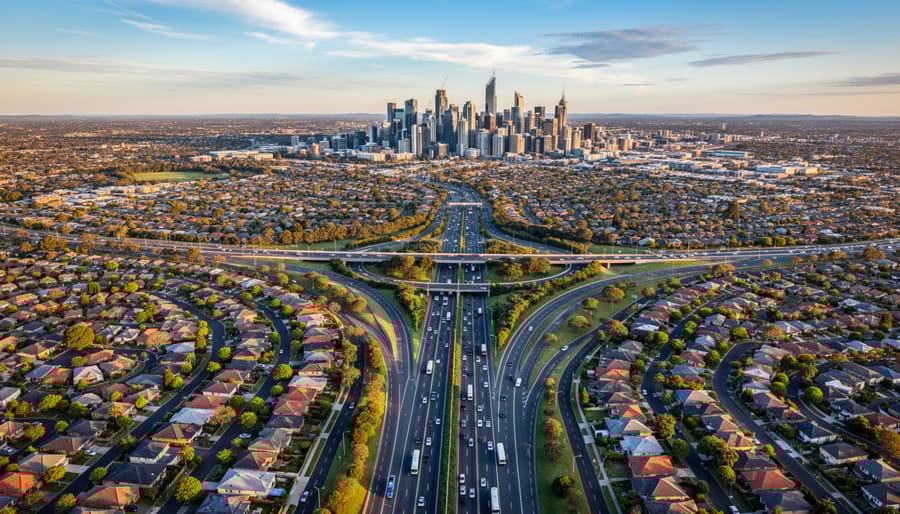
Australia tells a different urban story compared to our international counterparts. While European cities developed compact centres connected by efficient public transport, our capital cities stretch across vast distances. Melbourne sprawls across more than 9,990 square kilometres, while Sydney extends along 12,368 square kilometres of coastline and inland suburbs. This makes us some of the most spread-out cities in the developed world.
The numbers reveal our challenge: Australian commuters travel an average of 16 kilometres each way to work, with many suburban residents facing journeys exceeding 30 kilometres. In contrast, the average European commute sits around 10 kilometres. Our love affair with the quarter-acre block and the Australian dream of home ownership has pushed housing developments further from employment centres, creating what urban planners call low-density sprawl.
This sprawling nature means commuting zones become particularly crucial for Australian sustainability efforts. When your neighbour works 40 kilometres in one direction while you travel 35 kilometres the opposite way, traditional carpooling becomes nearly impossible. Yet within defined commuting zones, we discover pockets of opportunity. That business park 8 kilometres away might employ dozens of residents from your suburb. The university campus 12 kilometres down the road could be the destination for multiple families on your street.
Understanding and mapping these commuting zones specific to Australian geography helps us identify realistic solutions for our unique challenge. It’s about working smarter with the urban landscape we have, rather than against it.
The Environmental Cost of Cross-Zone Commuting
Every day, millions of Australians cross multiple commuting zones to reach their workplaces, creating an environmental ripple effect that extends far beyond individual journeys. Understanding the true cost of cross-zone commuting reveals why reducing these distances matters so urgently for our planet.
According to the Australian Bureau of Statistics, the average Australian commuter travels 16 kilometres to work, with many crossing two or more distinct commuting zones. When we calculate the carbon footprint, the numbers become stark. A single-occupancy vehicle commute of 30 kilometres daily generates approximately 3.8 tonnes of CO2 annually, equivalent to the carbon absorbed by 173 tree seedlings grown for ten years.
The zone-hopping effect multiplies these emissions significantly. Research from the Department of Infrastructure shows that commuters traveling across three zones emit up to 60 percent more greenhouse gases than those working within their local zone. This occurs not just from distance, but from the stop-start nature of cross-zone travel through varying traffic densities.
Public transport offers a more sustainable alternative, though effectiveness varies by zone connectivity. Train commuters produce 75 percent fewer emissions per kilometre than solo drivers, while buses reduce emissions by approximately 50 percent. However, inadequate cross-zone public transport links often force commuters toward private vehicles, particularly in outer metropolitan areas.
Beyond individual choices, adopting energy efficient driving techniques can reduce fuel consumption by up to 25 percent for those who must drive across zones. Simple practices like maintaining steady speeds and reducing air conditioning use make measurable differences.
The cumulative effect is sobering. In Sydney alone, cross-zone commuting generates an estimated 5.2 million tonnes of CO2 annually. Melbourne contributes another 4.8 million tonnes. These figures represent opportunities for transformation. Communities across Brisbane, Perth, and Adelaide are already demonstrating that when we work closer to home or embrace zone-appropriate transport options, we collectively create powerful environmental change. The question becomes not whether we can afford to act, but whether we can afford not to.
Sustainable Commuting Strategies Within Your Zone
Active Transport: Walking and Cycling for Short-Zone Trips
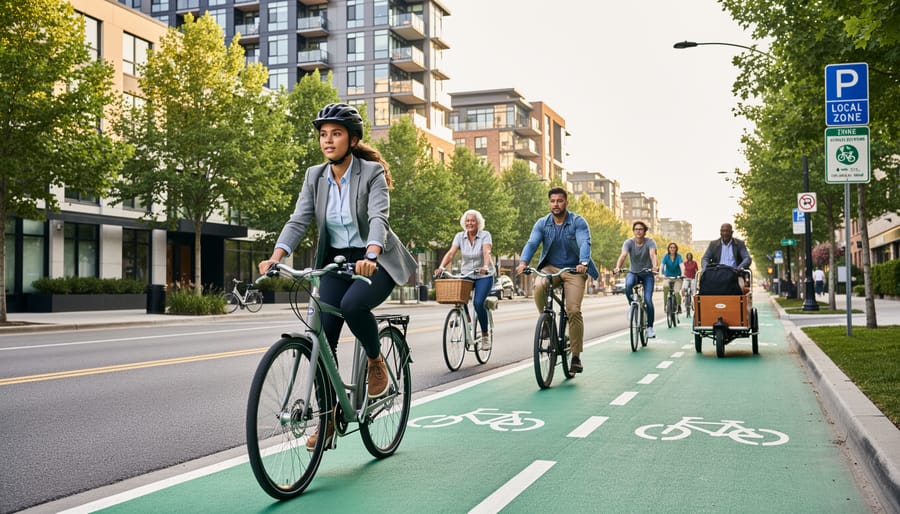
For trips under 5 kilometres, your legs become your most sustainable transport solution. Within compact commuting zones, walking and cycling transform from fitness activities into practical alternatives to driving that slash emissions while boosting your wellbeing.
Australian cities are increasingly embracing active transport infrastructure. Melbourne’s expanding network of protected bike lanes now connects residential zones with employment hubs, while Brisbane’s CityCycle scheme and Sydney’s growing cycling corridors demonstrate how infrastructure investment unlocks two-wheeled potential. The transformation is visible: councils across Australia recorded a 43% increase in cycling journeys between 2019 and 2023.
E-bikes are revolutionising the conversation about distance and effort. What once felt too far or too hilly becomes achievable, extending your practical cycling zone from 3 to 10 kilometres. Many Australian workplaces now offer secure bike storage and end-of-trip facilities, removing common barriers to pedal-powered commuting.
Community initiatives are driving change at the local level. Bike Buddy programs in Perth match experienced cyclists with beginners, while Walking School Bus groups in Adelaide create safe, social morning routines for families. These grassroots movements build confidence and demonstrate that active transport thrives on collective action.
The benefits extend beyond carbon reduction. Regular active commuters report improved mental health, stronger community connections, and significant cost savings. When we redesign our commuting zones around human-powered movement, we create neighbourhoods where sustainability becomes the natural, enjoyable choice.
Public Transport Optimization
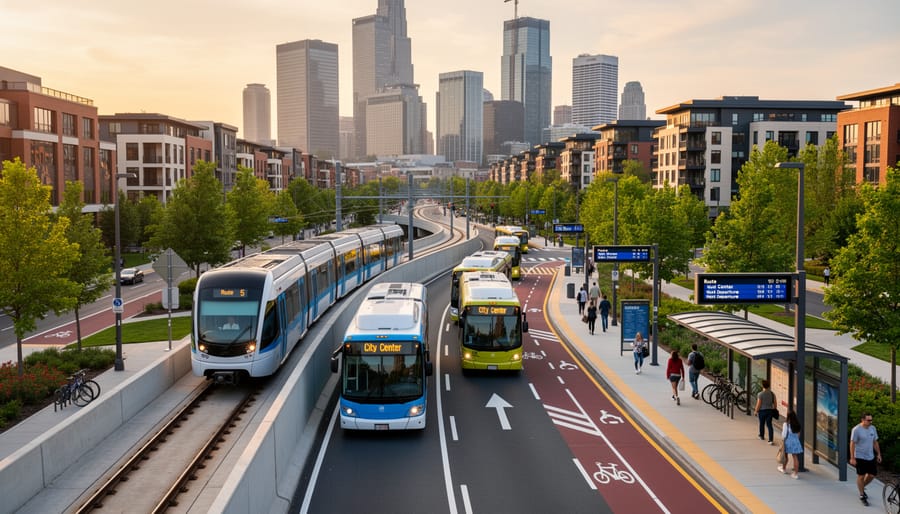
Understanding your local public transport system transforms how efficiently you can navigate commuting zones while slashing your carbon footprint. The beauty of strategic public transport use lies not just in reducing emissions, but in discovering how interconnected our communities truly are.
Start by mapping transit hubs within your commuting zone. Major stations like Sydney’s Central or Melbourne’s Southern Cross serve as vital connection points between multiple transport modes. These hubs often sit at zone boundaries, making them perfect meeting spots for carpools or transition points for multi-modal journeys. Download your transport authority’s app to identify real-time connections and plan journeys that minimize waiting times between services.
For NSW residents, your Opal card offers significant savings through daily and weekly caps, with off-peak travel costing 30% less. Travel outside peak hours when possible, and remember that after eight paid journeys in a week, the rest are free. This encourages frequent public transport use over driving. Victorian commuters benefit from Myki’s two-hour and daily fare structures, where strategic timing can reduce costs substantially. Consider combining Myki Money for flexibility with Myki Pass for regular commuting patterns.
Regional bus networks are the unsung heroes of sustainable commuting, often providing direct routes that trains don’t cover. Many regional services now coordinate with train timetables, creating seamless journeys across multiple zones. Communities in areas like the Central Coast or Geelong have established informal park-and-ride arrangements near bus stops, maximizing accessibility while minimizing individual vehicle use. Share these local knowledge gems with neighbours to strengthen your community’s sustainable transport network.
Carpooling and Ride-Sharing Networks
Across Australian suburbs and regional centres, carpooling and ride-sharing networks are transforming daily commutes into opportunities for connection and environmental action. These zone-based initiatives match neighbours, colleagues, and community members travelling similar routes, dramatically reducing the number of vehicles on our roads while building stronger social bonds.
Workplace carpooling programs have gained remarkable momentum in Australian business districts. Companies in areas like Macquarie Park in Sydney and the Tonsley Innovation District in Adelaide actively coordinate commuting zones where employees can connect through dedicated apps or workplace noticeboards. These programs often include preferential parking spots for carpool vehicles and financial incentives that make sharing rides the obvious choice. Even when participants use energy efficient vehicles, carpooling multiplies the environmental benefits by reducing overall vehicle numbers.
Community-driven schemes are flourishing in regional areas where public transport options remain limited. Towns like Ballarat and Toowoomba have established neighbourhood carpooling networks through local Facebook groups and council-supported platforms. Parents coordinate school run rosters, residents share trips to regional shopping centres, and workers travelling to nearby cities form regular carpool partnerships.
The environmental impact speaks volumes: a single carpool replacing four solo commutes can reduce carbon emissions by up to 75 percent per person. Beyond sustainability, participants consistently report unexpected benefits including reduced stress, lower fuel costs, and meaningful friendships formed during their shared journeys. These networks prove that sustainable commuting doesn’t require sacrifice but rather creates richer, more connected communities.
Businesses and Commuting Zones: A Sustainability Partnership
Location-Based Hiring and Remote Work Policies
Forward-thinking Australian businesses are reimagining their hiring strategies by mapping commuting zones to create more sustainable workforces while supporting work-life balance. This approach considers where potential employees live in relation to office locations, reducing carbon footprints and fostering stronger community connections.
Melbourne-based tech company Envato has pioneered location-conscious recruitment by prioritising candidates within accessible public transport corridors. Their policy offers tiered work-from-home flexibility based on commuting distance, with employees living beyond 20 kilometres receiving three guaranteed remote days weekly. This strategy reduced their workforce’s combined weekly commute by approximately 8,000 kilometres, cutting emissions while improving staff retention by 23 percent.
Brisbane’s environmental consultancy GHD implemented a similar model by establishing satellite offices in key suburban hubs throughout South East Queensland. By matching employees to offices within their natural commuting zones, they’ve created teams that rarely travel more than 30 minutes, transforming productivity and wellbeing. Their hybrid policy allows employees to choose their primary hub, recognising that commuting zones shift as life circumstances change.
For businesses ready to embrace this approach, start by mapping your current workforce’s commuting patterns using postcode data. Identify clusters where multiple employees live and consider flexible arrangements or co-working partnerships in those areas. During recruitment, transparently communicate your location-based policies, attracting candidates who value sustainability.
The beauty of zone-based hiring lies in its dual impact: businesses reduce their scope three emissions while employees reclaim time previously lost to lengthy commutes. It’s about building workforces that mirror the communities they serve, creating genuine connections between workplace and neighbourhood.
Corporate Commute Programs That Work
Australian businesses are leading the charge with innovative workplace transport programs that make sustainable commuting genuinely appealing. These success stories demonstrate how strategic initiatives can transform employee travel habits while building stronger workplace communities.
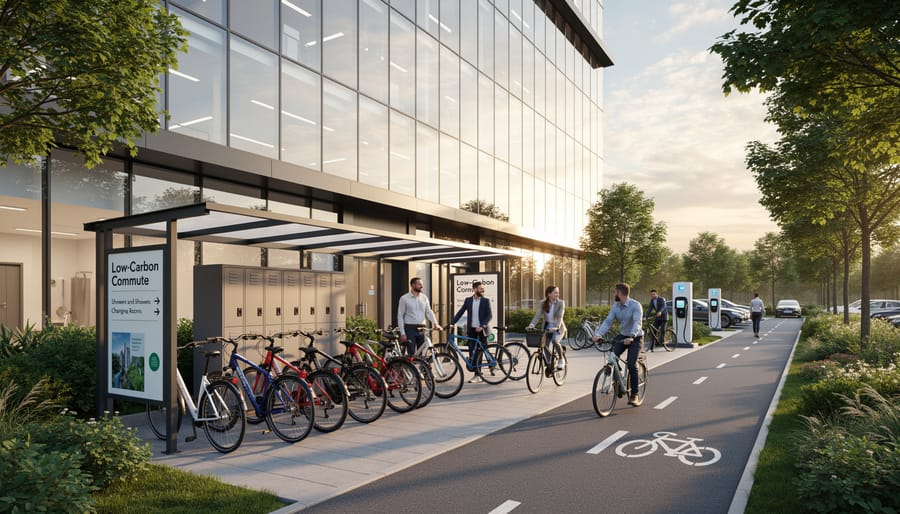
Melbourne’s RMIT University runs a comprehensive bike-to-work scheme providing employees with secure bike storage, shower facilities, and maintenance workshops. Staff who cycle regularly earn wellness points redeemable for campus cafe vouchers, creating tangible rewards for sustainable choices. The program has reduced single-occupancy vehicle trips by 23% since its launch.
In Sydney’s tech precinct, several companies have pooled resources to operate shared shuttle services connecting major train stations with office hubs during peak times. This collaborative approach, covering zones within a 5-kilometre radius, has proven cost-effective for businesses while eliminating the frustration of last-mile connectivity for employees.
Brisbane-based accounting firm BDO introduced a parking cash-out program where employees who forgo designated parking spots receive monthly public transport credits or bike maintenance allowances. This financial incentive acknowledges that parking spaces represent real costs, redirecting those savings toward greener alternatives.
Perth’s Woodside Energy incentivises carpooling through priority parking for shared vehicles and quarterly prize draws for participants. Their internal ride-matching platform connects colleagues living in similar commuting zones, fostering connections while reducing emissions.
These programs succeed because they address practical barriers, offer genuine benefits, and create positive peer influence around sustainable commuting choices.
Community Initiatives Transforming Australian Commuting Zones
Across Australia, communities are taking commuting into their own hands with inspiring initiatives that prove sustainable transport doesn’t require massive infrastructure overhauls. These grassroots movements and local government programs are reshaping how we think about getting from A to B.
In Melbourne’s inner north, the Moreland Council’s Car Share Hub program has transformed unused parking spaces into community car-share zones. Since launching in 2019, the initiative has removed an estimated 12 privately owned vehicles per shared car from local streets, significantly reducing emissions within the commuting zone. Residents report saving up to $6,000 annually while cutting their carbon footprint by approximately 40 percent compared to traditional car ownership.
Queensland’s Sunshine Coast Regional Council has pioneered a ride-matching platform specifically designed for coastal commuting zones. The CoastConnect app pairs residents traveling similar routes, creating carpooling networks that have reduced peak-hour traffic congestion by 18 percent in participating suburbs. Local business owner Sarah Mitchell shares, “I’ve halved my fuel costs and made three new friends in my neighborhood. It’s changed my morning routine from stressful to social.”
In Western Australia, the City of Fremantle’s e-bike library program lets residents borrow electric bikes for up to a month, encouraging them to test sustainable commuting before committing to purchase. The program has achieved a 65 percent conversion rate, with borrowers either buying their own e-bikes or switching to public transport permanently. This hands-on approach removes the barrier of upfront costs while building confidence in alternative transport modes.
Tasmania’s Hobart City Council has created “green commuter precincts” where businesses receive grants to install end-of-trip facilities like bike storage, showers, and lockers. The Salamanca precinct now boasts a 35 percent active transport rate among workers, triple the city average.
The common thread? These initiatives start small, focus on genuine community needs, and create social connections alongside environmental benefits. They demonstrate that transforming commuting zones doesn’t require waiting for perfect conditions. Whether it’s sharing rides, bikes, or ideas, Australian communities are proving that collective action delivers measurable results. The lesson is clear: sustainable commuting thrives when neighbors work together and local governments provide supportive frameworks that make green choices the easy choices.
Making It Personal: Assessing Your Commuting Zone Impact
Understanding your personal commuting zone impact starts with honest reflection about your daily travel patterns. Begin by tracking your commute for one week, noting the distance, mode of transport, and time spent travelling to work, shops, schools, and regular activities. This simple exercise reveals patterns you might not have noticed before.
Next, calculate your carbon footprint using Australian-specific tools. The Australian Government’s Green Vehicle Guide provides detailed emissions data for different vehicle types, while the Climate Active Carbon Neutral Standard calculator offers comprehensive assessment options. Simply input your weekly kilometres, vehicle type, and fuel consumption to see your transport emissions in real terms. The average Australian commuter produces approximately 2.5 tonnes of CO2 annually just from their work commute, so knowing your number is the first step toward meaningful change.
Now comes the exciting part – discovering sustainable alternatives within your commuting zone. Map out local public transport options using your state’s journey planner. Transport for NSW, PTV Victoria, and TransLink Queensland all offer route planning tools showing multimodal options. You might be surprised to find a train station within cycling distance or a bus route you’d overlooked.
Consider carpooling through platforms like Liftshare Australia or exploring your workplace’s ride-share programs. Many Australian businesses now offer facilities for cyclists and pedestrians, making active transport increasingly practical. If driving remains necessary, adopting eco driving practices can reduce emissions by up to 25 percent.
Create a personalised action plan by identifying one change you can implement immediately. Perhaps it’s cycling twice weekly, catching the train on Wednesdays, or working from home when possible. Small adjustments within your commuting zone compound over time, creating lasting environmental benefits while often saving money and improving your wellbeing. Remember, every sustainable choice contributes to Australia’s collective climate action, and your commuting zone is where that change begins.
Understanding your commuting zone isn’t just about mapping distance on paper. It’s about recognizing that every journey we take ripples outward, affecting air quality, traffic congestion, carbon emissions, and the wellbeing of communities across Australia. The good news? We’re already seeing remarkable shifts as individuals and organizations embrace zone-conscious commuting practices.
From the Sydney office that introduced staggered start times to reduce peak-hour pressure, to the Melbourne community that rallied for better cycling infrastructure in their 15-kilometer zone, change is happening because people like you are taking steps forward. These aren’t isolated success stories but part of a growing movement recognizing that sustainable commuting doesn’t require perfection. It asks for progress.
Your commuting zone presents unique opportunities. Perhaps you’re within walking distance but haven’t explored safe routes yet. Maybe you’re in the outer zones where carpooling could halve your weekly fuel consumption while building connections with neighbors. Or you might be positioned perfectly to advocate for better public transport links that would benefit hundreds in your area.
The transformation toward sustainable commuting zones across Australia won’t happen overnight, and that’s perfectly okay. What matters is that we’re moving in the right direction together. Start small. Choose one day a week to try a different commuting method. Talk with your employer about flexible arrangements. Connect with local sustainability groups exploring shared transport solutions.
Your commuting zone is more than a geographic boundary. It’s your sphere of influence, where individual choices combine to create collective momentum. The question isn’t whether you can make a difference, but which sustainable commuting practice you’ll embrace first. Australia’s future depends not on grand gestures, but on communities coming together, one journey at a time.