
Australia generates over 75 million tonnes of waste annually, yet fewer than 40% of us truly understand the science-backed methods that could revolutionise how our communities handle refuse. The gap between our good intentions and effective action has never been more critical to bridge.
Every plastic bottle in your yellow bin, every food scrap in your compost, and every electronic device you responsibly dispose of represents a choice between pollution and regeneration. The science of eco-friendly waste management isn’t about feel-good gestures—it’s about proven, measurable technologies that transform rubbish into resources whilst protecting our unique Australian ecosystems.
From the red earth of the Outback to our pristine coastlines, our continent faces distinct waste challenges that demand locally-informed solutions. Traditional landfills leach toxins into our groundwater, microplastics infiltrate our marine environments, and methane emissions from decomposing organic waste accelerate climate change. Yet across our cities and regional communities, innovative Australians are pioneering approaches that work with nature’s cycles rather than against them.
The methods we’ll explore combine rigorous scientific principles with practical application. Aerobic digestion harnesses microbial communities to break down organics. Pyrolysis technology converts waste into fuel through controlled thermal decomposition. Advanced material recovery facilities employ optical sorting and artificial intelligence to reclaim valuable resources from mixed waste streams. These aren’t futuristic concepts—they’re operational systems already reducing waste, creating jobs, and protecting our environment right now.
Understanding these methods empowers you to advocate for better infrastructure, make informed disposal decisions, and join the growing movement of Australians committed to genuine environmental stewardship. The transition from wasteful to regenerative starts with knowledge, strengthens through community action, and succeeds through sustained commitment.
The Science Behind Sustainable Waste Management
Understanding the Waste Hierarchy in Practice
The waste hierarchy isn’t just a catchy slogan—it’s a scientifically ranked framework that guides us toward the most environmentally sound waste management decisions. Think of it as a pyramid, with the most preferred options at the top and the least desirable at the bottom.
Prevention sits at the peak, and here’s why it’s the gold standard: waste that’s never created requires no energy for collection, processing, or disposal. When Melbourne’s Yarra Valley Water introduced reusable container programs at their facilities, they prevented 15,000 single-use bottles from entering the waste stream in just six months. This approach saves raw materials, reduces carbon emissions from manufacturing and transport, and eliminates the environmental burden entirely.
Next comes reuse, where items serve their purpose multiple times without reprocessing. Community repair cafes across Sydney and Brisbane demonstrate this beautifully, extending the life of electronics, clothing, and furniture while building local connections.
Recycling follows, transforming materials into new products. While valuable, it still consumes energy and water—making it scientifically less efficient than prevention or reuse.
Recovery involves extracting energy from waste through controlled processes, while disposal in engineered landfills represents our last resort.
The science is clear: every step down the hierarchy requires more energy input and produces greater environmental impact. By cultivating waste reduction habits and prioritizing prevention, Australian households and businesses can achieve the most significant environmental benefits. This hierarchy isn’t arbitrary—it reflects thermodynamic efficiency and ecological impact, making it our roadmap for genuine sustainability.
Circular Economy: Nature’s Blueprint for Zero Waste
Nature solved the waste problem millions of years ago. In natural ecosystems, nothing goes to waste. A fallen leaf becomes nutrients for new growth, while one creature’s byproduct nourishes another. The circular economy takes this brilliant blueprint and applies it to how we design, produce, and manage materials in our communities.
Unlike the traditional linear economy where we take resources, make products, and throw them away, a circular approach keeps materials flowing in continuous loops. Products are designed from the outset to be repaired, reused, or completely broken down into components that feed back into production cycles. This isn’t just theory; Australian businesses are proving it works.
Melbourne’s Circular Economy Hub showcases companies transforming coffee waste into skincare products and building materials. In South Australia, Mighty Kingdom Games achieved zero waste to landfill by redesigning their entire office system, from compostable packaging to furniture made from reclaimed materials. Meanwhile, Queensland’s sugar cane industry now converts bagasse, previously burned as waste, into biodegradable packaging and renewable energy.
The science behind this approach draws from industrial ecology, which studies material and energy flows through industrial systems just as ecologists study natural ecosystems. By mapping these flows, businesses identify opportunities to close loops, creating symbiotic relationships where one operation’s waste becomes another’s resource.
For Australian households and businesses ready to embrace this approach, start by questioning the very concept of waste. Could your organic matter nourish community gardens? Might your business partner with others to exchange materials? These practical steps mirror nature’s wisdom, proving that waste is simply a resource waiting for the right connection.
Composting and Organic Waste Processing
Aerobic Composting: Turning Kitchen Scraps Into Black Gold
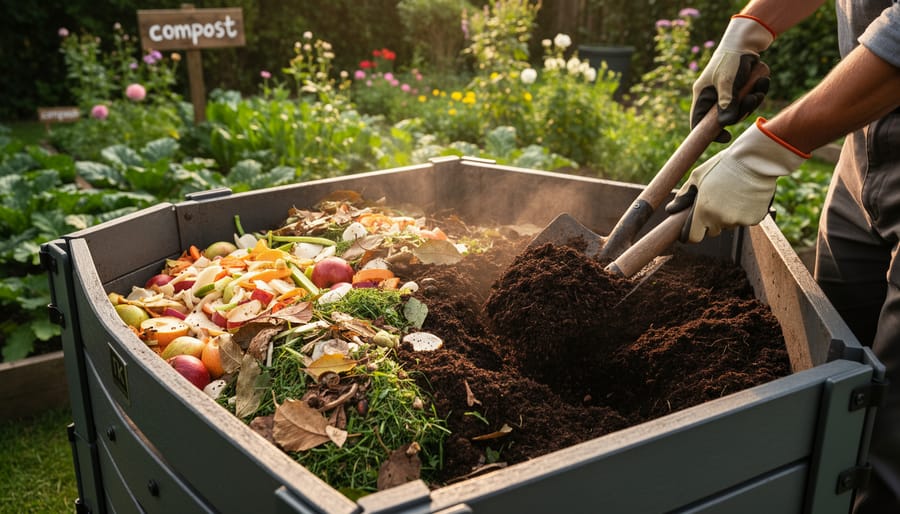
Composting transforms organic waste into nutrient-rich soil through the work of billions of microorganisms, making it one of nature’s most elegant waste solutions. When you toss vegetable peels, coffee grounds, and garden clippings into a compost bin, you’re creating the perfect environment for aerobic bacteria to thrive. These microscopic workers need three key ingredients: oxygen, moisture, and a balanced carbon-to-nitrogen ratio of roughly 30:1.
The science behind successful composting is surprisingly straightforward. Oxygen-loving bacteria break down organic matter, generating heat that can reach 60-70°C in the centre of an active pile. This heat accelerates decomposition and kills weed seeds and pathogens. Maintaining proper moisture levels, similar to a wrung-out sponge, keeps these beneficial microbes happy and productive.
Across Australia, households and communities are embracing various composting methods with impressive results. Melbourne’s Compost Revolution program has distributed over 17,000 compost bins and worm farms to residents, diverting thousands of tonnes from landfill annually. Community gardens in Sydney’s inner west operate shared composting hubs where neighbours contribute kitchen scraps and take home finished compost for their gardens.
Even apartment dwellers are getting involved through bokashi bins and compact aerobic systems designed for balconies. The payoff extends beyond reducing waste, enriching depleted Australian soils while cutting methane emissions that would otherwise escape from landfills. It’s practical environmental action that delivers tangible results right in your backyard.
Vermicomposting: Harnessing Worm Power
Vermicomposting transforms organic waste through the digestive power of earthworms, primarily red wrigglers (Eisenia fetida), which process food scraps into nutrient-rich castings. The science is elegant: worms consume organic matter, and beneficial microbes in their gut break down the material into readily available plant nutrients. Their castings contain up to five times more nitrogen, seven times more phosphorus, and eleven times more potassium than ordinary soil.
For Australian gardens facing our challenging climate, worm castings are gold. They improve water retention in sandy soils and drainage in clay, while their natural beneficial bacteria suppress plant diseases. A thriving worm farm can process up to half its weight in organic matter daily, diverting significant waste from landfill.
Starting small is simple. A basic home worm farm handles kitchen scraps for a family of four, sitting neatly on a balcony or under the sink. Melbourne’s Ceres Community Environment Park demonstrates the scalability beautifully, running community worm farms that process tonnes of local organic waste annually while educating hundreds of residents.
Schools, community gardens, and apartment complexes across Sydney and Brisbane are embracing shared worm farms, creating mini circular economies where yesterday’s vegetable peelings become tomorrow’s thriving tomatoes, strengthening community connections along the way.
Industrial Organic Processing and FOGO Programs
Across Australia, councils are transforming how communities handle food organics and garden organics through FOGO programs, and the results are remarkable. These large-scale composting initiatives divert thousands of tonnes of organic waste from landfills while creating nutrient-rich products that regenerate our soils.
The science behind industrial organic processing relies on aerobic decomposition, where microorganisms break down organic matter in oxygen-rich environments. Modern facilities use in-vessel composting systems or aerated windrow techniques, carefully monitoring temperature, moisture, and carbon-to-nitrogen ratios to optimise decomposition. These controlled conditions kill weed seeds and pathogens while accelerating the natural composting process from months to just weeks.
Take Adelaide’s FOGO program, which has diverted over 30,000 tonnes of organic waste annually since its introduction. The finished compost returns to local parks, gardens, and farms, reducing the need for synthetic fertilisers and improving soil water retention during droughts.
What makes these programs truly powerful is community participation. When your lime-green FOGO bin is collected, you’re contributing to a circular economy that enriches local agriculture and prevents methane emissions. Many councils now offer residents free or discounted compost created from their own waste, closing the loop and demonstrating how collective action creates tangible environmental benefits right in our backyards.
Anaerobic Digestion: Creating Energy From Waste
The Science of Biogas Production
Picture this: inside a sealed tank at a farm in regional Victoria, billions of microscopic workers are transforming yesterday’s food scraps and agricultural waste into clean energy. This isn’t science fiction – it’s anaerobic digestion, and it’s happening across Australia right now.
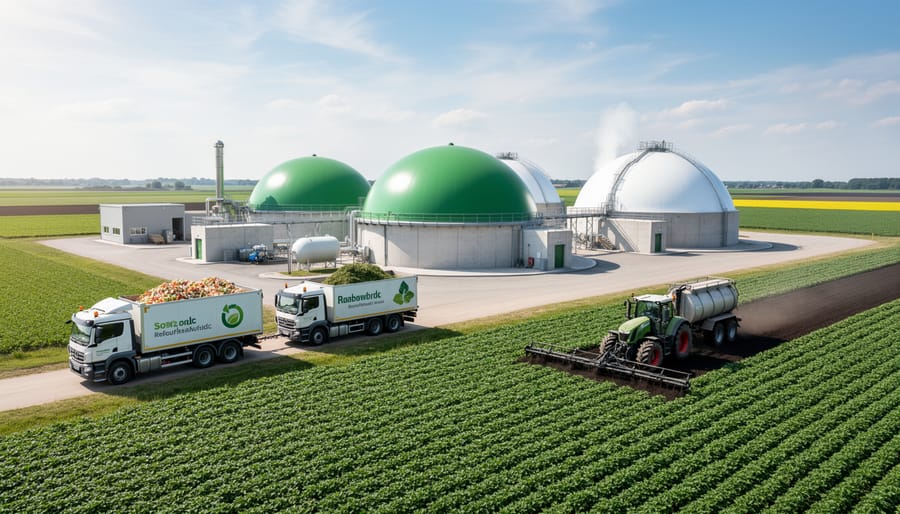
The process relies on nature’s own recycling system. When organic matter breaks down in oxygen-free environments, specialized microorganisms called methanogens get to work. These tiny organisms consume organic waste through four distinct stages: first, bacteria break down complex materials like proteins and fats into simpler compounds. Next, different bacteria convert these into acids and alcohols. Then, another group transforms these substances into acetic acid and hydrogen. Finally, methanogens produce methane gas – the same clean-burning fuel that powers homes and vehicles.
What makes this particularly exciting for Australian communities is the dual benefit. The biogas produced can generate electricity or heat, reducing reliance on fossil fuels. Meanwhile, what remains after digestion – called digestate – is a nutrient-rich fertilizer perfect for our agricultural lands. It’s like getting two sustainable solutions from one waste stream.
Australian councils and farms are increasingly embracing this technology. The process diverts organic waste from landfills where it would otherwise produce uncontrolled methane emissions, a potent greenhouse gas. By capturing and using this methane intentionally, we’re turning a climate problem into an energy solution. Even better, communities can start small with household-scale digesters or join together for larger facilities, making this science accessible to everyone committed to sustainable waste management.
Australian Anaerobic Digestion Success Stories
Across Australia, innovative facilities are proving that waste doesn’t have to be wasted. These success stories demonstrate how anaerobic digestion is transforming our relationship with organic waste while creating tangible community benefits.
In Sydney’s western suburbs, the Austral Brickworks facility has become a game-changer for the region. This state-of-the-art anaerobic digestion plant processes over 40,000 tonnes of organic waste annually from local councils and food manufacturers. The biogas generated powers the equivalent of 2,000 homes, while the nutrient-rich digestate supports nearby farms in Campbelltown and Camden. What makes this facility particularly special is its community engagement program, where local schools visit to learn about the waste-to-energy process firsthand.
Melbourne’s South East Water has integrated anaerobic digestion into its wastewater treatment operations at the Carrum Downs facility. By processing sewage sludge alongside food waste collected from restaurants and markets across the city’s eastern suburbs, they’ve achieved energy self-sufficiency while reducing methane emissions by 45%. The biosolids produced are certified for agricultural use, helping market gardeners in the Mornington Peninsula improve soil health without synthetic fertilizers.
Regional areas are equally impressive. The Goulburn Valley in Victoria hosts an agricultural-scale digester that processes dairy waste and crop residues, generating renewable energy that feeds back into the local grid. Farmers involved report reduced odours, lower fertilizer costs, and additional revenue streams, creating a circular economy model that benefits the entire community.
These facilities prove that sustainable waste management creates jobs, supports agriculture, and reduces our carbon footprint simultaneously.
Advanced Recycling Technologies
Materials Recovery Facilities: High-Tech Sorting
Across Australia, Materials Recovery Facilities are transforming from manual sorting sheds into high-tech hubs of innovation. These modern plants harness cutting-edge technology to dramatically boost recycling accuracy and efficiency, keeping valuable materials out of landfills.
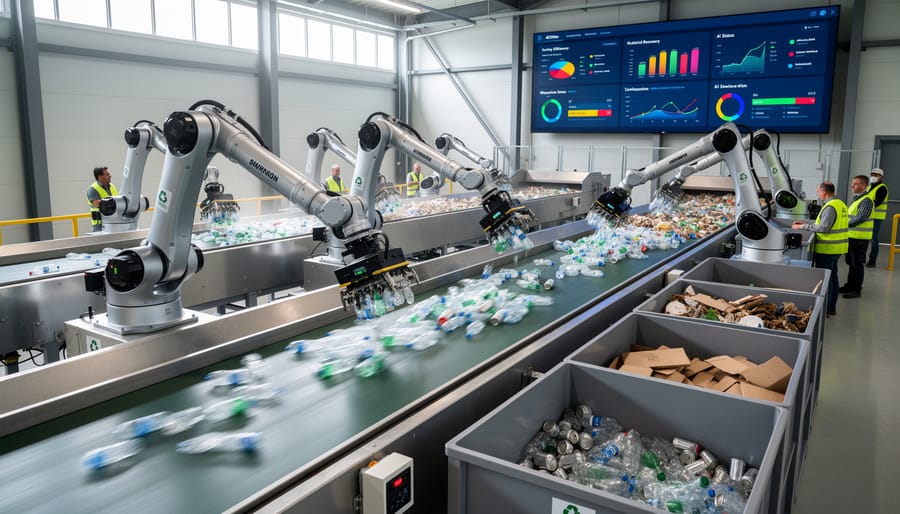
At the heart of this revolution are optical sorters using near-infrared spectroscopy. These sophisticated sensors identify different plastic types, paper grades, and metals in milliseconds by analyzing how materials reflect light. What once took dozens of workers hours to sort manually now happens automatically at speeds exceeding 60,000 items per hour.
Artificial intelligence has elevated this process further. Melbourne’s advanced facilities now employ AI-powered systems that learn to recognize contamination patterns and adapt sorting protocols in real-time. These smart systems can distinguish between a yogurt container and a butter tub, directing each to its proper recycling stream with remarkable precision.
Robotic arms equipped with machine vision technology handle the delicate final sorting stages, plucking out remaining contaminants that optical systems miss. Sydney’s newest facility reports contamination rates dropping below 2 percent thanks to these tireless mechanical workers.
This technological leap means the bottles, cans, and cardboard you place in your recycling bin actually have a fighting chance of becoming new products rather than waste, strengthening Australia’s circular economy from the ground up.
Chemical Recycling: Breaking Plastics Down to Build Them Back Better
When traditional mechanical recycling reaches its limits, chemical recycling steps in as a game-changer for plastics that would otherwise end up in landfill. This innovative approach breaks plastic waste down to its molecular building blocks, creating virgin-quality materials that can be used again and again.
The two primary methods making waves in Australia are pyrolysis and depolymerization. Pyrolysis heats plastics in the absence of oxygen, converting them into oils and gases that become feedstock for new plastics or fuels. Depolymerization, on the other hand, uses chemical reactions to reverse the polymerization process, returning plastics like PET to their original monomers. Think of it as unscrambling an egg, which traditional recycling could never achieve.
Several Australian facilities are already pioneering these technologies. Licella in New South Wales operates a plant converting mixed plastic waste into high-value chemicals, while Queensland communities are exploring partnerships to establish regional chemical recycling hubs. These facilities can process contaminated plastics, multi-layer packaging, and other materials that confound conventional recycling systems.
While energy-intensive, chemical recycling offers genuine solutions for our most challenging plastic waste streams. As the technology scales and integrates renewable energy sources, it’s becoming an essential complement to our existing waste management toolkit, keeping valuable resources in circulation rather than buried underground.
E-Waste Recovery: Mining Urban Gold
Aussie homes and businesses are sitting on a goldmine – literally. Every mobile phone contains trace amounts of gold, silver, copper and rare earth elements like palladium. When we properly process old electronics, we can recover these valuable materials while preventing toxic components like lead and mercury from poisoning our environment.
Several Australian facilities now specialize in recycling electronic waste using scientific recovery methods. The process begins with careful dismantling, separating components like circuit boards, screens and batteries. These parts then undergo specialized treatments – hydrometallurgical processes use chemical solutions to extract precious metals, while pyrometallurgical methods involve controlled high-temperature smelting.
Close the Loop, an Australian social enterprise, demonstrates this brilliantly. They’ve diverted over 5,000 tonnes of e-waste from landfill, recovering materials that become new products right here in Australia. Their toner cartridge program has extracted enough materials to manufacture asphalt used in Melbourne’s roads.
For every million mobile phones recycled, we can recover approximately 16 tonnes of copper, 350 kilograms of silver and 34 kilograms of gold. That’s not just environmentally responsible – it reduces our reliance on destructive mining operations. By supporting local e-waste collection programs through councils or retailers, you’re helping create a circular economy that values what we’ve already extracted from the earth.
Bioremediation and Natural Waste Treatment
Constructed Wetlands: Nature’s Water Treatment Plants
Across Australia, engineered wetlands are proving that nature offers some of the most effective water treatment solutions. These constructed ecosystems use plants, microorganisms, and natural filtration processes to clean wastewater, turning what was once considered waste into a valuable resource.
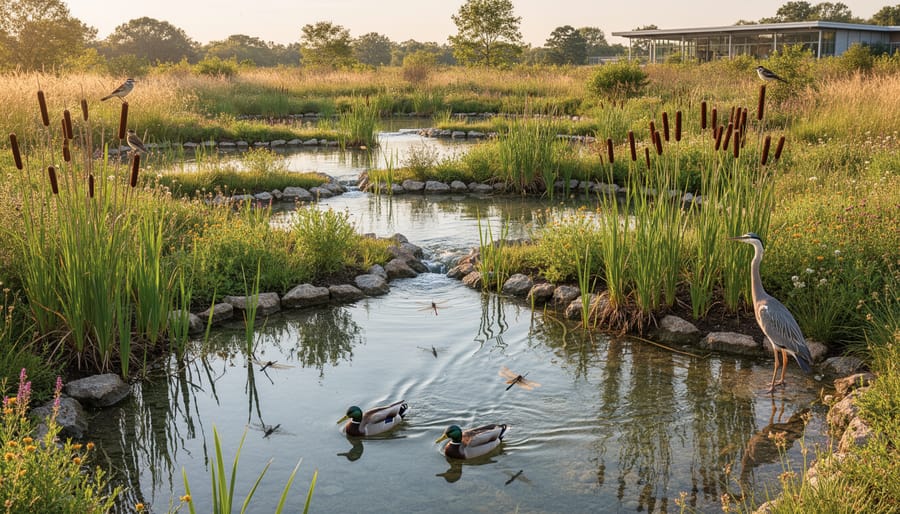
Communities like Adelaide’s Parafield stormwater wetlands demonstrate this approach beautifully. Here, strategically planted reeds, sedges, and native vegetation work alongside beneficial bacteria to remove pollutants, excess nutrients, and contaminants from urban runoff. The plants absorb nitrogen and phosphorus while their root systems provide habitat for microbes that break down organic matter. It’s a living filter that improves water quality without energy-intensive mechanical treatment.
The benefits extend beyond water purification. These wetlands create vital habitats for native birds, frogs, and insects, supporting biodiversity in urban areas where green spaces are precious. Many Australian councils have embraced this dual-purpose approach, designing wetlands as both treatment systems and community recreational spaces where locals can observe wildlife and connect with nature.
The science is compelling: constructed wetlands can remove up to 90 percent of suspended solids and significantly reduce harmful bacteria. For businesses and communities seeking sustainable wastewater solutions, these natural treatment plants offer a proven, cost-effective alternative that works with Australia’s ecosystems rather than against them.
Phytoremediation: Plants That Clean Contaminated Soil
Nature provides remarkable cleaning solutions through phytoremediation, where plants literally draw pollutants from contaminated soil. This green technology works through several processes: hyperaccumulation, where plants absorb heavy metals into their tissues; phytostabilisation, which prevents contaminants from spreading; and rhizofiltration, using roots to filter pollutants from water.
Australian communities are already seeing impressive results. In Newcastle, native plants like lomandra and kangaroo grass have successfully treated soil contaminated by former industrial sites, transforming brownfield areas into usable parkland. The Victorian EPA has documented several projects where indigenous plant species remediate heavy metal contamination from old mining sites, with certain eucalyptus varieties proving particularly effective at extracting lead and zinc.
What makes this approach brilliant is its dual benefit: cleaning contaminated land while restoring native ecosystems. Community groups across Australia are establishing demonstration gardens showcasing phytoremediation plants suitable for local conditions. These living laboratories show how patient, plant-based solutions can address legacy contamination without harsh chemicals or expensive earth removal. While the process takes time, typically years rather than months, it creates lasting environmental restoration that supports biodiversity and community wellbeing simultaneously.
Waste-to-Energy Technologies Done Right
Modern Thermal Treatment With Strict Emission Controls
When recycling and composting aren’t viable options, modern thermal treatment facilities offer a scientifically sound alternative that’s worlds apart from the old incinerators of decades past. These advanced energy-from-waste plants, operating in several Australian locations, transform non-recyclable materials into electricity while maintaining emission standards that often surpass international benchmarks.
Here’s what makes contemporary thermal treatment eco-friendly: state-of-the-art filtration systems capture virtually all harmful pollutants before they reach the atmosphere. These facilities operate at extremely high temperatures (around 850-1000°C), which ensures complete combustion and destroys harmful compounds. The heat generated powers turbines to produce electricity that can supply thousands of homes, genuinely diverting waste from landfills while creating renewable energy.
Australian thermal treatment plants undergo rigorous monitoring, with real-time emission data often publicly available. Communities near these facilities in Western Australia and New South Wales have seen remarkable outcomes, including reduced methane emissions from avoided landfill and consistent power generation.
The bottom line? While reducing and reusing remains paramount, thermal treatment with strict controls provides a responsible pathway for materials that genuinely cannot be recycled. It’s not perfect, but it represents significant progress in managing our unavoidable waste scientifically and safely.
The Australian Context: When Is Waste-to-Energy Appropriate?
In Australia’s waste hierarchy, waste-to-energy technologies sit firmly above landfill but below reduction, reuse, and recycling. This positioning matters enormously for our communities. While countries like Sweden have successfully integrated these systems after achieving recycling rates above 50%, Australia’s national recycling rate hovers around 60%, with significant regional variation.
The question isn’t whether waste-to-energy is good or bad, but rather where it fits appropriately. These technologies work best for residual waste that cannot be recycled despite our best efforts, such as contaminated materials or multi-layered packaging. In Western Australia and New South Wales, facilities are processing waste that would otherwise fill precious landfill space, generating electricity while dramatically reducing methane emissions.
However, the Australian context demands caution. We must avoid creating systems that compete with recycling programs for feedstock. Communities in Victoria have successfully demonstrated that investing in better sorting facilities and education programs first maximizes resource recovery. Waste-to-energy becomes appropriate when we’ve exhausted reduction and recycling options, not as a replacement for them. This approach protects our recycling infrastructure while addressing the reality that some waste remains unavoidable in our current systems.
Community-Scale Solutions You Can Support or Implement
Neighbourhood Composting Hubs
Across Australian suburbs, neighbourhood composting hubs are transforming how communities manage organic waste. These shared facilities collect food scraps and garden waste from multiple households, creating high-quality compost through accelerated aerobic decomposition. The science is beautifully simple: microorganisms break down organic matter in oxygen-rich conditions, producing temperatures of 55-65°C that kill pathogens and weed seeds while creating nutrient-rich soil amendments.
Melbourne’s Ceres Community Environment Park operates successful hubs processing over 100 tonnes annually, demonstrating how community waste solutions can divert substantial volumes from landfill. The key to their effectiveness lies in maintaining the correct carbon-to-nitrogen ratio (roughly 30:1), adequate moisture levels, and regular aeration to support beneficial bacteria.
Starting your own hub requires surprising little: a suitable site (community gardens or council land work well), basic bins or bay systems, and committed volunteers. Many councils offer grants and technical support. Brisbane’s neighbourhood hubs show that even small-scale operations processing 20-30 households’ waste make meaningful environmental impact while strengthening community connections. The resulting compost returns nutrients to local gardens, completing the cycle sustainably.
Business Organic Waste Programs
Across Australia, forward-thinking businesses are transforming their organic waste from a disposal problem into a community asset. Cafes, restaurants, and retailers are increasingly partnering with specialist collection services that divert food scraps, coffee grounds, and plant-based packaging from landfill to commercial composting and anaerobic digestion facilities.
Melbourne’s hospitality precinct in Fitzroy showcases this collaboration beautifully, where a network of twenty cafes shares a twice-weekly collection service. Their combined organic waste feeds into a nearby processing facility that produces nutrient-rich compost for local urban farms and community gardens. Similarly, Sydney’s Surry Hills has seen major retailers join forces with food rescue organizations, separating still-edible items for redistribution while sending genuine waste to bio-processors.
These partnerships typically involve clear bin systems, staff training, and contamination monitoring to ensure the scientific processes downstream work effectively. The beauty of this approach is its scalability—what works for a single cafe can expand to entire shopping districts. Many councils now offer subsidized commercial organic waste programs, making participation financially attractive while creating meaningful environmental impact through reduced methane emissions and soil regeneration.
Repair Cafes and Resource Recovery Centers
Across Australia, Repair Cafes and Resource Recovery Centers are breathing new life into items destined for landfill, demonstrating that waste prevention starts before materials even enter the disposal stream. These community-driven initiatives tackle waste at its source by extending product lifecycles through skilled repair, refurbishment, and education.
Repair Cafes operate on a beautifully simple principle: volunteer fixers help community members repair broken household items, from toasters to clothing, usually free of charge. Melbourne’s Repair Cafe Network has diverted thousands of kilograms from landfill while teaching valuable repair skills. The environmental science is compelling—manufacturing new products requires significant energy and raw materials, whereas repairing existing items reduces these demands dramatically, cutting carbon emissions by up to 90% compared to replacement.
Resource Recovery Centers, found at many Australian council facilities, go further by accepting reusable items for refurbishment and resale. Brisbane’s Tip Shop network has created a thriving circular economy, where rescued furniture, building materials, and electronics find new homes rather than burial in landfill.
These initiatives foster community connection while challenging our throwaway culture. They prove that keeping materials in circulation isn’t just environmentally sound—it’s economically sensible and socially enriching. By participating in or supporting these programs, you’re joining a growing movement that values resourcefulness over consumption.
Measuring Success: Key Indicators of Eco-Friendly Waste Management
Knowing whether our waste management efforts are truly making a difference requires looking beyond the bins and measuring what really matters. Across Australia, communities are embracing specific indicators that tell the story of their environmental progress, giving us all a clearer picture of success.
The most revealing metric is the waste diversion rate, which measures the percentage of waste redirected from landfill through recycling, composting, and recovery. The City of Adelaide has achieved an impressive 80% diversion rate, demonstrating what’s possible when communities commit to comprehensive programs. This single number reflects countless individual actions, from separating organics to choosing reusable options.
Carbon reduction measurements have become equally crucial. By tracking greenhouse gas emissions prevented through waste management practices, we can quantify our climate impact. For instance, diverting one tonne of food waste from landfill to composting can prevent up to 1.5 tonnes of CO2-equivalent emissions. Victorian councils now routinely report these figures, showing residents the tangible climate benefits of their efforts.
Resource recovery percentages tell us how effectively we’re transforming waste into valuable materials. Australia’s container deposit schemes provide clear evidence, with some states recovering over 90% of eligible containers. This metric demonstrates that well-designed systems can achieve remarkable results.
Communities are also monitoring contamination rates in recycling streams, participation levels in organics programs, and the economic value of recovered materials. Sydney’s innovative dashboard shares real-time data with residents, creating transparency and encouraging continuous improvement. When we can see our collective impact through these meaningful indicators, it strengthens our resolve and proves that every sustainable choice contributes to measurable environmental progress.
The transformation of waste into valuable resources isn’t a distant dream—it’s happening right now in communities across Australia, and it’s proving that environmental responsibility and economic prosperity go hand in hand. Scientific waste management methods represent more than just smart environmental policy; they create jobs, reduce costs, protect our unique ecosystems, and build resilient communities ready for the future.
What makes this particularly exciting is that every Australian, regardless of where they live or their circumstances, can be part of this transformation. Whether you’re starting a compost bin in your suburban backyard, supporting local council initiatives for better recycling infrastructure, or choosing products from businesses committed to circular economy principles, your actions create ripples of positive change. Communities from Newcastle to Perth have demonstrated that when individuals, businesses, and local governments collaborate, remarkable progress becomes possible.
The science is clear, the technology exists, and the benefits extend far beyond environmental protection. Better waste management means cleaner beaches for our grandchildren, healthier soils for our farmers, and thriving industries that turn yesterday’s rubbish into tomorrow’s resources.
Now is the time to act. Connect with local environmental groups, advocate for improved waste infrastructure in your area, and share your knowledge with neighbours and friends. Visit your council’s website to understand what programs already exist, and don’t hesitate to voice support for expanding these initiatives. Together, we’re not just managing waste—we’re building a cleaner, more sustainable Australia that future generations will thank us for creating.