
Solar panels gleam from rooftops across Australian suburbs, yet a troubling pattern emerges: these clean energy systems cluster predominantly in postcodes where household incomes exceed $100,000 annually. Meanwhile, families facing the steepest electricity bills—those who would benefit most from solar savings—remain locked out of the renewable revolution happening above their neighbours’ heads.
This isn’t simply an unfortunate coincidence. The upfront cost of residential solar and battery storage systems, ranging from $8,000 to $30,000, creates a formidable barrier that perpetuates energy inequality across our communities. Renters comprising nearly one-third of Australian households face additional hurdles, unable to install systems on properties they don’t own. Low-income homeowners, despite having suitable roofs and genuine need, struggle to access financing or lack the credit history required for solar loans.
The consequences extend beyond individual electricity bills. As energy-secure households lock in decades of reduced costs and grid independence, those without solar face compounding disadvantage: rising network charges, fewer tariff options, and diminishing control over their essential energy expenses. This growing divide undermines Australia’s broader transition to renewable energy, excluding millions from participating in climate solutions while concentrating benefits among already-advantaged groups.
Yet emerging models across Australian communities demonstrate that solar equity isn’t merely aspirational—it’s achievable. From innovative financing schemes to community solar gardens and targeted support programs, pathways exist to democratise clean energy access. Understanding these barriers and championing inclusive solutions transforms residential solar from a privilege into a widely accessible tool for household resilience, financial stability, and collective climate action.
The True Cost of Being Left Behind
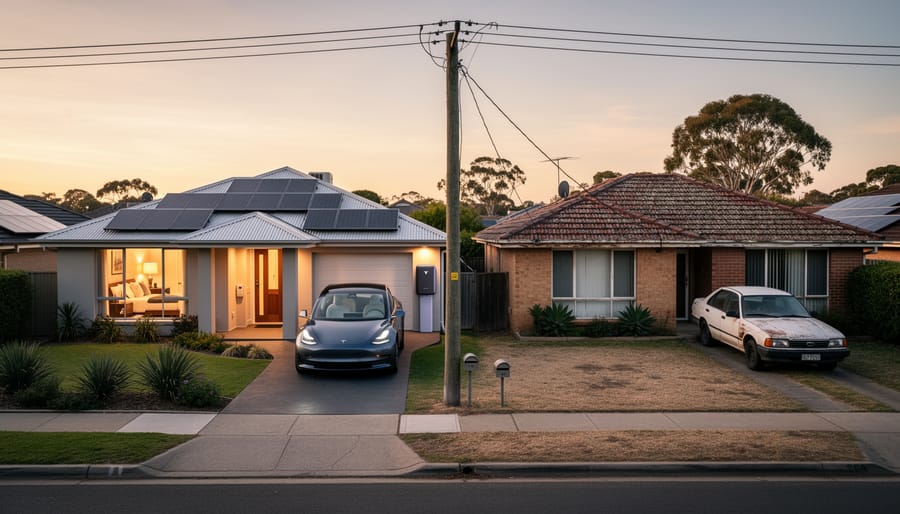
The Upfront Barrier
For many Australian households, the promise of energy independence through solar battery systems remains frustratingly out of reach. The numbers tell a sobering story: a quality home battery system typically costs between $8,000 and $15,000, with installation pushing the total investment even higher. When combined with solar panels, families are looking at a minimum outlay of $15,000 to $25,000.
This isn’t pocket change for most Australians. With the median household disposable income sitting around $62,000 annually, and many families already stretched thin by rising living costs, finding this kind of upfront capital feels impossible. Even though the long-term savings are genuine, with households potentially cutting electricity bills by 70-90 percent over the system’s lifetime, the initial barrier remains stubbornly high.
The irony cuts deep: the families who would benefit most from lower energy bills, those spending a disproportionate share of their income on electricity, are precisely the ones unable to access the technology that could help them. Meanwhile, wealthier households can afford the investment, reap the financial rewards, and contribute to a cleaner energy future.
This creates a two-tiered system where sustainable living becomes a privilege rather than a right, widening the gap between those who can afford energy security and those who cannot.
Who Gets Left Out
Across Australia, the clean energy transition is leaving significant communities behind. Renters make up roughly 30% of Australian households, yet they’re largely excluded from solar adoption—unable to make structural changes to properties they don’t own, and often facing split incentive problems where landlords won’t invest in upgrades that primarily benefit tenants.
Apartment dwellers face similar challenges. Even when they own their units, installing solar requires body corporate approval and navigating complex shared roof spaces, making the process frustratingly difficult or impossible.
Pensioners and fixed-income households represent another overlooked group. While they’d benefit enormously from reduced energy bills, upfront installation costs—typically $8,000-15,000—remain prohibitively expensive despite potential long-term savings.
First Nations communities, particularly in remote areas, often lack access to grid infrastructure entirely, making solar and storage potentially transformative yet frequently unaffordable without targeted support programs.
Regional Australians face their own barriers: fewer installers mean higher costs and longer wait times, while some older grid infrastructure isn’t equipped for modern solar systems. These communities, often experiencing higher energy costs than metropolitan areas, ironically struggle most to access the very solutions that could provide relief.
When Solar Creates a Two-Tier Energy System
The Peak Hour Penalty
Every evening across Australia, a quiet financial divide emerges as the sun sets. Households without battery storage face what’s become known as the peak hour penalty—premium electricity rates that kick in precisely when families arrive home, cook dinner, and settle in for the evening.
For families relying solely on the grid, these evening hours between 5pm and 9pm can see electricity costs triple compared to daytime rates. In some parts of Sydney and Melbourne, peak rates can reach 50 cents per kilowatt-hour or more. A single household might spend an extra $400 to $800 annually just because they’re using power when everyone else is.
Meanwhile, neighbours with solar and battery systems are insulated from this burden. They’ve stored their daytime solar generation and simply switch to battery power during peak periods, effectively bypassing premium rates altogether. The benefits of battery storage extend beyond avoiding peak charges—households can achieve 80-90% energy independence.
This creates a troubling equity gap. Renters, low-income families, and those in apartments—often the very households most vulnerable to energy bill stress—continue paying peak penalties month after month. They’re subsidising the grid infrastructure while those who could afford upfront battery investments enjoy ongoing savings. It’s a cycle that entrenches financial inequality, making the energy transition work brilliantly for some Australians while leaving others further behind.
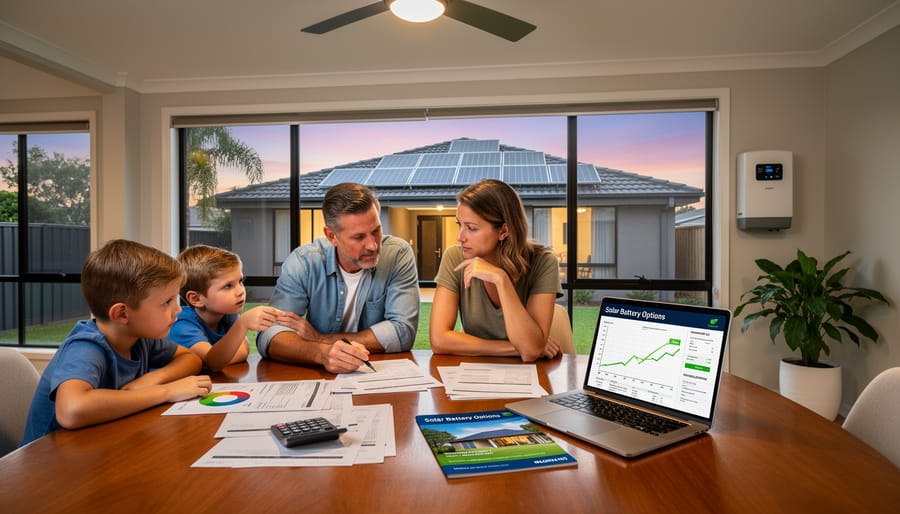
Grid Export Gaps
Across Australia, the golden promise of solar has dimmed considerably for households without batteries. Feed-in tariffs, the rates energy retailers pay for excess solar exported to the grid, have plummeted in recent years. What once reached 60 cents per kilowatt-hour in some states now hovers between 5 and 10 cents in many areas, barely covering a fraction of the 25 to 35 cents households pay to draw power from the grid.
This dramatic shift creates a two-tiered system. Families who can afford solar energy storage capture and use their own sunshine, maximizing their investment and slashing electricity bills. Meanwhile, solar-only households watch their excess generation flow to the grid for minimal return, often during the day when they’re at work or school. They’re essentially subsidizing the grid’s daytime energy supply while still paying premium rates for evening power.
The equity gap widens further when we consider that battery systems remain out of reach for many Australian families, typically adding eight to fifteen thousand dollars to installation costs. Those who got in early with generous feed-in tariffs locked in decades-long returns, while today’s new solar adopters face significantly reduced financial benefits. This declining value proposition particularly impacts renters, low-income households, and those in apartments who already face barriers to solar access, making the clean energy transition increasingly uneven across our communities.
Community Solutions Already Working in Australia
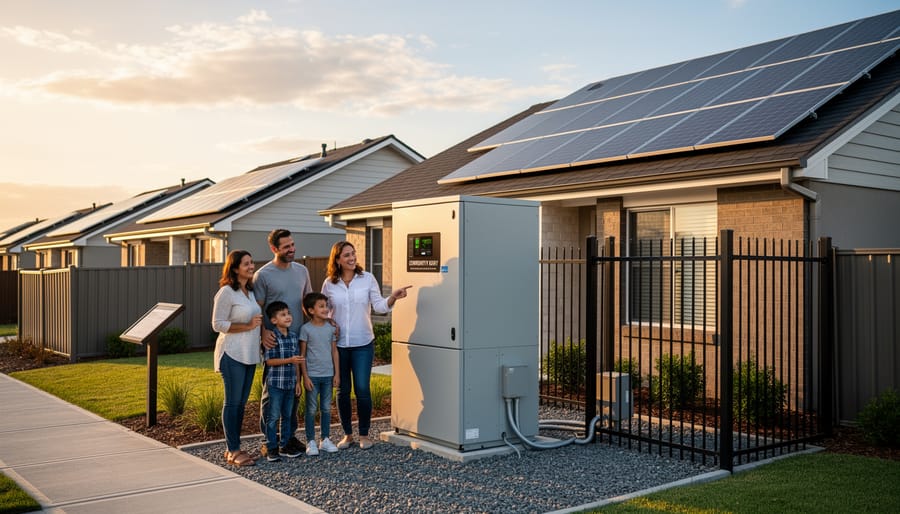
Shared Battery Programs
Across Australia, innovative shared battery programs are breaking down financial barriers and proving that energy storage doesn’t need to be a solo investment. These community-scale projects work similarly to community-based housing models, pooling resources to benefit entire neighborhoods.
Western Australia’s PowerBank project in Mandurah stands as a pioneering example. Launched in 2020, this 1.2 megawatt-hour battery serves 18 homes, allowing residents without rooftop solar or those in rental properties to access stored renewable energy at competitive rates. Participants have reported electricity bill reductions of up to 30 percent, with the battery also providing backup power during outages.
Victoria has embraced this model enthusiastically. The Mooroolbark Community Battery, installed in 2022, serves over 250 households in Melbourne’s outer east. Residents can virtually store excess solar energy and draw it back during evening peak times, effectively creating a neighborhood energy bank. This approach has proven particularly valuable for apartment dwellers and renters previously excluded from solar benefits.
In New South Wales, the Ausgrid network is rolling out community batteries across Sydney, with installations in Beacon Hill and Banksia already operational. These batteries store surplus solar during the day and redistribute it locally, reducing pressure on the grid while ensuring fair access to clean energy.
These shared programs demonstrate that storage equity isn’t just about individual ownership—it’s about reimagining energy infrastructure as a collective resource that serves everyone.
Social Housing Solar Schemes
Across Australia, innovative social housing solar schemes are breaking down barriers and bringing clean energy to communities that need it most. These partnerships between state governments, community housing providers, and utilities demonstrate how collaborative approaches can create meaningful change.
In New South Wales, the Together Towards Zero program has retrofitted thousands of public housing units with rooftop solar and battery storage, directly reducing energy bills for residents facing cost-of-living pressures. Victoria’s Solar Homes initiative extends to social housing tenants, while South Australia’s pioneering Virtual Power Plant project connects low-income households through shared battery networks.
What makes these programs particularly powerful is their community-centered design. Rather than treating public housing residents as passive recipients, many schemes involve tenants in energy literacy workshops and monitoring programs, building both knowledge and confidence. Community organisations play a crucial role as trusted intermediaries, ensuring programs reach isolated communities and culturally diverse populations.
Aboriginal-controlled housing cooperatives have also embraced solar partnerships, combining energy independence with broader community development goals. These initiatives show that when governments prioritize equity alongside emissions reduction, solar access becomes a pathway to dignity, not charity. The results speak for themselves: reduced bills, improved thermal comfort, and residents actively participating in Australia’s clean energy transition.
Rental Property Innovations
Exciting changes are underway for Australia’s rental market, where nearly one-third of households have traditionally been locked out of solar benefits. Portable battery systems are now emerging as game-changers, allowing renters to store solar energy from community gardens or rooftop panels and take their investment with them when they move. Several Australian councils are piloting programs that match landlords with accredited installers, offering streamlined approvals and split-incentive models where both property owners and tenants share the financial benefits through reduced energy bills and increased property value. In Victoria and Queensland, innovative landlord rebate schemes provide additional incentives for investment properties to install solar and storage systems, with agreements ensuring tenants receive fair access to the clean energy generated. Community housing providers are leading the charge too, demonstrating how large-scale installations across rental portfolios can deliver equity outcomes while maintaining affordability. These developments signal a promising shift toward ensuring clean energy access isn’t determined by whether you own or rent your home.
Financial Pathways That Level the Playing Field
Government Rebates and Loans
Good news for Australian households looking to make the switch to solar and battery storage – there’s genuine financial support available right across the country, and it’s specifically designed to bridge the affordability gap.
Victoria leads the charge with its Solar Battery Rebate, offering up to $1,400 for eligible households earning under $180,000 annually. The program also includes interest-free loans up to $8,800, making battery storage genuinely accessible to middle-income families who’ve previously been priced out. Applications open through Solar Victoria’s online portal, with approved installers guiding you through the process.
South Australia’s Home Battery Scheme provides subsidies of $3,000 for batteries up to 10kWh, scaling to $6,000 for larger systems. This program has helped thousands of households in a state where energy costs hit hardest, demonstrating how targeted support can level the playing field.
New South Wales residents can access the Empowering Homes program, which offers interest-free loans up to $9,000 for battery systems and up to $14,000 when combined with solar panels. The ACT’s Sustainable Household Scheme similarly provides zero-interest loans up to $15,000 over seven years.
Queensland and Tasmania have introduced regional battery rebate schemes targeting specific postcodes, recognizing that location shouldn’t determine energy equity. Western Australia and the Northern Territory currently offer smaller-scale programs through local councils and community energy initiatives.
The key to accessing these programs? Don’t wait. Most operate on limited annual budgets and close once funding is exhausted. Check your state government’s energy website regularly, connect with local solar installers who understand the application requirements, and join community energy groups who share experiences navigating these programs. Together, we’re making clean energy everyone’s right, not just a privilege.
Virtual Power Plants
Virtual Power Plants are emerging as an exciting pathway for Australian households to access battery storage while supporting grid stability. These innovative programs work by pooling household batteries into a network that can be managed collectively, releasing stored energy during peak demand periods. In exchange for allowing your battery to contribute to this larger system, energy retailers or network operators significantly subsidize the upfront cost of installation.
Here’s how it works in practice: instead of paying the full $10,000-15,000 for a home battery, VPP participants might receive subsidies of $3,000-6,000, making storage far more accessible. Your household still retains priority access to your stored solar energy, but during critical grid events, a small portion can be dispatched to help stabilize the network.
Several Australian providers are leading the charge. Tesla’s Virtual Power Plant in South Australia partnered with the state government to install batteries in public housing, demonstrating how VPPs can directly address energy equity. AGL, Origin Energy, and Energy Locals all offer VPP programs across different states, each with varying subsidy levels and participation requirements.
Eligibility typically requires existing or planned solar panels, suitable battery installation space, and enrollment with a participating retailer. Some programs prioritize low-income households or renters in social housing, specifically targeting equity concerns. While you’re agreeing to share some control over your battery, most programs guarantee you’ll maintain at least 70-80% capacity for household use, ensuring your family’s energy security comes first while contributing to a more resilient community energy future.
What Needs to Change (And How You Can Help)
Policy Priorities
Making solar and storage accessible to all Australians requires decisive action from policymakers at every level of government. The path forward is clear, and communities across the country are already calling for change.
Expanded rebate programs represent the most immediate opportunity. While schemes like the Victorian Solar Homes Program have shown promise, we need nationwide coordination to ensure no Australian misses out based on their postcode. Income-tested rebates and zero-interest loan schemes should become standard, not exceptional, helping families who would benefit most from lower energy bills actually access the technology.
Renters deserve equal opportunities to embrace clean energy. Currently, nearly a third of Australians face structural barriers simply because they don’t own their homes. Policy reforms must include portable solar credits, streamlined landlord approval processes, and tenant protection guarantees that make installation a genuine option for everyone.
Community battery programs offer transformative potential for apartment dwellers and those with unsuitable roofs. Local councils from Western Sydney to regional Queensland are pioneering these shared storage solutions, but they need dedicated federal funding to scale up. These batteries don’t just store energy; they strengthen grid resilience and build neighbourhood connections around sustainability.
Grid modernisation remains essential infrastructure work. Our electricity networks must evolve to handle distributed energy resources fairly, with tariff structures that reward community contribution rather than punishing innovation. This isn’t just about technology – it’s about ensuring everyday Australians who invest in solar aren’t disadvantaged by outdated systems.
Together, these reforms create the foundation for genuine energy democracy across Australia.
Your Role in the Energy Transition
The energy transition isn’t just about technology—it’s about people, and you have a vital part to play in creating a fairer clean energy future for all Australians.
Start by getting involved with community energy projects in your area. Many regions now have community solar programs that allow renters and apartment dwellers to access solar benefits without rooftop installations. These accessible sustainability initiatives are spreading across the country, and your participation helps prove their viability.
Advocate to your local council for solar and storage programs targeting lower-income households. Council meetings welcome community input, and your voice can influence funding decisions that create genuine equity in energy access.
Choose energy retailers that offer fair solar feed-in tariffs and support community energy projects. Your wallet is a powerful tool for change, and switching providers takes less than an hour.
Finally, share your solar journey with neighbours, friends, and family. Whether you’ve installed panels, joined a community program, or discovered helpful rebates, your knowledge can open doors for others. Real change happens when communities support each other through the transition, ensuring nobody gets left behind in Australia’s clean energy future.
The path to a clean energy future isn’t just about installing more panels and batteries—it’s about ensuring every Australian household has the opportunity to participate in this transformation. When we talk about residential solar and storage equity, we’re really talking about the kind of country we want to build together. The good news is that the momentum is already building, from community solar gardens sprouting up in regional areas to innovative financing models making technology accessible to renters and lower-income families.
Each of us has a role to play in this shift. Whether you’re advocating for stronger government incentives, supporting community energy projects in your neighbourhood, or simply sharing information about accessible solar options with friends and family, these actions matter. Local councils, businesses, energy providers, and community organisations across Australia are already proving that equitable access isn’t just idealistic—it’s entirely achievable.
The environmental benefits of solar and storage can only reach their full potential when everyone can participate. By working together to dismantle the barriers that keep clean energy out of reach for many Australians, we’re not just reducing emissions—we’re building stronger, more resilient communities. The transition to sustainable energy should lift everyone up, and with collective action and commitment, that vision is within our grasp. Start by exploring what initiatives exist in your local area, and consider how you might contribute to making clean energy a reality for all Australians.