
Low carbon concrete slashes the embodied carbon footprint of traditional concrete by up to 70 percent through clever substitutions and optimised mix designs, making it one of the most effective tools Australia’s construction sector has to reduce its climate impact. Concrete is responsible for roughly eight percent of global CO2 emissions, a staggering figure driven by the energy-intensive production of Portland cement. For every tonne of cement produced, nearly a tonne of carbon dioxide enters the atmosphere. When you consider that Australia alone produces millions of cubic metres of concrete each year, the ecosystem impact becomes impossible to ignore.
Low carbon concrete tackles this problem head-on by replacing a significant portion of traditional cement with supplementary cementitious materials like fly ash, ground granulated blast-furnace slag, or even calcined clay. These alternatives often come from industrial waste streams, turning a disposal challenge into a construction asset. Some mixes incorporate recycled aggregates or bio-based additives, further trimming the carbon cost. The result? A material that performs just as well as standard concrete in most applications while dramatically cutting emissions.
Across Australia, forward-thinking councils, developers, and architects are already specifying low carbon mixes for everything from residential slabs to major infrastructure. Perth’s new civic centre used a blended concrete that cut emissions by 40 percent. Brisbane developers are experimenting with geopolymer concrete that eliminates Portland cement entirely. These aren’t experimental prototypes anymore. They’re proven, code-compliant materials you can specify today.
Understanding what low carbon concrete is, how it performs, and where to source it puts you in control of your project’s carbon footprint while supporting Australia’s shift toward a circular, resilient construction economy.
Why Traditional Concrete Is Australia’s Hidden Climate Challenge
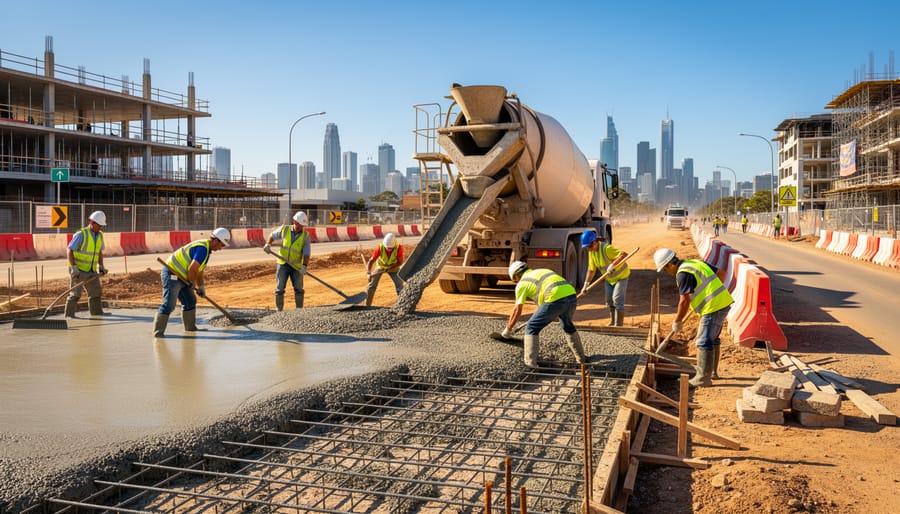
Concrete might seem like an inert material, just sand, water and cement, but its production tells a different story. When you factor in Australia’s construction boom and our reliance on concrete for everything from suburban driveways to major infrastructure, the climate impact becomes impossible to ignore.
The problem starts in cement kilns. To produce cement, limestone is heated to extreme temperatures (around 1,450 degrees Celsius), a process that releases massive amounts of CO2 in two ways. First, burning fossil fuels to reach those temperatures creates emissions. Second, and less obvious, the chemical transformation of limestone itself releases carbon dioxide trapped in the rock. This double hit means cement emissions account for 8% of global CO2 emissions, more than the entire aviation industry.
In Australia specifically, cement manufacturing represents a significant chunk of our industrial emissions profile. We have several large cement plants operating across the country, and our construction sector’s appetite for concrete shows no signs of slowing. With state governments committing to major infrastructure projects and population growth driving residential construction, concrete demand continues climbing year after year.
This creates a tension with Australia’s climate commitments. We’ve pledged to reduce national emissions by 43% below 2005 levels by 2030, and reach net zero by 2050. Meeting those targets while pouring millions of cubic metres of traditional concrete every year simply doesn’t add up. The construction industry can’t remain on the sidelines of climate action when concrete foundations, quite literally, underpin so much of our built environment.
The scale of the challenge becomes clearer when you consider that replacing just 20-30% of cement in concrete mixes could cut our construction sector’s carbon footprint dramatically, without waiting for futuristic technologies or massive infrastructure overhauls.
What Makes Concrete ‘Low Carbon’?
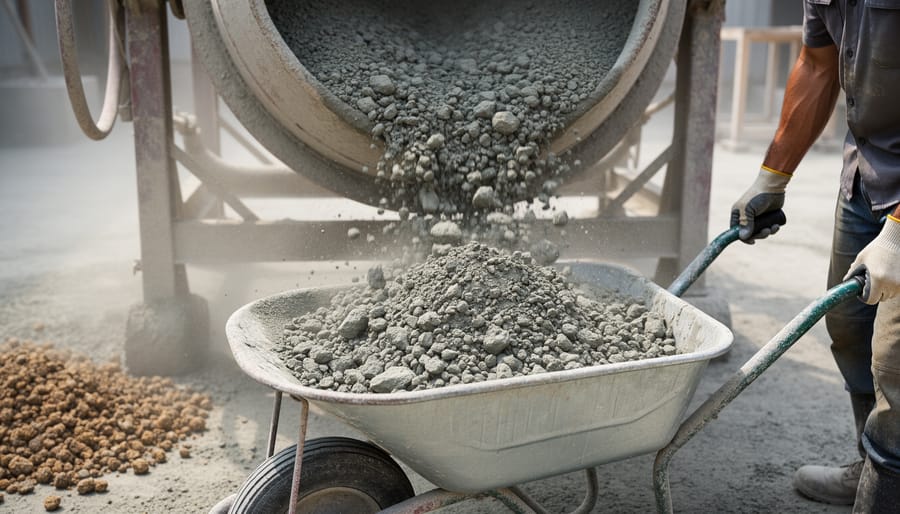
Low carbon concrete isn’t a single product but rather a family of innovative approaches that drastically cut the carbon emissions associated with traditional concrete production. The key is understanding that most of concrete’s environmental impact comes from cement, the binding agent that holds everything together. Cement production accounts for roughly 8% of global CO2 emissions, and in Australia, the cement industry contributes significantly to our construction sector’s carbon footprint.
So what makes concrete “low carbon”? It’s about tackling that cement problem through four main pathways.
The first approach replaces some or all of the traditional Portland cement with alternative binders. These might be industrial by-products like fly ash from coal power stations or ground granulated blast furnace slag from steel manufacturing. More revolutionary options include geopolymer binders made from materials like volcanic ash or metakaolin, which can slash emissions by up to 80% compared to conventional cement.
The second strategy incorporates recycled and waste materials into the concrete mix itself. Instead of mining virgin aggregates (the sand and gravel that make up concrete’s bulk), manufacturers use crushed recycled concrete, reclaimed glass, or even demolition waste. This reduces both the embodied energy of raw material extraction and the waste going to landfill, a circular economy win.
Carbon capture represents the third pathway, where CO2 emissions are actually injected into fresh concrete during production. The carbon becomes mineralised within the concrete structure, permanently sequestering it while improving the material’s strength. It’s essentially turning a waste product into a structural benefit.
Finally, optimised mix designs use computer modelling and precision batching to create concrete that uses the minimum cement needed for a specific application. Rather than over-engineering with excess cement for every job, these tailored mixes match strength requirements exactly, cutting unnecessary emissions.
Australian manufacturers combine these approaches in various ways depending on local availability of materials, project requirements, and regional conditions. A low carbon concrete for a Brisbane footpath might use different innovations than one for a Melbourne high-rise foundation, but all share the same goal: delivering the performance builders need while dramatically reducing the carbon cost of construction.
Types of Low Carbon Concrete Being Used in Australia
Geopolymer and Alternative Binder Concretes
Geopolymer concrete replaces traditional Portland cement with industrial by-products like fly ash or slag, activated by an alkaline solution. This swap can cut embodied carbon by up to 80% compared to conventional concrete, making it one of the most promising low carbon alternatives available today.
Australia is at the forefront of geopolymer research and commercial application. The University of Melbourne and CSIRO have been developing geopolymer formulations specifically suited to Australian conditions for over two decades. Their work has led to real-world applications across the country.
Wagners, a Queensland-based company, produces Earth Friendly Concrete, a geopolymer product that’s been used in major projects including the Brisbane West Wellcamp Airport and the Global Change Institute building. Zeobond, another Australian innovator, has supplied geopolymer concrete for infrastructure projects throughout Victoria and New South Wales.
These materials perform exceptionally well in aggressive environments. Geopolymer concrete shows superior resistance to acid attack and high temperatures, making it particularly suitable for industrial applications, marine structures, and even bushfire-prone areas where heat resistance matters.
Recycled Aggregate and Waste-Based Concretes
Australia produces over 27 million tonnes of construction and demolition waste each year, and recycled aggregate concrete is turning that problem into a solution. These concretes replace virgin quarried materials with crushed concrete from demolished buildings, recycled asphalt, crushed glass, and even crushed bricks. The result cuts both landfill pressure and the carbon emissions from extracting and transporting new aggregates.
Several Australian states now mandate minimum recycled content in government projects. In Victoria, VicRoads specifies recycled concrete aggregate in road base applications, while Sydney’s Green Square development incorporated recycled materials in footpaths and landscaping elements. Geelong manufacturer Alex Fraser processes hundreds of thousands of tonnes of construction waste annually into certified recycled aggregates that meet Australian standards for structural use.
Industrial by-products offer another avenue. Fly ash from coal power stations and ground granulated blast furnace slag from steel production have served as cement replacements for decades, though their availability is shifting as these industries change. Newer innovations include using recycled glass as a sand replacement and incorporating foundry sand or spent coffee grounds into mix designs. These waste streams reduce embodied carbon while solving disposal challenges, creating genuine circular economy outcomes in Australia’s construction sector.
Carbon-Cured and Mineralised Concretes
One of the most innovative approaches turns concrete production from a carbon emitter into a carbon consumer. Carbon-curing technology injects captured CO₂ directly into fresh concrete during the manufacturing process, where it undergoes a chemical reaction with the cement and becomes permanently mineralised within the material itself.
The science is elegant: instead of releasing CO₂ into the atmosphere, you’re essentially locking it away as a stable calcium carbonate crystal structure. This process can reduce the carbon footprint of concrete by 5-15% while actually improving early strength development and surface durability. Companies like CarbonCure in Canada have pioneered the commercial application, and Australian producers are now bringing similar technologies online.
Several Australian concrete suppliers have started trialling carbon-curing systems at their batching plants. The equipment retrofits into existing production lines without major overhauls, making adoption relatively straightforward. For every cubic metre of concrete produced using this method, roughly 15-20 kilograms of CO₂ gets permanently sequestered.
What makes this particularly exciting for Australia is our growing carbon capture infrastructure and industrial CO₂ sources. As more facilities capture emissions, concrete production could become a valuable carbon sink rather than a liability, creating a circular solution that benefits both industries.
Real Australian Projects Leading the Way
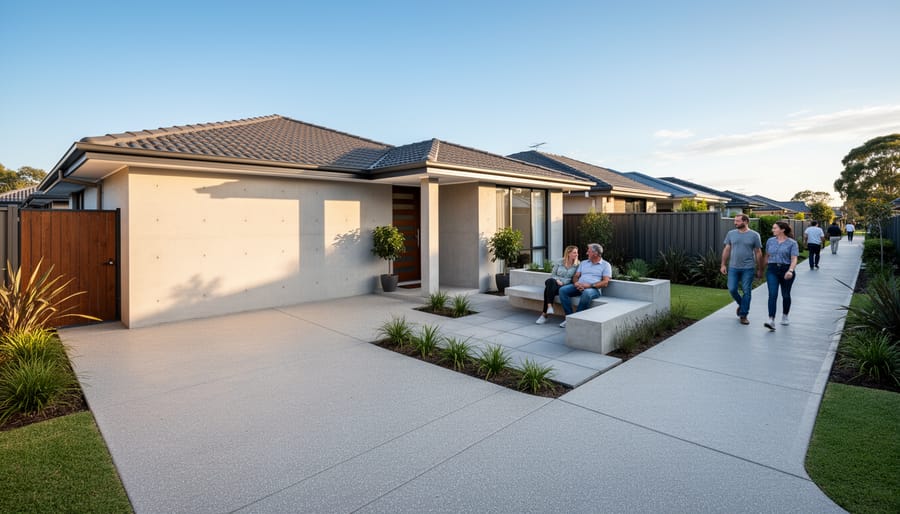
Several Australian projects have proven that low carbon concrete works in real-world conditions, from commercial towers to community spaces and major infrastructure.
In Melbourne, the International House Sydney building became one of the country’s first major commercial projects to specify low carbon concrete throughout its structure. The developers worked with local suppliers to reduce the cement content by 40% through fly ash substitution, cutting the building’s embodied carbon significantly while maintaining all structural requirements. The project demonstrated that large-scale adoption was feasible within standard construction timelines and budgets.
Sydney’s Green Square Library and Plaza set a benchmark for public buildings. The City of Sydney mandated geopolymer concrete for non-structural elements and optimised mixes for structural components, achieving a 30% reduction in concrete emissions across the entire project. The library has become a case study used by councils across Australia looking to green their infrastructure procurement.
Queensland’s Logan City Council made headlines by specifying low carbon concrete for footpath and kerb construction across multiple suburbs. Using recycled glass and crushed recycled concrete as aggregates, the initiative diverted thousands of tonnes of waste from landfill while reducing the carbon footprint of routine infrastructure maintenance. Residents have seen no difference in performance, but the council reports significant progress toward its zero emissions target.
In Western Australia, a housing development in Fremantle pioneered the use of carbon-cured concrete for residential slabs and driveways. The technology injects captured CO2 into the concrete during mixing, permanently storing carbon while improving early strength. Homeowners were initially sceptical about the “experimental” material, but site inspections two years later showed excellent durability and no issues with cracking or performance.
The Monash University Clayton campus installed geopolymer concrete footpaths as part of its sustainability research program. Students and staff use the pathways daily, providing real-world testing under high foot traffic. The university openly shares performance data, helping demystify low carbon alternatives for other institutions.
These projects share common lessons. Early supplier engagement proved essential, contractors need time to adjust mix designs and train crews. Most projects found the performance matched or exceeded traditional concrete once the learning curve was overcome. Importantly, each success story has encouraged neighbouring projects to follow suit, creating regional clusters of expertise and normalising low carbon options in local supply chains.
The momentum is building, with tenders increasingly requesting carbon reduction specifications and more suppliers adding low carbon products to their standard offerings.
Performance and Durability: Separating Fact from Concern
When builders and developers first hear about low carbon concrete, the same question surfaces: will it hold up? It’s a fair concern when you’re constructing something meant to last decades, but the performance data tells a reassuring story.
Most low carbon concrete formulations meet or exceed Australian Standards for structural concrete (AS 3600). Geopolymer concretes, for instance, have demonstrated compressive strengths ranging from 30 to 80 MPa, comparable to conventional concrete across most applications. The CSIRO and universities including Melbourne and UNSW have conducted extensive testing showing these materials perform reliably under load.
Durability in Australia’s harsh conditions matters just as much as initial strength. Low carbon concretes often outperform traditional mixes in specific scenarios. Geopolymer concrete shows superior resistance to acid attack and sulfate exposure, making it ideal for coastal environments and industrial settings where conventional concrete deteriorates faster. Testing in tropical North Queensland conditions has confirmed excellent performance in high-humidity, high-chloride environments.
Heat tolerance is another area where some low carbon formulations excel. Geopolymer concrete maintains structural integrity at temperatures where Portland cement concrete begins to degrade, a significant advantage for buildings in bushfire-prone regions.
Pros
- Comparable or superior compressive strength to conventional concrete in most applications
- Enhanced resistance to chemical attack, particularly in marine and industrial environments
- Better performance in high-temperature conditions and improved fire resistance
- Proven durability in Australian climate testing across multiple regions
Cons
- Long-term performance data beyond 20 years is still accumulating for newer formulations
- Some mixes require modified curing processes that builders may be unfamiliar with
- Performance can vary more between suppliers than with standardised traditional concrete
- Limited availability of independent testing data for every climate zone across Australia
The concrete reality is that low carbon alternatives aren’t experimental anymore. Projects completed five to fifteen years ago continue performing as expected, and accelerated aging tests predict service lives matching conventional concrete. What’s needed now isn’t more proof of concept, it’s wider adoption that will generate the decades of field data that fully satisfies every engineering concern.
How to Specify Low Carbon Concrete for Your Project
Specifying low carbon concrete starts with asking the right questions before you even approach a supplier. Request clear documentation of the concrete’s embodied carbon figure, typically measured in kilograms of CO2 equivalent per cubic metre. Reputable suppliers will provide Environmental Product Declarations (EPDs) or third-party verified data showing exactly how much their product reduces emissions compared to standard mixes.
In Australia, look for concrete that meets AS 3600 structural standards while achieving lower carbon intensity. The Green Building Council of Australia’s Green Star rating system recognises low carbon concrete, and some states offer additional guidance through their sustainable procurement frameworks. Don’t accept vague claims about being “eco-friendly”, insist on specific numbers and independent verification to avoid greenwashing.
When speaking with concrete suppliers, ask what type of low carbon solution they’re offering. Is it geopolymer, recycled aggregate, or carbon-cured? Each has different applications and performance characteristics. Question what percentage of cement has been replaced and with what materials. Request case studies from similar projects in your climate zone, particularly if you’re building in coastal areas where durability matters most.
Specify performance requirements rather than prescribing exact mix designs. Tell your supplier what compressive strength you need, what exposure classification applies, and what your carbon reduction target is. Let them propose solutions that meet those criteria. Many Australian suppliers now offer standard low carbon mixes that simply substitute for conventional concrete at minimal extra cost.
Work with builders and concreters who’ve handled low carbon concrete before. Experience matters because curing times and workability can differ slightly from what trades expect. When you choose green providers you’re getting expertise alongside materials.
Include carbon reduction targets in your project specifications from the start. A clause requiring concrete with at least 30% lower embodied carbon than baseline AS 3600 mixes gives suppliers a clear benchmark and prevents value engineering from eliminating sustainability goals later. Put it in writing, make it measurable, and ensure it’s part of the contract rather than an optional consideration.
The Cost Reality: Is Low Carbon Concrete More Expensive?
Cost is the first question most Australian builders and homeowners ask about low carbon concrete, and the honest answer is: it depends where you are and what you’re comparing.
In major metropolitan areas like Sydney and Melbourne, low carbon concrete currently costs roughly the same as traditional concrete for standard applications, sometimes adding 5-10% to material costs. Regional projects may see slightly higher premiums due to limited supplier networks, though this gap is closing fast as more batching plants adopt low carbon mixes. The real cost difference often comes down to specification complexity rather than the material itself, bespoke high-performance mixes cost more than standardised alternatives, whether they’re low carbon or not.
Several factors drive pricing variations. Transport distance matters significantly in Australia’s vast geography. Project scale affects negotiating power with suppliers. The specific low carbon approach chosen, geopolymer versus recycled aggregate versus carbon-cured, carries different cost implications. Market maturity plays a role too: early adopters in 2023 paid premiums that 2026 projects simply don’t face anymore.
Government support is shifting the economics. Various state programs offer rebates for sustainable construction materials, and federal green building incentives can offset initial costs. Developers pursuing Green Star certifications often find that low carbon concrete becomes cost-neutral when factored against overall project ratings and marketability.
The lifecycle perspective changes the calculation entirely. Lower carbon footprints reduce liability for future carbon pricing. Enhanced durability in some formulations means reduced maintenance costs over decades. Property values increasingly reflect sustainability credentials, much like ethical investing now recognises that environmental performance affects long-term returns.
Many Australian suppliers now price low carbon options competitively as their default offering, making the cost question increasingly irrelevant.
What’s Coming Next for Low Carbon Concrete in Australia
Australia’s concrete sector is moving faster than many realize. Federal and state governments are embedding embodied carbon limits into infrastructure procurement, with major projects now requiring Environmental Product Declarations and carbon reduction targets. By 2027, several states are expected to mandate embodied carbon reporting for all public buildings, pushing low carbon concrete from optional to standard practice.
The concrete industry itself is committing to dramatic change. Cement Australia and Boral have both pledged to cut emissions significantly by 2030, investing in carbon capture facilities and alternative fuel sources. Meanwhile, Australian research institutions are collaborating with industry on next-generation binders that could eliminate portland cement entirely from certain applications. Field trials of algae-based binders and bacteria that mineralise CO2 within concrete are already underway in Sydney and Melbourne.
For communities and businesses, this shift creates genuine opportunities. Local councils are beginning to specify low carbon mixes for footpaths, community centres, and sports facilities, creating demand that regional suppliers are racing to meet. Small and medium concrete companies that invest in batching equipment for alternative mixes now will have a competitive edge as the market tilts.
The timeline matters. Early adopters today are shaping supplier capabilities and proving what works in Australian conditions. By getting involved now, whether through your local council, your next building project, or simply asking suppliers what low carbon options they offer, you’re accelerating the transition. The concrete beneath our feet is changing, and that change is happening in your community right now.
Australia’s construction industry stands at a pivotal moment. Low carbon concrete isn’t just another building material option, it’s reshaping how we think about the structures that define our communities. From suburban homes to major infrastructure projects, this innovation is proving that we don’t have to choose between building quality and climate responsibility.
The projects showcased across this article demonstrate that low carbon concrete works. It performs, it lasts, and increasingly, it makes financial sense. What started as a niche solution for environmentally conscious early adopters has become a viable choice for mainstream construction. Australian companies are developing world-leading technologies, and local councils are writing it into specifications. The momentum is building.
Your next project, whether it’s a backyard patio, a home renovation, or a commercial development, presents an opportunity. Ask your builder about low carbon options. Request quotes that include sustainable concrete specifications. By making informed choices in your own projects, you’re not just reducing emissions from a single build, you’re signalling market demand that accelerates industry transformation.
Every tonne of low carbon concrete specified is a vote for a cleaner future. It supports Australian innovation, creates green jobs, and demonstrates to your community that sustainable choices are practical, not just aspirational. The construction materials we choose today will shape Australia’s built environment for generations. Let’s make sure we’re building with both the present and the future in mind.