
Climate change mitigation isn’t some distant challenge for future generations—it’s happening right now in backyards, businesses, and communities across Australia. The good news? Every action we take today, from switching to renewable energy to transforming how we move around our cities, creates measurable impact in reducing carbon emissions.
Australian households and businesses are uniquely positioned to lead this transformation. Our abundant sunshine makes solar energy one of the most effective mitigation strategies available, while our innovative spirit drives solutions from regenerative agriculture to circular economy practices. The choices we make about energy consumption, transportation, food systems, and waste management directly influence our national carbon footprint and set the standard for climate action in the Asia-Pacific region.
Understanding climate change mitigation strategies means recognizing that solutions exist at every level. Individuals can dramatically reduce their carbon footprint through energy-efficient homes and sustainable transport choices. Businesses can implement comprehensive emission reduction programs while improving their bottom line. Communities can advocate for systemic changes that accelerate the transition to a low-carbon economy.
This isn’t about perfection or overnight transformation. It’s about progress, practical steps, and collective momentum. Whether you’re taking your first steps toward sustainability or looking to deepen your environmental commitment, proven strategies exist to guide your journey. The question isn’t whether we can make a difference—it’s how quickly we’ll act on the knowledge and tools already within our reach.
Understanding Carbon Mitigation in the Australian Context
Why Australia’s Carbon Challenge is Unique
Australia faces a distinctive set of challenges when it comes to climate action, making our mitigation journey both urgent and complex. As one of the world’s largest coal exporters and with our domestic energy grid still heavily reliant on fossil fuels, we’re navigating a particularly tricky transition. Our vast distances mean transport emissions are substantial, while our sun-drenched landscape ironically presents both a challenge through extreme heat and droughts, and an enormous opportunity for renewable energy generation.
What makes our situation especially unique is the combination of a carbon-intensive economy alongside some of the most vulnerable ecosystems on the planet. The Great Barrier Reef, our ancient forests, and unique wildlife are already experiencing climate impacts. Meanwhile, our energy infrastructure was built around coal-fired power stations, requiring significant investment and planning to transform.
However, there’s genuine reason for optimism. Communities across the country are already demonstrating that practical change is possible. From carbon pricing mechanisms being discussed at policy level to grassroots solar cooperatives in regional towns, Australians are finding innovative solutions tailored to our specific context. Understanding these unique challenges helps us craft mitigation strategies that actually work for our geography, economy, and way of life.
The Power of Individual and Collective Action
While systemic change requires government and industry leadership, the collective power of individual action creates unstoppable momentum for carbon reduction. Every choice you make—from your morning coffee to your commute—contributes to Australia’s carbon footprint, but more importantly, each decision represents an opportunity for positive change.
Australian households account for roughly 20% of national emissions, making our daily choices genuinely significant. When you switch to renewable energy, reduce food waste, or choose active transport, you’re not just cutting your personal emissions—you’re demonstrating demand that shifts markets and influences policy.
The real magic happens when individual actions amplify through community. Across Australia, neighbourhoods are forming climate action groups, businesses are committing to net-zero targets, and local councils are implementing ambitious sustainability programs. Melbourne’s community energy projects, Sydney’s business sustainability networks, and regional town tree-planting initiatives show how collective effort multiplies impact.
Small businesses particularly hold tremendous influence. By adopting sustainable practices, you’re not only reducing your operational footprint but inspiring employees, customers, and competitors to follow suit. When combined with transparent communication about your sustainability journey, you help normalise climate action and build the social license for broader transformation.
The path forward isn’t about perfection—it’s about participation. Start where you are, do what you can, and connect with others doing the same.
Energy Efficiency and Renewable Energy Solutions
Harnessing Australia’s Solar Advantage
Australia’s abundant sunshine isn’t just a tourism drawcard—it’s our greatest renewable energy asset. With some of the highest solar radiation levels globally, Australians are uniquely positioned to harness solar power for meaningful climate action, and increasingly, communities across the country are doing exactly that.
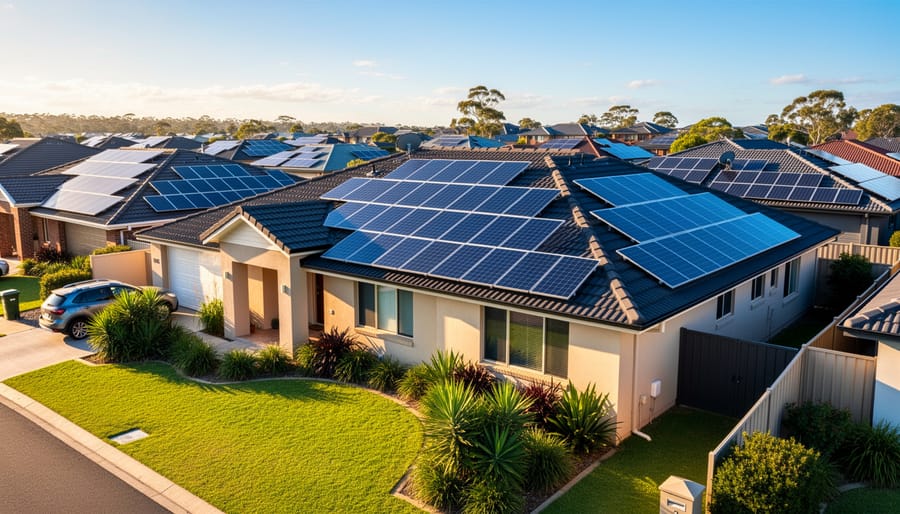
Residential solar installations have transformed suburban rooftops into mini power stations. Today, over three million Australian households have embraced solar panels, collectively generating clean energy that significantly reduces our national carbon footprint. The initial investment typically pays for itself within four to six years through reduced electricity bills, making it both an environmental and financial winner.
The real game-changer, however, is battery storage technology. Modern lithium batteries allow households to store excess solar energy generated during the day for use during evening peak hours. This means greater energy independence and less reliance on grid electricity, which in many regions still depends heavily on fossil fuels. Community battery projects are also emerging in neighbourhoods across Melbourne, Sydney, and Perth, allowing residents without suitable roofs to participate in the solar revolution.
Feed-in tariffs remain available in most states, enabling homeowners to sell surplus electricity back to the grid. While rates vary between providers and regions, they provide ongoing returns that further improve solar’s financial viability.
For businesses, commercial solar installations offer substantial carbon reduction opportunities alongside impressive operational savings. Government rebates and incentives continue to make solar more accessible. The Small-scale Renewable Energy Scheme provides certificates that reduce upfront costs, while various state-based programs offer additional support. Victorian residents can access Solar Victoria rebates, while other states offer similar assistance programs worth investigating through your local energy authority.
Home and Workplace Energy Efficiency Upgrades
Your home is likely your biggest opportunity to reduce carbon emissions while saving money on energy bills. Australian households account for around 20% of our national energy use, but simple upgrades can slash this impact dramatically.
Start with insulation, as it’s the foundation of energy efficiency. Australia’s diverse climate zones mean different approaches: northern Queensland homes need excellent ceiling insulation and ventilation to reduce cooling costs, while Melbourne and Hobart properties benefit from comprehensive wall and underfloor insulation to cut heating demands. Government rebates through your state’s energy efficiency scheme can cover significant costs, making upgrades more accessible.
Swapping to LED lighting is perhaps the easiest win. LEDs use 75% less energy than traditional bulbs and last years longer. Throughout an average Australian home, this simple switch can reduce lighting energy use by hundreds of dollars annually.
Smart thermostats learn your household patterns and optimize heating and cooling automatically. In our climate, where temperatures can swing dramatically between seasons, these devices prevent energy waste by adjusting temperatures when you’re away or asleep. Many models integrate with solar systems for even greater savings.
Consider upgrading to energy-efficient appliances when replacements are due. Look for high star ratings on fridges, washing machines, and air conditioners. While the upfront cost may be higher, the lifetime savings are substantial.
For those ready to take the next step, zero energy homes represent the ultimate in residential efficiency, producing as much energy as they consume. These comprehensive upgrades create comfortable, climate-resilient homes while virtually eliminating household carbon emissions.
Switching to Green Energy Providers
Making the switch to a green energy provider is one of the most impactful climate actions available to Australian households and businesses. The good news? It’s simpler than you might think, and you don’t need solar panels on your roof to access renewable energy.
When you choose a green power retailer, you’re supporting wind, solar, and hydroelectric projects across Australia. These providers purchase energy from renewable sources or offset your consumption through renewable energy certificates (RECs). Look for retailers accredited under the government’s GreenPower program, which guarantees your money funds additional renewable energy generation beyond what’s already mandated.
Start by comparing providers using independent comparison sites that show the percentage of renewable energy in their offerings. Many Australian retailers now offer 100% carbon-neutral or renewable options, though it’s worth reading the fine print to understand whether they’re buying renewables directly or using offsets.
Consider community energy retailers like Enova Energy or Powershop, which prioritise renewable sources and often reinvest profits into local sustainability projects. While green plans might cost slightly more initially, many households find the difference minimal, especially when combined with energy-efficient practices.
The switch itself is straightforward. Your new retailer handles the transition, there’s no interruption to your supply, and you’ll typically see the change reflected on your next bill. By choosing renewable energy, you’re voting with your wallet for Australia’s clean energy future.
Sustainable Transport and Mobility
Electric Vehicles and the Australian Market
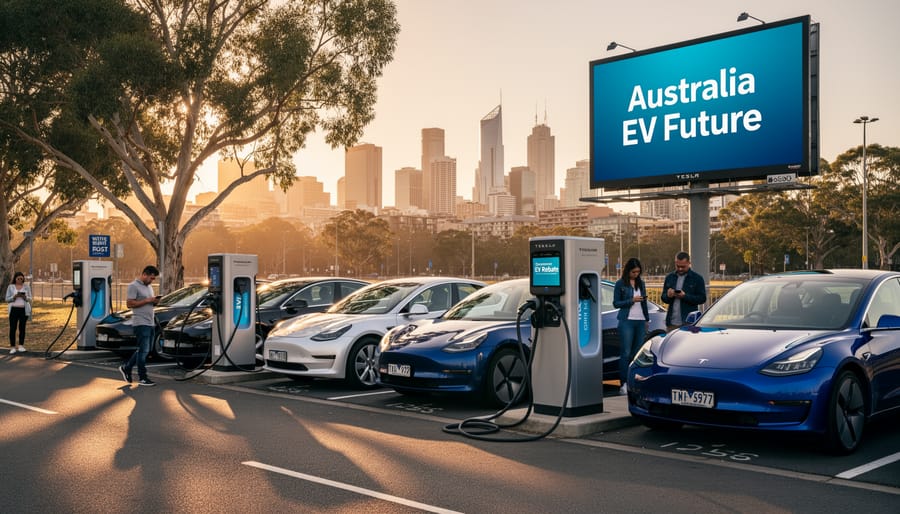
Australia’s electric vehicle journey is accelerating, though we’re still catching up to global leaders. Currently, EVs represent around 8% of new car sales nationwide, with cities like Canberra and Sydney leading adoption rates. This growing community of early adopters is proving that electric transport works brilliantly in Australian conditions, from coastal commutes to country town living.
The charging infrastructure network is expanding rapidly across the country. Public fast-charging stations now connect major highways, with charging hubs appearing in shopping centres, workplaces, and community centres. Most EV owners charge at home overnight using standard power points or dedicated wall boxes, taking advantage of off-peak electricity rates and rooftop solar systems. For apartment dwellers, strata-approved charging solutions are becoming increasingly accessible.
Government incentives vary by state, making EVs more affordable than ever. Several states offer stamp duty exemptions, registration discounts, and interest-free loans for EV purchases. Some councils provide free public charging or discounted parking for electric vehicles, recognising their role in reducing local emissions.
Practical considerations matter too. Modern EVs suit Australian driving distances perfectly, with most models offering 300-500km range. Maintenance costs drop significantly without oil changes or exhaust systems, while home charging typically costs less than traditional fuel. For many Australian families, switching to an EV represents both environmental action and long-term financial sense.
Public Transport, Cycling, and Alternative Mobility
Rethinking how we move around our communities represents one of the most practical ways Australians can slash carbon emissions while improving quality of life. Transport accounts for nearly 20% of Australia’s greenhouse gas emissions, with most coming from private vehicles. The good news? Communities across the country are already proving that change is possible and enjoyable.
Australian cities are embracing a transport revolution that prioritises people over cars. Brisbane’s CityCycle program and Melbourne’s extensive tram network show how accessible public transport can transform urban living. Perth has committed billions to expanding its rail system, while Sydney continues building light rail connections that reduce car dependency.
The shift toward bike-friendly infrastructure is gaining momentum too. Adelaide now boasts over 900 kilometres of cycling paths, and Canberra’s network makes cycling a genuine daily option for thousands of residents. Many regional centres are following suit, installing separated bike lanes and secure parking facilities.
Community-led initiatives are making real differences. Carpooling apps connect neighbours heading the same direction, while workplace travel plans encourage shared commutes. Regional communities have pioneered innovative solutions like community bus services that fill gaps left by commercial operators.
Small changes multiply quickly. Choosing public transport twice weekly instead of driving saves approximately 1.5 tonnes of CO2 annually per person. Cycling for short trips reduces emissions while boosting physical health. Even working from home one day weekly cuts transport emissions by 20%. These choices collectively reshape our cities while building stronger, more connected communities.
Carbon Sequestration Through Land Management
Reforestation and Native Planting Initiatives
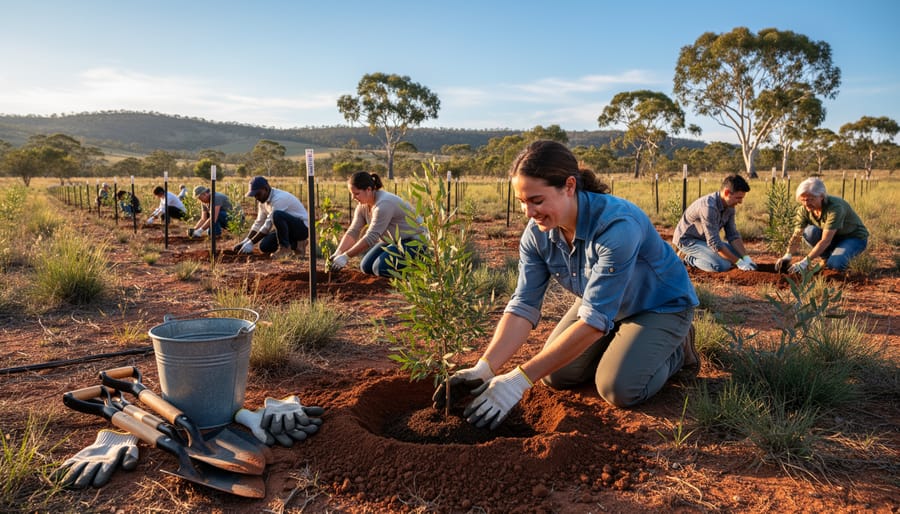
Across Australia, communities are discovering that one of the most satisfying ways to fight climate change is getting your hands dirty. Reforestation and native planting initiatives are transforming degraded landscapes, cooling our cities, and sequestering carbon—one seedling at a time.
Community tree-planting programs have blossomed nationwide, from Landcare groups in regional areas to urban greening projects in our capital cities. These initiatives do more than capture carbon; they restore habitat for native wildlife, prevent erosion, and create cooler microclimates in increasingly hot urban environments. In Melbourne, the Urban Forest Strategy aims to increase canopy cover to 40%, while Sydney’s Western Parkland City is planting millions of trees to combat the urban heat island effect.
The key to successful restoration lies in choosing native Australian species. Plants like eucalypts, acacias, and bottlebrushes have evolved for our unique climate and soil conditions, requiring less water and maintenance while supporting local ecosystems. Unlike exotic species, natives provide food and shelter for indigenous birds, insects, and mammals, creating a ripple effect of ecological benefits.
Getting involved is easier than you might think. Check with your local council about community planting days, join a Landcare or Bushcare group, or participate in initiatives like National Tree Day each July. Many organizations provide seedlings, tools, and expert guidance—you just need to show up. Even small actions matter: planting a native garden at home, sponsoring trees through conservation groups, or supporting businesses that fund restoration projects all contribute to Australia’s reforestation goals.
Regenerative Agriculture and Soil Carbon
Australian soils hold incredible potential as carbon sinks, and farmers and gardeners across the country are discovering that healthy soil isn’t just good for plants—it’s a powerful climate solution. Regenerative agriculture focuses on practices that actively rebuild soil organic matter, sequestering atmospheric carbon dioxide underground where it belongs.
Practical approaches include minimizing soil disturbance through no-till or reduced tillage methods, keeping soil covered with living plants or mulch year-round, and incorporating diverse crop rotations or polycultures. For home gardeners, adding compost, planting cover crops in veggie patches during off-seasons, and avoiding synthetic chemicals all contribute to building soil carbon.
Carbon farming initiatives are gaining momentum nationwide, with the Australian Government’s Emissions Reduction Fund providing financial incentives for landholders who increase soil carbon stocks. This creates opportunities for farmers to generate Australian Carbon Credit Units while improving soil health, water retention, and farm resilience.
Community groups and local landcare networks are sharing knowledge about regenerative practices, making these techniques accessible to everyone from broadacre farmers to suburban gardeners. By working with nature rather than against it, we’re not just growing food—we’re drawing down carbon and building healthier ecosystems that can weather our changing climate.
Blue Carbon: Protecting Australian Coastal Ecosystems
Australia’s coastal ecosystems are climate champions often overlooked in favour of forests. Mangroves, seagrass meadows, and salt marshes store carbon up to 40 times faster than terrestrial forests, locking it away for centuries in their underwater soils. Known as blue carbon ecosystems, these coastal habitats capture roughly 20 million tonnes of CO2 annually across our continent.
Communities are taking action to protect these vital carbon stores. In Western Australia, volunteer groups are replanting mangroves along degraded coastlines, while Queensland’s Reef Guardians program engages locals in seagrass monitoring. These efforts mirror the grassroots approach seen in sustainable food choices, where individual actions create collective impact.
You can support blue carbon through citizen science projects like Seagrass Watch or by advocating for coastal protection in your local council. Even reducing plastic use helps, as marine debris damages these sensitive ecosystems that safeguard both our climate and coastal biodiversity.
Waste Reduction and Circular Economy Practices
Reducing Landfill Emissions
When organic waste breaks down in landfill without oxygen, it produces methane—a greenhouse gas 25 times more potent than carbon dioxide. In Australia, organic waste accounts for roughly 35% of household rubbish, representing a significant opportunity for emissions reduction that starts right at home.
Composting transforms this challenge into climate action. Australian households can establish simple compost systems using kitchen scraps, garden clippings, and paper products. Whether you choose a traditional bin, worm farm, or bokashi system for apartments, you’re diverting waste while creating nutrient-rich soil. Many local councils now offer subsidised compost bins and free workshops to help residents get started—a fantastic community resource worth exploring.
For those unable to compost at home, council green waste collection services ensure organic materials are professionally processed rather than landfilled. Some innovative councils have introduced Food Organics Garden Organics (FOGO) bins, making participation even easier for households.
Businesses generate substantial food waste, but commercial programs are expanding across Australia. Restaurants, cafes, and offices can partner with organic waste collection services that convert food scraps into compost or renewable energy through anaerobic digestion. Some states offer incentives through carbon tax schemes and waste levy reductions, making commercial composting both environmentally and financially sensible. Together, these efforts significantly reduce methane emissions while building healthier soils for Australian agriculture.

Embracing the Circular Economy
The circular economy offers one of the most powerful yet underutilised approaches to cutting carbon emissions. Rather than the traditional take-make-dispose model, this framework keeps resources in use for as long as possible, dramatically reducing the embedded carbon in everything we consume.
Think about it: every product you buy carries invisible carbon from manufacturing, transport, and packaging. When we extend a product’s life or choose secondhand, we’re preventing those emissions from occurring again. Australians are already embracing this shift, with communities across Sydney, Melbourne, and Brisbane establishing repair cafes where volunteers help fix everything from toasters to bicycles.
Start with the basics: refuse what you don’t need, reduce what you do need, and reuse before buying new. The simple act of repairing a broken appliance rather than replacing it can save hundreds of kilograms of carbon emissions. Many Australian councils now run repair workshops and tool libraries, making it easier than ever to participate.
When purchasing is necessary, prioritise products designed for longevity and repair. Look for items with replaceable parts, clear repair instructions, or manufacturer take-back schemes. Companies like The Bower in Sydney demonstrate how reuse centres can divert tonnes of materials from landfill whilst creating local jobs.
Embrace secondhand marketplaces, from community swap meets to online platforms. Every preloved purchase is a climate win. The circular economy isn’t about sacrifice; it’s about being smarter with resources whilst building stronger, more connected communities. Together, we’re proving that what’s good for the planet can also enrich our lives.
Business and Community Carbon Mitigation Strategies
Carbon Auditing and Net-Zero Commitments
Understanding your carbon footprint is the essential first step toward meaningful climate action. For Australian businesses, this process begins with carbon auditing—a comprehensive assessment of greenhouse gas emissions across your operations, from energy consumption to supply chain activities and employee travel.
The good news? You don’t need to navigate this alone. Organizations like the Clean Energy Regulator provide frameworks specifically designed for Australian businesses, while community-focused groups such as Business for Climate offer peer support networks where companies share experiences and resources. Many Australian businesses start by tracking their Scope 1 and 2 emissions (direct emissions and purchased electricity) before expanding to the more complex Scope 3 categories like supply chains.
Setting a net-zero target means committing to balance the carbon you emit with the carbon you remove from the atmosphere, typically by a specific year. Australian businesses are increasingly adopting Science-Based Targets, which align with what climate science tells us is necessary to limit global warming to 1.5 degrees Celsius.
Your reduction roadmap might include switching to renewable energy, improving energy efficiency, electrifying transport fleets, and supporting Australian carbon offset projects. Companies like Melbourne’s Hepburn Wind and countless small enterprises across the continent are proving that net-zero isn’t just achievable—it’s becoming good business practice that resonates with customers, attracts talent, and builds long-term resilience.
Community-Led Mitigation Projects
Across Australia, communities are proving that climate action doesn’t have to wait for top-down solutions. From coastal towns to inland cities, grassroots initiatives are making measurable differences in local carbon footprints while bringing neighbours together.
Take the Yarra Energy Foundation in Melbourne, which has helped over 1,800 households slash their emissions through bulk-buy solar programs and home energy assessments. By pooling resources, participants save money while accessing expert advice tailored to their specific circumstances. Similarly, the City of Sydney’s Community Gardens program transforms unused spaces into carbon-absorbing green zones that also provide fresh produce and social connection.
In regional areas, communities are getting creative. The Sunshine Coast’s Plastic Free Noosa movement has eliminated millions of single-use plastics from local businesses, reducing the carbon-intensive production and transportation of disposables. Meanwhile, community energy cooperatives like Repower Shoalhaven are giving residents direct ownership of renewable energy projects, keeping investment local while accelerating the transition away from fossil fuels.
Getting involved is easier than you might think. Start by checking your local council website for sustainability programs or community environment groups. Many councils offer free workshops on composting, native gardening, and energy efficiency. Join a local Landcare group to participate in tree planting days, or connect with your neighbourhood’s Buy Nothing group to reduce consumption through sharing.
The beauty of community-led projects is their accessibility. Whether you have an hour a month or can commit more time, there’s a place for you in Australia’s growing network of climate-conscious communities taking meaningful action together.
Taking Your First Steps Toward Carbon Mitigation
Starting your carbon mitigation journey doesn’t require perfection—it requires that crucial first step. The beauty of climate action is that even modest changes create ripples that extend far beyond your individual footprint, particularly when communities move together.
Begin with a carbon audit of your daily life. Track your energy consumption for a week, noting your transport choices, household energy use, and consumption patterns. This baseline helps you identify where your efforts will have the greatest impact. Many Australians discover that transport and home energy are their biggest contributors, making them ideal starting points.
Choose one high-impact action to master before adding more. If you’re commuting daily, could you trial public transport twice weekly or organize a carpool with neighbours? For homeowners, switching to a green energy provider takes mere minutes online and immediately reduces your emissions. Renters might start with LED bulbs throughout their homes—a small investment that cuts lighting energy by up to 80 percent.
The momentum principle matters here. Successfully implementing one change builds confidence and clarity about what works for your circumstances. After establishing your first habit, add another. Perhaps you’ll tackle food waste by composting, or reduce consumption by embracing secondhand shopping at your local op shops.
Connect with community climate groups in your area. From Canberra to Cairns, neighbourhood sustainability networks offer shared knowledge, bulk-buying opportunities for solar installations, and the encouragement that sustains long-term commitment. Research shows that people embedded in environmentally conscious communities maintain their climate actions far longer than those going solo.
Remember, Australia’s emissions reduction journey needs every contributor. Your actions today create permission and inspiration for others tomorrow—and that collective momentum drives the systemic change we urgently need.
The path to a low-carbon future isn’t a distant dream—it’s being built right now, and you’re already part of the solution. Every time you choose renewable energy, reduce waste, or support sustainable businesses, you’re contributing to a powerful wave of change sweeping across Australia. From Perth to Brisbane, communities are proving that carbon mitigation isn’t just necessary; it’s achievable, practical, and increasingly rewarding.
Your commitment to understanding and implementing these strategies matters more than you might think. When individuals, households, and businesses across the nation make conscious choices together, the impact multiplies exponentially. The solar panels appearing on suburban rooftops, the composting initiatives in local schools, the businesses switching to circular economy models—these aren’t isolated actions. They’re threads weaving together to create a resilient, sustainable Australia that future generations will inherit.
The urgency is real, but so is the opportunity. Australia stands at a pivotal moment where innovation, policy support, and community action are aligning like never before. The choices we make today will determine whether we simply react to climate change or actively shape a thriving, net-zero future.
Start with one strategy from this guide. Share your journey with neighbours, colleagues, and friends. Join local sustainability groups. Support businesses committed to carbon reduction. Your individual effort, combined with thousands of others, creates the collective momentum Australia needs. The time for climate action isn’t tomorrow—it’s today, and you’re exactly where you need to be to make a difference.