
Australia’s data centers consumed enough electricity in 2023 to power 850,000 homes, with that figure projected to double by 2030. Yet right now, forward-thinking Australian businesses are slashing their data center energy costs by up to 40% while dramatically reducing their carbon footprint through strategic renewable energy adoption.
The opportunity has never been more compelling. Solar and wind installations specifically designed for data center operations are delivering payback periods of just 4-7 years across Queensland, New South Wales, and Victoria. Companies like NextDC and NEXTDC Goodman have already demonstrated that renewable-powered data centers aren’t just environmentally responsible—they’re financially smarter, offering long-term energy price stability in an increasingly volatile market.
This shift matters beyond the balance sheet. Data centers account for approximately 6.5% of Australia’s total electricity consumption, a figure that places significant strain on our grid during peak periods. By transitioning to renewable sources, businesses directly contribute to grid stability while positioning themselves ahead of increasingly stringent environmental regulations and growing stakeholder expectations for carbon neutrality.
The path forward combines multiple renewable solutions: rooftop and ground-mounted solar arrays, power purchase agreements with wind farms, battery storage systems for 24/7 operation, and emerging green hydrogen technology. Australian businesses of every size—from single-rack operations to hyperscale facilities—can implement these solutions with surprising ease.
This article explores proven renewable energy strategies tailored specifically for Australian data center operators. You’ll discover real-world case studies from businesses across the continent, detailed cost-benefit analyses using current Australian energy pricing, practical implementation roadmaps, and community partnership opportunities that amplify both environmental and social impact. The transition to renewable-powered data infrastructure isn’t just possible—it’s happening now, and the competitive advantage belongs to those who act first.
The True Cost of Powering Australia’s Data Centers
Energy Consumption Reality Check
Australian data centres are absolute powerhouses when it comes to energy consumption, and understanding the reality of their demands is crucial for making informed decisions about renewable solutions. A medium-sized facility can consume as much electricity as 50,000 Australian homes annually, with energy costs representing up to 40% of operational expenses.
Peak demand typically hits during business hours, particularly between 2-6pm when both commercial operations and residential air conditioning strain the grid. This coincides with afternoon solar generation, presenting a natural synergy for solar-powered facilities. However, overnight cooling requirements and continuous computing demands mean data centres operate 24/7, unlike many traditional industries.
Compared to manufacturing or retail sectors, data centres maintain remarkably consistent energy loads, making them ideal candidates for dedicated renewable energy systems. The mining industry might dwarf individual facility consumption, but data centres’ concentrated urban locations and predictable patterns create unique opportunities for optimizing equipment for efficiency and renewable integration.
Understanding these patterns helps Australian businesses identify where renewable energy investments deliver maximum impact, whether through on-site solar arrays covering peak demands or hybrid systems that maintain operations around the clock. The key is matching energy generation profiles with consumption realities.
What This Means for Your Business Bottom Line
The numbers tell a compelling story that affects every Australian business running digital infrastructure. Traditional energy costs have climbed steadily across our states, with wholesale electricity prices jumping by 25-35% in recent years. For data centers consuming massive amounts of power around the clock, this translates to eye-watering operational expenses that directly impact your bottom line.
Consider this: a medium-sized data center in Sydney or Melbourne can easily spend between $500,000 to $2 million annually on electricity alone. With the Australian Energy Market Operator forecasting further increases over the next decade, particularly as aging coal infrastructure retires, businesses face a stark choice. Continue paying escalating rates for traditional power, or invest in renewable alternatives that lock in predictable, often lower costs.
Queensland businesses have already witnessed this shift, where solar-powered facilities are achieving energy cost reductions of 40-60% compared to grid-reliant competitors. Western Australian data centers tapping into wind energy report similar savings. These aren’t distant possibilities but current realities for Australian businesses taking action today. The financial case becomes even stronger when you factor in federal and state incentives designed specifically to support renewable transitions, reducing upfront investment barriers while accelerating your return on investment timeline.
Renewable Energy Solutions Built for Data Centers
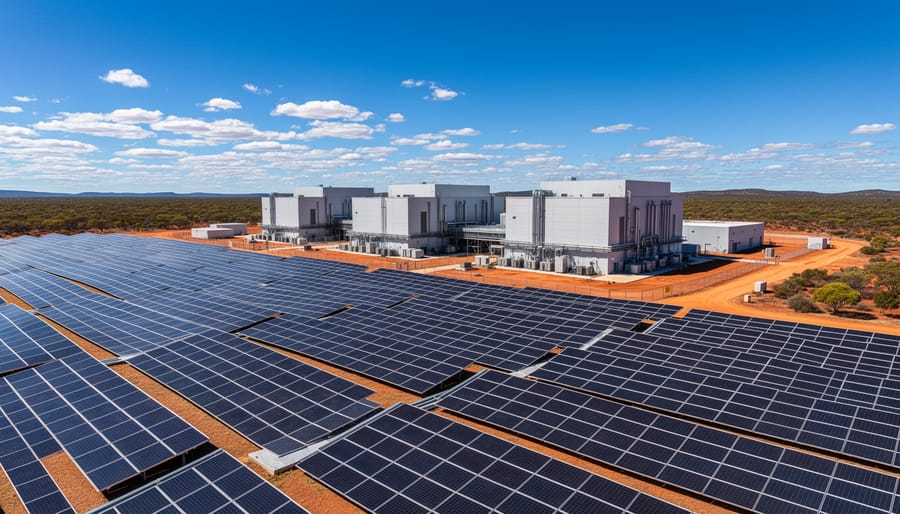
Solar Power: Australia’s Natural Advantage
Australia’s geography presents an extraordinary opportunity that forward-thinking data center operators are embracing with enthusiasm. With some of the highest solar irradiance levels globally, our sunburnt country receives enough sunshine to power data operations sustainably while significantly reducing operational costs.
Leading Australian data centers are already proving this potential. Rather than viewing renewable energy as merely an environmental checkbox, operators are discovering that solar power represents a genuine competitive advantage. Many facilities now feature expansive rooftop solar arrays that generate substantial portions of their daytime energy needs, directly offsetting grid consumption during peak demand periods when electricity costs spike.
What’s particularly exciting is the collaborative approach emerging across the sector. Data centers are partnering with local solar farms through power purchase agreements, creating win-win scenarios that support regional renewable energy projects while securing long-term price stability. These partnerships strengthen local communities by creating jobs and demonstrating corporate commitment to sustainability beyond facility walls.
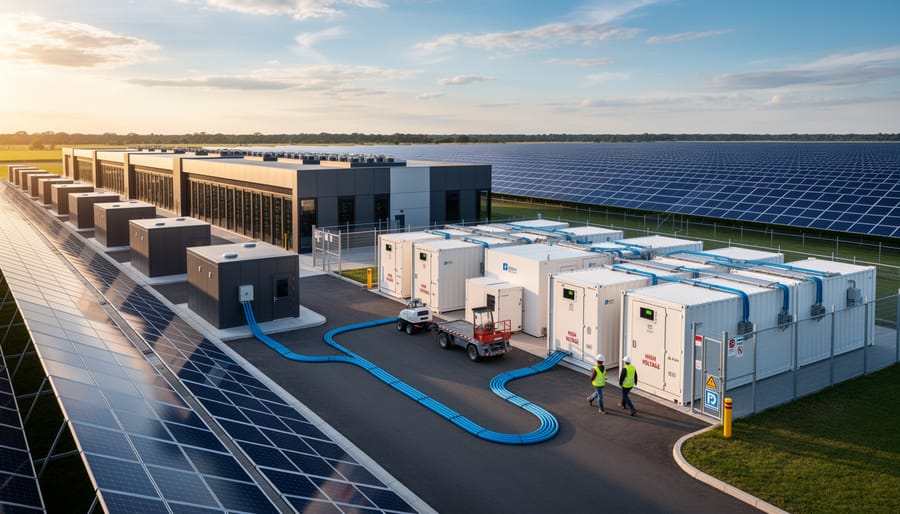
The integration of battery storage systems has transformed solar from an intermittent solution into a reliable baseload power source. Modern lithium-ion and emerging battery technologies enable data centers to store excess solar energy generated during peak sunshine hours, then deploy it during evening demand or grid outages. This combination delivers genuine energy resilience while maximizing renewable energy utilization.
For businesses considering data center services, choosing operators with robust solar installations means your digital operations actively contribute to Australia’s clean energy transition. It’s practical sustainability that makes financial sense while positioning your organization as an environmental leader.
Wind Energy Partnerships and Power Purchase Agreements
Power Purchase Agreements (PPAs) offer Australian data centers a practical pathway to secure wind energy without building their own infrastructure. These long-term contracts connect you directly with wind farm operators, providing price certainty and renewable energy credentials that matter to your stakeholders.
Victoria, South Australia, and Tasmania stand out as powerhouses for wind energy partnerships. South Australia generates over 60% of its electricity from wind, while Tasmania’s abundant wind resources complement its hydroelectric systems. Victoria’s wind farms stretch across regions from Portland to Gippsland, creating multiple partnership opportunities for businesses across the eastern seaboard.
Through a PPA, your data center commits to purchasing a specific amount of electricity from a wind farm over 10-25 years. This arrangement protects you from volatile energy prices while guaranteeing the wind farm operator stable revenue to maintain operations. Many Australian wind farms actively seek corporate partners, and several facilitators can help structure agreements suited to your consumption patterns.
For smaller data centers, community wind projects and aggregated PPAs present accessible alternatives. These arrangements allow multiple businesses to share output from a single wind farm, spreading both investment and risk. The result? Clean energy access becomes achievable regardless of your facility’s size, strengthening Australia’s renewable energy community while securing your business’s sustainable future.
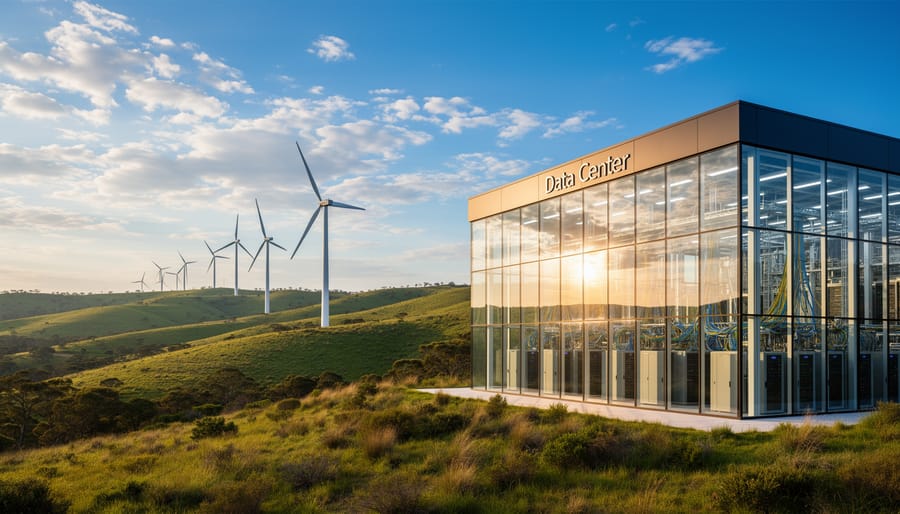
Hybrid Systems That Keep You Running 24/7
The reality of renewable energy is that the sun doesn’t always shine and the wind doesn’t always blow, but your data centre needs to run around the clock. That’s where hybrid renewable systems become your strongest ally. By combining solar, wind, and increasingly, battery storage, Australian data centres are building resilient power systems that deliver consistency without compromise.
Think of it like a symphony – each renewable source plays its part at different times. Solar panels generate peak power during daylight hours, while wind turbines often perform best at night or during cooler months. Battery storage acts as the conductor, smoothing out the transitions and filling gaps when both sources are quiet. Several data centres in South Australia and Queensland are already pioneering these integrated approaches, proving that reliability and sustainability can go hand in hand.
The key is intelligent energy management systems that predict usage patterns and weather conditions, automatically switching between sources or drawing from storage as needed. When paired with efficient cooling systems and optimised workload scheduling, these hybrid setups often achieve 90-95% renewable energy coverage.
For businesses concerned about uptime, most hybrid systems maintain a minimal grid connection as backup, but many operators find they rarely need it. The technology has matured remarkably, making 24/7 renewable operation not just possible, but practical and economically sound for Australian conditions.
Green Grid Electricity: The Easiest First Step
Before considering installing renewable energy systems on-site, the quickest and most straightforward way to green your data center is switching to renewable electricity through your grid provider. Across Australia, accredited GreenPower programs let businesses purchase electricity from verified renewable sources like wind and solar farms, with no infrastructure changes required.
Most major energy retailers offer GreenPower options in every state and territory, allowing you to choose between partial or complete renewable coverage. Simply contact your current provider to inquire about their green options, or compare offerings through government comparison sites. Many Australian businesses have discovered this transition costs less than expected, with some paying just a modest premium for 100% renewable electricity.
State-based renewable energy schemes also provide additional pathways. Victoria’s Victorian Energy Upgrades program and NSW’s Energy Savings Scheme can reduce costs further. This immediate action demonstrates environmental commitment to stakeholders while you plan longer-term sustainability strategies. It’s a powerful first step that proves going green doesn’t require massive investment or operational disruption.
Australian Businesses Leading the Renewable Data Center Revolution
Major Data Center Success Stories
Australian businesses are leading the charge in data center sustainability, proving that renewable energy integration isn’t just possible—it’s profitable and scalable.
Sydney-based Macquarie Telecom Group stands as a shining example, powering their Intellicentre facilities with 100% renewable energy. By partnering with local wind and solar providers, they’ve eliminated over 40,000 tonnes of carbon emissions annually while maintaining the reliability their enterprise clients demand. Their success demonstrates that even mission-critical operations can run entirely on clean energy.
In Melbourne, NEXTDC has committed to achieving net-zero emissions across their entire Australian portfolio. Their M2 data center sources renewable energy through power purchase agreements with Victorian wind farms, creating a direct connection between data infrastructure and regional renewable projects. This approach not only reduces their environmental footprint but also supports rural communities through investment in local energy generation.
Meanwhile, Amazon Web Services continues expanding their Australian renewable energy footprint, with multiple solar and wind projects across New South Wales and Queensland. These initiatives inject millions into regional economies while powering their cloud infrastructure sustainably.
Even smaller operators are finding success. Brisbane’s EdgeDC partnered with community solar schemes to offset their energy consumption, proving that renewable integration works at every scale. Their model shows that you don’t need massive capital to make meaningful progress—strategic partnerships and phased approaches can achieve impressive results.
These pioneers share common traits: clear commitment from leadership, partnerships with Australian renewable providers, and transparent reporting that builds trust with environmentally conscious clients. Their journeys offer practical roadmaps for businesses ready to take action.
Small to Medium Business Wins
You don’t need a massive IT budget to join Australia’s renewable energy revolution. Across the country, small to medium businesses are proving that sustainable data operations are within reach, regardless of company size.
Take Melbourne’s Pixel Digital, a design agency that transformed its modest server room by installing a 5kW solar array on their office roof. Within 18 months, they’d offset 80% of their data center electricity costs while reducing their carbon footprint by 6 tonnes annually. Director Sarah Chen admits she was initially hesitant about the investment, but government rebates covered nearly 40% of installation costs, making the decision straightforward.
In regional Queensland, accounting firm Davidson & Partners took a different approach. Rather than investing in on-site generation, they migrated their data infrastructure to a Brisbane-based colocation facility powered entirely by wind energy. This strategy eliminated their upfront capital requirements while instantly achieving 100% renewable operations. The monthly cost increase was less than 15%, offset by improved reliability and the ability to promote their environmental credentials to clients.
Community initiatives are making the transition even easier. The Adelaide Tech Collective, a group of 12 local businesses, negotiated bulk purchasing power for a shared renewable energy agreement, securing rates comparable to fossil fuel alternatives. This collaborative approach demonstrates that smaller players can leverage collective buying power to access solutions typically reserved for enterprise-scale operations.
The message is clear: transitioning to renewable energy doesn’t require corporate-sized resources. With creative thinking, available incentives, and supportive business communities, Australian SMEs are successfully making the shift while strengthening their bottom line and future-proofing their operations.
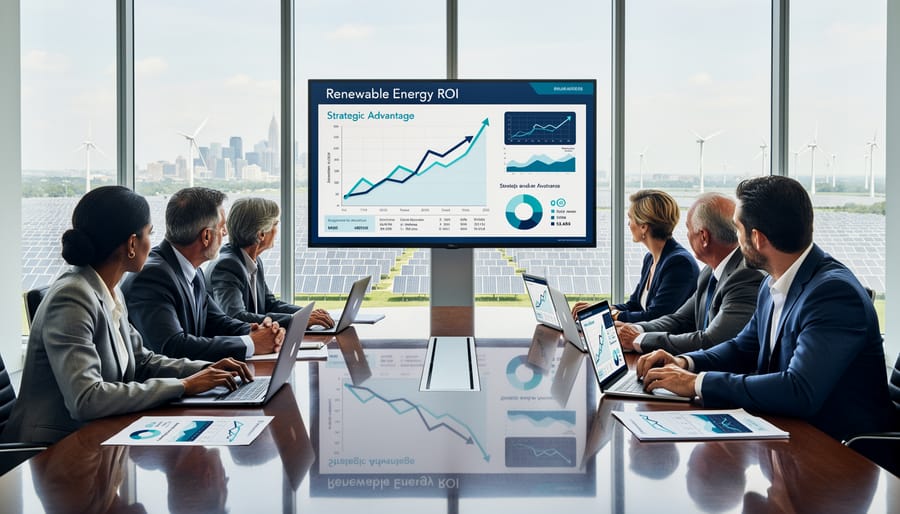
Making the Business Case to Your Leadership Team
Financial Incentives and Government Support in Australia
Good news for Australian businesses looking to power their data centers with renewable energy—you’re not in this alone. Our federal and state governments have recognised the urgent need for climate action and offer substantial support to make your transition both feasible and financially attractive.
The Clean Energy Finance Corporation (CEFC) provides low-cost finance for renewable energy projects, helping businesses overcome upfront capital barriers. Meanwhile, the Australian Renewable Energy Agency (ARENA) offers grants for innovative clean energy initiatives, particularly those demonstrating new technologies or approaches that could benefit the broader community.
At the state level, programs vary but are equally encouraging. Victoria’s Renewable Energy Zones initiative supports large-scale renewable projects, while New South Wales offers Environmental Upgrade Finance for businesses improving energy efficiency. Queensland’s Renewable Energy Fund has helped numerous businesses slash their energy costs whilst reducing emissions.
Don’t overlook accelerated depreciation benefits either. The federal government’s instant asset write-off scheme has been a game-changer for many small to medium businesses investing in solar installations and battery storage systems.
The Australian Taxation Office also recognises eligible renewable energy investments as deductible expenses, improving your project’s return on investment. Many businesses discover these incentives transform renewable energy from an aspirational goal into an immediately practical decision.
Your local council may offer additional rebates or streamlined approval processes for renewable installations. It’s worth having a conversation with them—community-focused initiatives often receive priority support, especially when they demonstrate environmental leadership within your region.
Long-Term Savings and Risk Management
Australian businesses are discovering that renewable energy delivers powerful financial protection beyond immediate cost savings. When Melbourne-based hosting provider NextDC locked in long-term renewable energy contracts, they shielded themselves from the price volatility that saw traditional energy costs spike by over 40% across eastern states in recent years. This predictability transforms budgeting from a guessing game into strategic planning.
The risk management benefits extend far beyond your energy bills. Companies like Equinix Australia report that their renewable commitments have strengthened relationships with environmentally conscious enterprise clients who increasingly audit their supply chain’s carbon footprint. This reputational advantage opens doors to partnerships and contracts that explicitly require sustainable operations, often supported by environmental management certification.
Australian investors and stakeholders now routinely assess environmental performance alongside financial metrics. The nation’s superannuation funds, managing trillions in retirement savings, actively favour companies demonstrating genuine climate action. For data centre operators, renewable energy adoption signals forward-thinking leadership and reduces exposure to potential carbon pricing mechanisms.
The competitive landscape is shifting rapidly. Businesses that act now position themselves as industry leaders, while those delaying risk being left behind as renewable energy transitions from optional initiative to market expectation across Australia’s digital infrastructure sector.
Your Roadmap to a Renewable-Powered Data Center
Step 1: Conduct an Energy Audit
Before making the leap to renewable energy, it’s essential to understand exactly where your data centre stands today. An energy audit gives you this vital baseline, and the good news is that many Australian businesses are discovering significant opportunities for improvement right from the start.
Begin by examining your current electricity bills and usage patterns over the past 12 months. Look for peak consumption periods and seasonal variations that might affect your renewable energy strategy. Many Australian energy providers now offer detailed consumption data that can highlight inefficiencies you might not have noticed.
Next, walk through your facility with a critical eye. Server utilisation rates often reveal surprising insights—some data centres find up to 30% of their servers are underutilised or could be consolidated. Simple practices like switching off unused equipment and optimising cooling systems can immediately reduce your baseline consumption.
Consider engaging a certified energy auditor familiar with Australian data centre standards. They’ll assess everything from your Power Usage Effectiveness (PUE) ratio to cooling efficiency, providing a comprehensive report that identifies quick wins and long-term opportunities. This roadmap becomes invaluable when planning your renewable energy transition, ensuring you’re not overbuilding capacity for wasteful systems.
Step 2: Choose Your Renewable Energy Strategy
Choosing the right renewable energy pathway for your data centre starts with understanding your unique circumstances. Australian businesses have several proven options: on-site solar installations work brilliantly in our sun-drenched climate, particularly for facilities with available roof space or land. Power Purchase Agreements (PPAs) let you buy renewable energy directly from generators without upfront investment, an increasingly popular choice for operations in Victoria and New South Wales. Green energy retail contracts offer the simplest entry point, allowing you to support renewable projects through your existing provider.
Consider your timeline carefully. On-site solar typically requires 6-12 months for planning and installation, while retail contracts can begin immediately. Budget matters too, but remember that many Australian data centres are seeing payback periods of just 3-5 years with solar installations. Your location plays a crucial role as well. Queensland and South Australian facilities benefit from exceptional solar resources, while Tasmania offers access to abundant hydroelectric power. Working with local renewable energy consultants who understand Australian regulations and incentives can help you navigate these choices confidently, ensuring your strategy aligns with both your environmental commitments and business objectives.
Step 3: Partner with the Right Providers
Choosing the right partners transforms your data center’s renewable energy journey from overwhelming to achievable. Start by connecting with Australia’s Clean Energy Council, which maintains a database of accredited renewable energy retailers and installers across every state and territory. Many Australian data centers have found success working with renewable energy consultants who understand both the technical demands of continuous operations and the nuances of our National Electricity Market.
Look for providers with proven data center experience and ask for references from similar-sized operations. Local energy cooperatives and community renewable projects are emerging across Australia, offering collaborative approaches that benefit both your facility and the broader community. Consider technology partners specializing in battery storage systems and smart grid integration, essential for managing renewable energy’s variable nature.
Don’t overlook financing partners either. Organizations like the Clean Energy Finance Corporation offer tailored solutions for businesses transitioning to renewables. The right partnership isn’t just about lowest cost; it’s about finding aligned values, reliable support, and expertise that grows with your needs. Many successful Australian data centers report that their renewable transition became smoother once they assembled a trusted team of specialists who understood their unique operational requirements.
Step 4: Implement and Monitor
Making the transition to renewable energy is an exciting journey that requires careful planning and ongoing commitment. Start by partnering with experienced Australian installers who understand data centre requirements and local grid conditions. Your implementation team should include energy specialists, IT professionals, and facilities managers working together to ensure seamless integration.
Begin with a phased rollout if you’re retrofitting existing infrastructure. This approach minimises disruptions while allowing your team to learn and adjust. Install monitoring systems from day one to track energy generation, consumption patterns, and cost savings in real-time. Many Australian data centres now use smart monitoring platforms that provide detailed insights into renewable energy performance.
Integration with existing power systems requires attention to backup solutions and load balancing. Work with your energy provider to establish clear protocols for grid connection and export arrangements. Consider joining industry networks and local business sustainability groups to share experiences and troubleshoot challenges together.
Set measurable targets for renewable energy usage and review progress quarterly. Document your journey and celebrate milestones with your team and customers. This transparency builds trust and demonstrates your commitment to Australia’s clean energy future. Regular performance reviews help identify optimisation opportunities, ensuring your renewable system continues delivering environmental and financial benefits for years to come.
Overcoming Common Challenges and Concerns
When Australian businesses consider renewable energy for their data centers, several concerns typically surface. Let’s address these head-on with practical insights from organizations that have already made the transition successfully.
The reliability myth is perhaps the most persistent barrier. Many worry that renewable energy can’t provide the constant, uninterrupted power that data centers demand. Here’s the reality: modern renewable systems incorporate battery storage, grid connections, and intelligent energy management systems that ensure continuous operation. Melbourne-based hosting provider Digital Pacific has demonstrated this beautifully, running their facilities on a hybrid renewable system with zero downtime since implementation. The key is designing a resilient energy mix rather than relying solely on one source.
Cost concerns are understandable, particularly when facing upfront investment figures. However, the narrative changes when you examine the full picture. While initial setup costs exist, the combination of declining renewable technology prices, government incentives available through programs like the Australian Renewable Energy Agency grants, and power purchase agreements means many businesses achieve positive cash flow within three to five years. Consider arranging a feasibility study with local renewable energy consultants who understand Australian conditions and can model your specific situation.
Technical complexity often feels overwhelming, but you’re not pioneering uncharted territory. Across Australia, specialist renewable energy integrators work specifically with data center operators, handling everything from site assessments to ongoing maintenance. They understand thermal management, power density requirements, and redundancy needs specific to computing environments.
The intermittency challenge deserves honest discussion. Solar panels don’t generate power at night, and wind isn’t constant. Smart businesses address this through energy storage solutions, maintaining grid connections as backup, and implementing demand response strategies that shift non-critical workloads to peak generation times. These approaches transform perceived limitations into opportunities for innovation and cost optimization.
Remember, every major Australian data center now running on renewables once faced these same concerns. The path forward exists, proven and accessible.
The Ripple Effect: Beyond Your Data Center
When your data centre switches to renewable energy, you’re not just transforming your own operations—you’re creating positive waves that extend far beyond your server racks.
Australian renewable energy projects supporting data centres are generating meaningful employment across regional areas. From solar farm technicians in Queensland to wind turbine maintenance crews in South Australia, these installations create both construction jobs and ongoing career opportunities. By choosing renewable energy, you’re directly contributing to skills development in emerging industries that will shape Australia’s economic future.
Your commitment also eases pressure on local electricity grids, particularly during peak demand periods. Data centres with onsite solar installations or dedicated renewable contracts reduce strain on shared infrastructure, benefiting neighbouring homes and businesses. In areas experiencing grid constraints, this can make a tangible difference to community energy security.
Perhaps most importantly, you become a catalyst for broader change. When businesses in your industry see your successful transition to renewables, it challenges the assumption that data-intensive operations must rely on fossil fuels. Your experience—the challenges you overcame, the solutions you discovered, and the benefits you’ve gained—becomes a roadmap for others.
Consider Melbourne’s NextDC, which powers its facilities with 100% renewable energy. Their visible commitment has sparked conversations throughout Australia’s tech sector, demonstrating what’s possible at scale. Similarly, smaller operators who share their renewable journey in local business networks often inspire neighbouring companies to explore their own options.
This ripple effect multiplies your environmental impact exponentially. Your decision today doesn’t just reduce your carbon footprint—it helps build momentum toward a cleaner energy future for Australia’s entire digital economy. That’s the kind of legacy worth investing in.
The journey toward renewable energy for data centers isn’t just about doing what’s right for our planet—it’s about positioning your business at the forefront of innovation while reaping tangible financial rewards. As we’ve explored throughout this article, Australian businesses now have unprecedented access to solar, wind, and hybrid renewable solutions that can significantly reduce operational costs while slashing carbon emissions.
The dual benefits are clear: environmental responsibility meets business advantage. Data centers powered by renewable energy demonstrate to clients, investors, and community members that your organization takes sustainability seriously. In an era where consumers increasingly make purchasing decisions based on corporate values, this commitment can become your competitive edge.
For Australian businesses, the transition has never been more accessible. Government incentives, falling technology costs, and proven local case studies have removed many of the traditional barriers. Whether you’re operating a small server room in suburban Brisbane or managing a large-scale facility in Sydney, renewable solutions exist to match your scale and budget.
The first step is simpler than you might think: conduct an energy audit, explore available incentives in your state, and connect with renewable energy providers who understand Australian conditions. By taking action today, you’re not just reducing your environmental footprint—you’re joining a growing community of Australian businesses leading the charge toward a sustainable future. Your data center can be part of the solution, proving that technological advancement and environmental stewardship go hand in hand.