
Australian businesses are stepping up to the climate challenge, and the corporate green initiatives they’re implementing are reshaping how we work, produce, and grow. From solar-powered offices in Sydney to zero-waste manufacturing in Melbourne, organizations across the country are discovering that environmental responsibility and commercial success go hand in hand.
Corporate green initiatives encompass everything from energy efficiency upgrades and waste reduction programs to sustainable supply chain management and employee engagement campaigns. These aren’t just feel-good measures—they’re strategic investments that reduce operational costs, attract top talent, strengthen brand reputation, and future-proof businesses against tightening environmental regulations. With Australian businesses facing increasing pressure from consumers, investors, and government bodies to demonstrate genuine environmental commitment, the question is no longer whether to act, but how quickly and comprehensively you can transform your operations.
The encouraging news? You don’t need unlimited budgets or specialized teams to begin. Successful corporate sustainability starts with understanding what initiatives deliver the greatest impact for your specific industry and context, then building momentum through small wins that engage your entire workforce. Whether you’re a startup in Brisbane or an established enterprise spanning multiple states, practical pathways exist to reduce your environmental footprint while enhancing your bottom line.
This guide explores the most effective corporate green initiatives working for Australian businesses today, providing the roadmap you need to join the sustainability leaders shaping our economic future.
Why Australian Businesses Are Racing Toward Green Workplaces
The Business Case That’s Impossible to Ignore
Let’s talk numbers, because while saving the planet feels good, the financial rewards of corporate green initiatives make an equally compelling story for Australian businesses.
The operational savings alone are remarkable. Companies across Australia are cutting energy costs by 20-40% through efficiency upgrades and renewable energy installations. Take Melbourne’s ISPT, which saved over $2 million annually by retrofitting their commercial properties with smart building technology. Water-efficient systems are delivering similar results, with businesses in drought-prone regions reducing utility expenses by thousands each year.
Then there’s the tax advantage. The Australian government’s instant asset write-off scheme covers eligible energy-efficient equipment, while various state programs offer additional rebates and incentives for businesses investing in sustainability. These aren’t small amounts – we’re talking substantial financial support that dramatically improves your return on investment.
Your brand reputation gets a measurable boost too. Recent research shows 88% of Australian consumers prefer buying from environmentally responsible companies, translating directly to increased revenue and customer loyalty. In a competitive market, your green credentials become a powerful differentiator.
Perhaps most compelling is the talent factor. With skilled workers increasingly selective about employers, strong environmental values have become essential for attracting top performers. Australian businesses with robust sustainability programs report 25% better staff retention rates and significantly lower recruitment costs. Young professionals, in particular, actively seek employers whose values align with their own environmental concerns.
The evidence is clear: going green isn’t just ethically right for Australian businesses – it’s financially smart, protecting your bottom line while building a more resilient future.
What Australian Employees Actually Want
Recent research paints a compelling picture of what matters to Australian workers when choosing their employers. A 2023 study by the Australian Conservation Foundation revealed that 78% of Aussie employees now consider a company’s environmental track record when making job decisions, a significant jump from just 54% five years earlier.
This shift is particularly pronounced among younger workers, with millennials and Gen Z actively seeking workplaces that align with their values. The demand isn’t just about token gestures either. Employees want to see genuine commitment through measurable initiatives like waste reduction programs, renewable energy transitions, and transparent sustainability reporting.
Melbourne-based tech company Envato exemplifies this understanding, achieving carbon neutrality and offering staff paid volunteer days for environmental projects. Their approach has contributed to impressive retention rates and attracted top talent. Similarly, Atlassian’s commitment to running on 100% renewable energy resonates strongly with their workforce.
Perth startup Banksea has taken employee engagement further by involving their team directly in sustainability decision-making, creating a green committee where staff vote on priority initiatives. This participatory approach fosters genuine ownership and enthusiasm.
The message is clear: Australian workers aren’t just looking for a pay cheque anymore. They’re seeking purpose-driven employers who take environmental responsibility seriously and create opportunities for meaningful involvement in building a sustainable future.
Energy Efficiency: Where Most Workplaces Start (And See Results Fastest)
Smart Lighting and Climate Control Solutions
Transforming your workplace lighting and climate systems delivers immediate environmental impact while slashing operational costs—a win-win that resonates across Australian businesses. When Melbourne-based accounting firm Stewart & Co partnered with energy efficiency specialists, their LED upgrade reduced lighting costs by 60% within the first year, paying for itself in just 18 months.
LED lighting retrofits represent the quickest sustainability win for most offices. Modern LEDs use 75% less energy than traditional fluorescent tubes and last up to 25 times longer. When combined with motion sensors and daylight harvesting systems, savings compound dramatically. A 500-square-metre Brisbane office recently installed occupancy sensors in meeting rooms and corridors, reducing unnecessary lighting by an additional 30%.
HVAC optimization proves equally transformative, particularly given Australia’s challenging climate extremes. Smart thermostats with zone control allow precise temperature management, crucial during scorching summers and cool winters. Brisbane and Perth businesses benefit from programmable systems that pre-cool buildings during off-peak electricity periods, while Sydney offices use adaptive setpoints that adjust based on occupancy and external temperatures.
The numbers tell a compelling story: a typical 1,000-square-metre office investing 25,000 dollars in comprehensive lighting and climate upgrades can expect annual savings exceeding 8,000 dollars, achieving full payback in three years. Beyond financial returns, these initiatives typically reduce carbon emissions by 40-50%, demonstrating genuine environmental leadership while building workplace pride in sustainability achievements.
Solar Power: Australia’s Natural Advantage
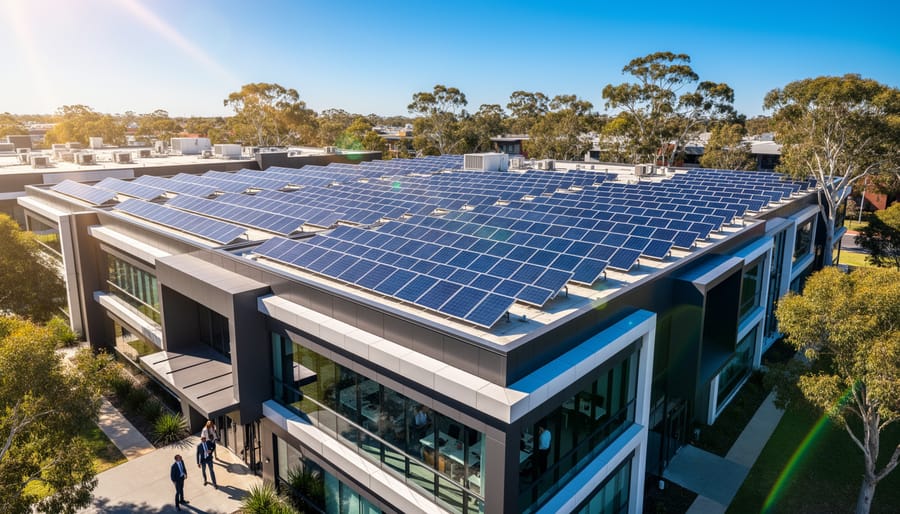
Australia’s extraordinary solar resource – averaging over 58 million petajoules of solar radiation annually – presents businesses with an unmatched opportunity to power operations sustainably whilst reducing energy costs. With some of the highest solar irradiance levels globally, Australian companies are increasingly recognising that solar isn’t just environmentally responsible; it’s economically smart.
Take Melbourne-based logistics company Linfox, which installed a 1.25-megawatt solar array across its Brisbane distribution centre. The system now generates enough electricity to power 300 homes annually, slashing the facility’s grid consumption by 30 percent. Similarly, Bunnings has committed to installing rooftop solar across its entire warehouse network, with over 90 stores already generating clean energy.
For businesses considering solar, several factors warrant attention. Roof orientation and condition are paramount – north-facing surfaces in Australia capture optimal sunlight. System sizing should align with your energy consumption patterns, considering both current usage and future growth. Quality matters too; while cheaper panels might seem attractive, reputable Australian-certified products with robust warranties ensure long-term performance.
The financial landscape for commercial solar remains encouraging. The Small-scale Technology Certificate scheme provides upfront rebates that significantly reduce installation costs. Many states offer additional incentives – Victoria’s Solar for Business program, for instance, provides rebates up to 3,500 dollars for eligible small businesses. With commercial electricity prices continuing to climb, most Australian businesses see payback periods between three to six years, after which they’re essentially generating free electricity.
Commercial solar providers like Solargain and Natural Solar now offer tailored packages including maintenance, monitoring, and performance guarantees, making the transition straightforward even for businesses without technical expertise. The message is clear: Australia’s sunshine is a natural competitive advantage waiting to be harnessed.
Waste Reduction Programs That Actually Work
The War on Single-Use Plastics in the Workplace
Single-use plastics remain one of the most visible environmental challenges in Australian workplaces, but the solution is more achievable than many organisations realise. Starting with a simple audit of your workplace plastic consumption creates the foundation for meaningful change. Walk through your office with fresh eyes and note every disposable coffee cup, plastic water bottle, takeaway container, and piece of cling wrap that passes through during a typical week.
The alternatives are increasingly accessible and affordable. Australian suppliers like Biome and The Sustainable Collective offer comprehensive workplace solutions, from compostable coffee cups to stainless steel water bottles that can be branded with your company logo. Many Melbourne and Sydney-based offices have partnered with KeepCup, an Australian success story, to provide reusable cup programs that reduce waste while building team identity.
Employee engagement transforms policy into practice. Launch your plastic-free initiative with a challenge week where teams track their plastic reduction, rewarding the most creative solutions. Provide clearly labelled alternatives at key points like kitchens and meeting rooms, making the sustainable choice the easiest choice. Consider appointing sustainability champions across departments who can troubleshoot barriers and celebrate wins.
The ripple effect extends beyond your office walls. When employees experience how simple these swaps become, they often adopt similar practices at home, amplifying your corporate initiative into genuine community impact. Start small, communicate clearly, and watch your workplace culture shift toward sustainability.
Composting and Organic Waste Solutions for Office Environments
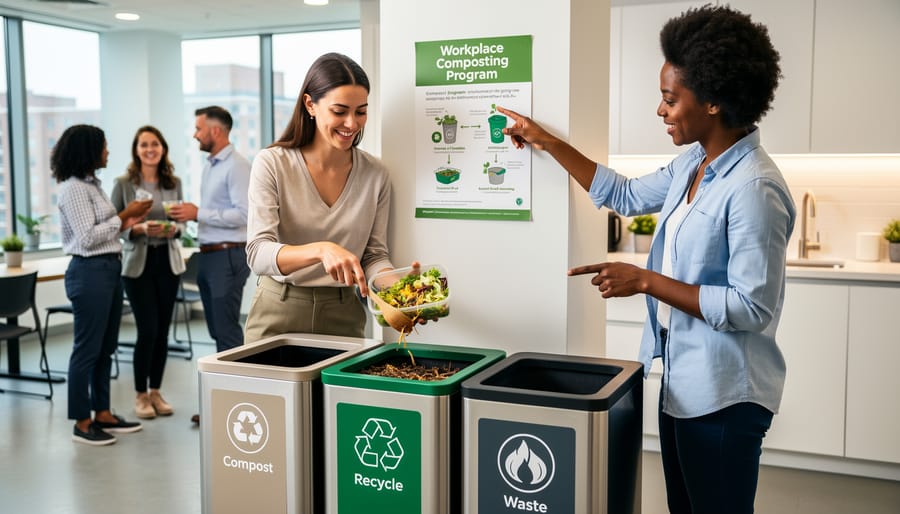
Workplace composting programs transform organic waste from a disposal problem into a valuable resource, and they’re more achievable than many Australian businesses realize. Even in dense urban environments, offices can make a significant impact by diverting food scraps, coffee grounds, and compostable packaging from landfill.
Start by assessing your office’s organic waste streams. Staff kitchens generate substantial compostable material, from fruit peels and tea bags to the mountains of coffee grounds most workplaces produce daily. Melbourne-based tech company Envato discovered they were sending over 40 kilograms of organic waste to landfill weekly before implementing their composting initiative.
For offices without outdoor space, indoor worm farms or bokashi systems work brilliantly. These compact solutions handle kitchen waste efficiently and produce nutrient-rich compost that can be donated to community gardens or used in office planters. Sydney’s Inner West Council even provides discounted worm farms to local businesses through their waste reduction program.
Partnering with local composting initiatives offers another practical pathway. Services like Compost Revolution and local councils across Brisbane, Perth, and Adelaide now collect organic waste from commercial premises. Some organizations, such as Return and Earn points in NSW, extend beyond container recycling to include organic waste programs.
Education remains crucial for success. Clear signage near bins, lunch-and-learn sessions, and appointing sustainability champions help staff understand what can be composted. Brisbane accounting firm Smith & Co found their contamination rates dropped by 70 percent after introducing a simple visual guide showing acceptable items.
Consider the broader impact too. When businesses compost, they demonstrate environmental leadership that resonates with employees and clients while supporting Australia’s goal of halving organic waste to landfill by 2030.
Sustainable Transportation Initiatives
Bike-to-Work Programs and EV Charging Stations
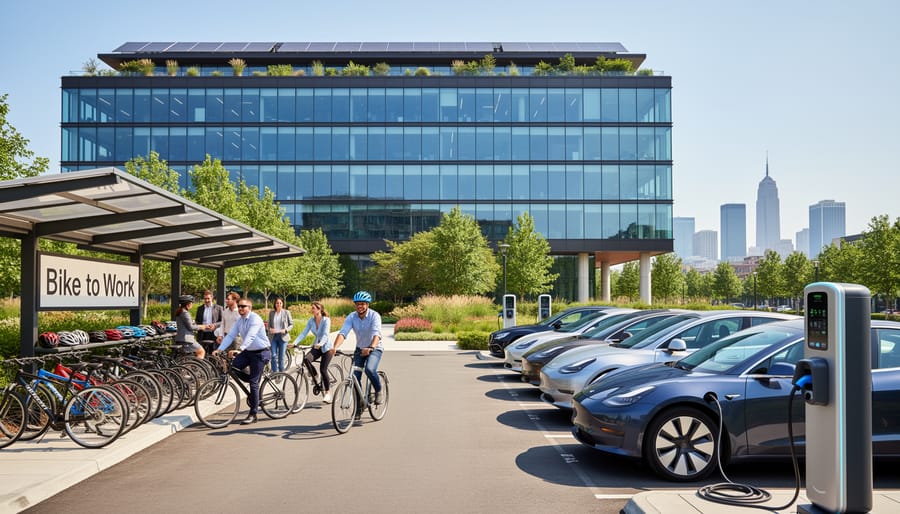
Getting your team pedalling to work or charging their electric vehicles at the office creates tangible environmental wins while boosting employee wellbeing. Australian workplaces are discovering that supporting active transport and EV infrastructure isn’t just good for the planet—it’s a powerful retention and recruitment tool.
Start with bike-friendly basics: secure storage, shower facilities, and end-of-trip amenities. Melbourne’s RMIT University exemplifies this approach, offering over 1,000 bike spaces and maintenance stations across campus. Their program has seen cycling commutes increase by 35% over three years. Consider partnering with local bike-share schemes or offering salary-sacrifice bicycle programs to remove financial barriers.
For EV charging infrastructure, Sydney’s Westfield shopping centres have installed hundreds of charging stations, demonstrating how workplace parking can double as charging hubs. Brisbane City Council’s administration building features solar-powered EV chargers, showing how renewable energy and transport initiatives can work together. Even small businesses can start modestly—a single charging point signals commitment and can be expanded as adoption grows.
Financial incentives matter too. Offer mileage reimbursement for bike commuters, subsidise public transport passes, or provide preferential parking for EVs and carpools. Track participation rates and carbon savings to demonstrate impact, celebrating milestones with your team. These programs work best when they’re visible, accessible, and championed by leadership who actively participate.
Remote Work as a Green Strategy
Remote work has emerged as one of the most impactful green strategies Australian businesses can adopt, with impressive environmental returns. When Melbourne-based employees work from home just two days weekly, they collectively prevent approximately 1.8 tonnes of carbon emissions per person annually – equivalent to planting 82 trees each year.
The numbers tell a compelling story for Australian organisations. Companies embracing hybrid models have reported fuel consumption reductions of up to 70% among participating staff, whilst simultaneously decreasing office energy use by 30-40%. This translates to significant environmental gains across our sprawling cities where commutes average 45-90 minutes in major centres like Sydney and Brisbane.
Beyond emissions, flexible work arrangements reduce office waste generation, lower demand for commercial real estate heating and cooling, and decrease water consumption. For businesses concerned about productivity, Australian studies show remote workers maintain or exceed performance levels whilst contributing to substantial carbon reduction targets. The beauty of this initiative lies in its dual benefit – it enhances employee wellbeing through reduced commute stress whilst advancing your organisation’s sustainability goals. Consider starting with a pilot programme tracking environmental metrics alongside employee satisfaction to demonstrate tangible green outcomes.
Water Conservation in the Australian Workplace
Low-Flow Fixtures and Greywater Systems
Reducing water consumption starts with smart fixture choices. Low-flow taps, showerheads, and dual-flush toilets can cut water use by up to 40% without compromising performance. Australian companies like Caroma lead the innovation here, offering WELS-rated products (Water Efficiency Labelling and Standards) that are independently verified for their water-saving capabilities. Their dual-flush toilet systems, invented right here in Australia, have become the global standard for water efficiency.
Installing low-flow fixtures is straightforward and often requires minimal plumbing modifications. Most businesses see payback periods of 12-18 months through reduced water bills. Look for fixtures with 4-star WELS ratings or higher for maximum savings.
Greywater systems take water conservation further by capturing water from sinks, showers, and washing machines for reuse in toilet flushing or landscape irrigation. Companies like Aqua Nova and Envirocycle provide commercial-grade systems suitable for office buildings. While installation requires proper planning and compliance with local regulations, these systems can reduce potable water consumption by 30-50%.
Before implementation, consult with your local water authority about permits and guidelines. Many Australian councils offer rebates for businesses installing water-saving infrastructure, making the transition more affordable while demonstrating genuine environmental commitment to your team and community.
Rainwater Harvesting for Commercial Buildings
Australian businesses are discovering that rainwater harvesting isn’t just environmentally responsible—it’s financially smart too. From washing vehicles to cooling systems and toilet flushing, commercial buildings can reduce mains water consumption by up to 40% through properly designed rainwater systems.
Companies like Stockland and Mirvac have integrated large-scale rainwater harvesting into their commercial developments, capturing thousands of litres annually. These systems typically include roof catchment areas, storage tanks, filtration systems, and dedicated plumbing networks for non-potable uses.
Regulatory requirements vary across states. In Victoria, commercial buildings over 2,000 square metres must incorporate water-saving measures including rainwater systems. Queensland mandates rainwater tanks for certain commercial developments, while New South Wales offers rebates through specific council programs. Western Australia requires integrated water management plans for large commercial projects.
The investment typically pays for itself within five to eight years through reduced water bills and potential stormwater charge reductions. Beyond cost savings, businesses demonstrate tangible environmental leadership—a powerful message for customers and employees alike. Many organizations now proudly display their rainwater systems as part of building tours, transforming infrastructure into a storytelling opportunity about their commitment to sustainability.
Getting Your Team On Board: The Human Element
Creating Green Champions and Sustainability Committees
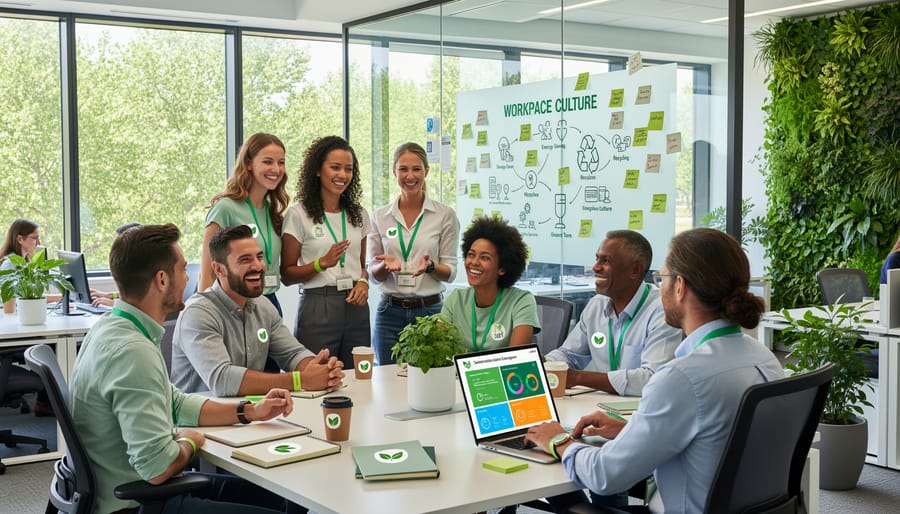
Empowering employees to lead sustainability efforts creates lasting change from within your organisation. Establishing green champions across different departments gives staff ownership of environmental initiatives while building momentum throughout your business.
Start by identifying passionate employees who can champion sustainability in their teams. These champions don’t need formal environmental qualifications—enthusiasm and commitment matter most. Melbourne-based accounting firm BDO Australia successfully launched their Green Team by inviting volunteers to coordinate recycling programs, lead lunchtime sustainability workshops, and propose eco-friendly office improvements.
Create a formal sustainability committee with representatives from various departments to ensure diverse perspectives. Meet monthly to review progress, share ideas, and plan initiatives. Sydney’s Atlassian holds quarterly sustainability summits where employee-led groups present projects ranging from office gardens to e-waste reduction programs.
Provide champions with resources and authority to implement changes. This includes allocated time during work hours, a modest budget for initiatives, and direct communication channels to leadership. Queensland construction company Hutchinson Builders empowers their sustainability committee to audit suppliers and recommend greener alternatives.
Recognition matters too. Celebrate wins through internal newsletters, awards, or team lunches. When employees see their contributions valued, engagement deepens and spreads organically across your workplace, creating a genuine culture of environmental responsibility.
Gamification and Incentive Programs That Work
Making sustainability stick in your workplace often comes down to one thing: engagement. Australian companies are discovering that gamification transforms green initiatives from mandatory policies into enthusiastic team efforts.
Consider launching inter-department challenges where teams compete to reduce waste, with real-time leaderboards displayed in common areas. Melbourne’s Medibank ran a successful “Commute Challenge” where employees tracked sustainable transport methods, earning points redeemable for charity donations or extra leave days. The friendly competition sparked conversations and lasting behaviour changes.
Recognition programs work brilliantly when they’re visible and meaningful. Create a monthly “Sustainability Champion” award highlighted in company newsletters, or establish a points system where employees earn rewards for actions like using reusable containers, participating in office gardens, or suggesting process improvements. Brisbane-based companies have found success with digital badges employees can display on email signatures.
The key is keeping rewards aligned with your sustainability values. Rather than generic gift cards, offer experiences like guided nature walks, native plant vouchers, or donations to local environmental groups in employees’ names. This reinforces the message while building genuine commitment.
Start small with one initiative, measure participation rates, and iterate based on feedback. When people feel their contributions matter and receive genuine recognition, sustainability becomes part of your workplace culture rather than just another policy document.
Measuring Success: Tracking Your Environmental Impact
Key Metrics and Reporting Tools
Measuring your progress is essential for maintaining momentum and demonstrating the real impact of your green initiatives. The good news? Australian businesses now have access to fantastic tools that make tracking straightforward and meaningful.
Start by monitoring your carbon footprint, which includes emissions from energy use, transport, and operations. Many Australian companies are finding success with platforms like the National Carbon Offset Standard (NCOS) calculator and Climate Active’s certification tools. These government-backed resources are designed specifically for our market and provide credible benchmarks.
Waste diversion rates tell a powerful story about your recycling and composting efforts. Track what percentage of waste avoids landfill each month. Simple spreadsheets work initially, but dedicated software like EcoOnline or Sustainment helps automate data collection as you grow.
Energy consumption deserves close attention too. Smart meters and platforms such as Wattwatchers provide real-time insights into usage patterns, helping identify opportunities for reduction. Many Australian energy retailers now offer free monitoring dashboards that integrate seamlessly with your existing systems.
Don’t forget water usage, particularly relevant in our climate. State-based programs like Sydney Water’s WaterFix offer assessment tools and tracking support.
The key is choosing metrics that align with your specific goals and starting simple. You can always expand your tracking as your green journey progresses, building confidence and capability within your team.
Certifications Worth Pursuing
Pursuing formal environmental certifications demonstrates genuine commitment while providing structured pathways for your sustainability journey. In Australia, three standout certifications can elevate your corporate green credentials.
Green Star certification, administered by the Green Building Council of Australia, focuses on building design and operation. It’s particularly valuable for businesses looking to reduce their environmental footprint through sustainable infrastructure. The assessment covers energy efficiency, water usage, materials selection, and indoor environmental quality.
Climate Active, backed by the Australian Government, offers carbon neutral certification for organisations, products, and services. The process involves measuring your carbon footprint, implementing reduction strategies, and offsetting remaining emissions through certified Australian projects. It’s becoming increasingly recognised by customers and partners who value verified environmental action.
B Corp certification takes a holistic approach, evaluating your entire business model across social and environmental performance, accountability, and transparency. While internationally recognised, Australian B Corps form a supportive community sharing resources and expertise.
Each certification requires investment in assessment fees and operational improvements, but the benefits extend beyond reputation. You’ll gain structured improvement frameworks, access to sustainability networks, and competitive advantages in tender processes where environmental credentials increasingly matter.
Australian Companies Leading the Way
Across Australia, businesses of all sizes are proving that environmental responsibility and commercial success go hand in hand. These pioneering companies are showing us what’s possible when sustainability becomes core to operations.
Melbourne’s Thankyou Group has built its entire business model around social and environmental impact. This social enterprise has eliminated plastic from 95% of its product range, switching to recycled and recyclable packaging materials. Their transparent supply chain demonstrates how consumer goods companies can radically reduce their environmental footprint while maintaining product quality and customer loyalty.
In the mining sector, traditionally challenged by environmental concerns, Fortescue Metals Group is making remarkable strides. The company has committed to carbon neutrality by 2030, investing heavily in renewable energy projects and green hydrogen technology. Their Chichester Hub now runs on a hybrid renewable energy system, reducing diesel consumption by approximately 100 million litres annually. This shift demonstrates that even resource-intensive industries can lead meaningful change.
Small businesses are equally impressive in their innovation. Sydney’s Fishburners, a co-working space, achieved carbon neutrality through comprehensive energy audits, solar panel installation, and partnering with local composting programs. They’ve created a blueprint that other small-to-medium enterprises can realistically follow, proving you don’t need a corporate-sized budget to make substantial environmental progress.
Queensland’s Bundaberg Brewed Drinks showcases regional leadership by installing one of Australia’s largest privately-owned solar arrays. This family-owned business now generates 90% of its energy needs from solar power, significantly reducing operational costs while cutting emissions.
Stone and Chalk, a fintech hub in Sydney, takes a holistic approach by embedding sustainability into tenant agreements, encouraging resident startups to adopt green practices from inception. They’ve fostered an entire ecosystem of environmentally conscious businesses.
These diverse examples prove there’s no single path to sustainability. Whether you’re a startup, family business, or major corporation, the key is starting somewhere and building momentum. Each of these companies began with clear goals, measured their impact, and adapted their approaches based on results.
The path to corporate sustainability isn’t reserved for multinational corporations with unlimited resources. Every Australian business, regardless of size, has the power to make meaningful environmental change right now. Whether you’re leading a startup in Melbourne, managing operations in regional Queensland, or running a family business in Perth, your green initiatives contribute to a collective movement that’s reshaping our nation’s environmental future.
The beauty of corporate green initiatives lies in their accessibility. Start small with a workplace recycling program or switch to renewable energy. Engage your team in carbon reduction challenges or partner with local environmental organizations. Each action creates ripples that extend beyond your business walls, influencing suppliers, customers, and the broader community.
Australian businesses taking sustainability seriously aren’t just protecting the environment; they’re building resilience, attracting talent, and positioning themselves for long-term success in an increasingly conscious marketplace. The evidence is clear: companies that prioritize environmental responsibility consistently outperform those that don’t.
Your sustainability journey begins with a single decision. Conduct an environmental audit this week, speak with your team about their green ideas, or connect with other Australian businesses already walking this path. Join local sustainability networks, share your learnings, and celebrate your progress, however modest it may seem.
The climate crisis demands action, but it also offers opportunity. Together, Australian businesses can lead the way in creating a sustainable economy that benefits everyone. Your commitment matters. Your actions count. The time to begin is now.