
Every time you cool a server rack in an Australian data centre, you’re making a choice about water. That choice ripples through our communities, our energy grids, and our increasingly precious water reserves.
Data centres across Australia now consume approximately 100 billion litres of water annually for cooling systems, a figure projected to triple by 2030 as our digital demands accelerate. In Perth, Melbourne, and Sydney, these facilities compete for the same water resources our families, farms, and industries depend on. Yet the connection between keeping servers cool and keeping water clean remains invisible to most Australians, even as data centres quietly become one of our fastest-growing water users.
Water treatment in data centres isn’t simply about filtration. It’s a delicate balance of chemistry, engineering, and environmental stewardship that determines whether facilities drain precious drinking water or operate as closed-loop systems that recycle up to 95% of their water. The difference between conventional and optimised water treatment can mean savings of millions of litres per facility, reduced energy consumption through improved heat exchange efficiency, and prevention of harmful chemical discharge into our waterways.
Australian facilities are pioneering solutions that work specifically for our climate extremes and water scarcity challenges. From Brisbane’s humidity to Adelaide’s heat, local innovations in water treatment are proving that responsible digital infrastructure doesn’t require sacrificing environmental values. Whether you’re a facility manager seeking operational improvements, a sustainability professional evaluating vendor options, or a business leader concerned about your digital footprint, understanding data centre water treatment represents a powerful lever for change. The facilities cooling our digital lives can become models of water stewardship, and that transformation starts with knowledge.
The Hidden Water Cost of Our Digital Lives
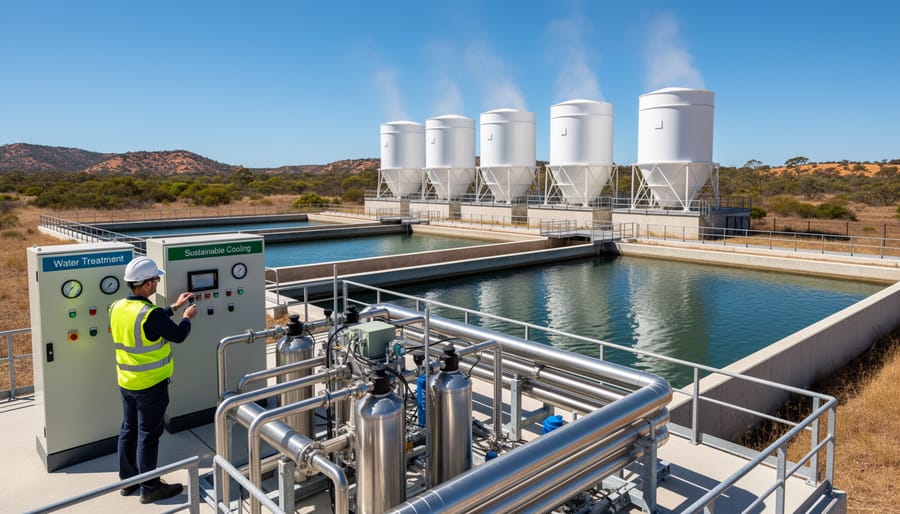
Why Data Centres Need So Much Water
If you’ve ever wondered why data centres consume millions of litres of water each year, the answer lies in how they keep cool. Every time you stream a video, send an email, or use cloud storage, the servers processing that information generate significant heat. Without proper cooling, these servers would overheat and fail within minutes.
Most Australian data centres rely on evaporative cooling systems, which work similarly to how our bodies use sweat to regulate temperature. These systems draw in hot air from the server rooms, pass it through water-saturated pads, and release the cooled air back into the facility. The catch? As water evaporates, it needs constant replenishment.
Think of it like a giant version of the evaporative coolers many Australians use in their homes, but operating 24 hours a day, 365 days a year. A medium-sized data centre can use anywhere from 11 to 19 million litres of water annually, with larger facilities consuming significantly more. In our already water-stressed continent, where communities from Perth to Brisbane regularly face restrictions, this presents a genuine challenge.
The water demands don’t stop at cooling either. Data centres also need water for humidity control, backup systems, and general operations. As Australia’s digital economy grows and more businesses shift to cloud-based services, our collective data infrastructure’s thirst continues to rise. This is precisely why water treatment and recycling initiatives have become critical conversations within the industry and our broader sustainability community.
Australia’s Unique Challenge
Australia faces a particularly complex challenge when it comes to data center water consumption. As one of the driest inhabited continents on Earth, our nation has long grappled with water scarcity, making every drop precious. Yet we’re simultaneously experiencing rapid digital growth, with data centers emerging across regions already stressed by persistent drought conditions.
Cities like Sydney and Melbourne, which host significant data infrastructure, have weathered severe water restrictions in recent years. Regional areas in New South Wales and Queensland, increasingly attractive for data center development due to lower land costs and renewable energy potential, are often the same communities facing agricultural water shortages and climate-related water stress.
This creates a real tension in our communities. On one hand, we need digital infrastructure to power our modern economy and connect our vast geography. On the other, we cannot afford to compromise water security for essential services, agriculture, and ecosystems already under pressure. The good news is that Australian innovation and community collaboration are rising to meet this challenge, with local solutions emerging that balance technological progress with environmental responsibility.
The Energy-Water Connection Nobody Talks About
Trading One Resource for Another
Here’s the reality facing data centre operators across Australia: cooling technology isn’t a simple choice between right and wrong, but rather a complex balancing act between two precious resources. When facilities shift from water-based cooling to air-cooled systems, they’re essentially trading litres for kilowatts, and understanding this exchange is crucial for making genuinely sustainable decisions.
Traditional evaporative cooling systems can consume millions of litres of water annually, but they’re remarkably energy-efficient. A typical Australian data centre using this method might use 15 litres of water per kilowatt-hour but keeps energy demands relatively low. Switch to air-cooling, and water consumption drops dramatically, sometimes to near zero. The catch? Energy consumption can spike by 20-40 percent, which means more coal or gas-fired power in regions still transitioning to renewables.
Several forward-thinking Australian facilities are pioneering hybrid approaches that flex between cooling methods based on real-time conditions. During Melbourne’s cooler months, they rely on air-cooling. When Sydney summers hit, they switch to water-based systems using recycled or greywater sources. This adaptive strategy acknowledges that neither resource should be squandered.
The key lesson from these Australian innovators is context matters enormously. In water-scarce regions like South Australia, the energy trade-off might be worthwhile. In Tasmania, where renewable hydropower is abundant and rainfall plentiful, water-based cooling could be the greener choice. There’s no one-size-fits-all solution, just thoughtful decisions that consider local environmental conditions and Australia’s broader sustainability goals.
The True Cost of Inefficiency
When we talk about inefficiency in data centre operations, the numbers tell a sobering story that affects all of us. Across Australia, poorly optimised water treatment systems in data centres aren’t just an industry problem—they’re a community challenge with real environmental and financial consequences.
Consider this: a mid-sized data centre operating with inefficient water cooling systems can waste up to 300 million litres of water annually. That’s roughly equivalent to the yearly water consumption of 2,000 Australian households. In a country where water scarcity is already a pressing concern, particularly in our inland regions, this wastage becomes even more significant.
The economic impact is equally striking. Australian data centres operating without proper energy-water optimisation typically spend 40% more on combined utilities than their efficiently managed counterparts. For a facility with an annual energy bill of $2 million, that’s $800,000 disappearing into inefficient systems every year—funds that could be redirected toward renewable energy initiatives or community environmental programs.
The carbon footprint connection is often overlooked. Water treatment and pumping account for approximately 15-20% of a data centre’s total energy consumption. When that energy comes from fossil fuel sources, inefficient water systems indirectly contribute substantial greenhouse gas emissions. One Queensland facility discovered their outdated water treatment approach was responsible for an additional 450 tonnes of CO2 emissions annually—equivalent to the emissions from 100 petrol cars driven for a year.
These aren’t just statistics; they represent tangible impacts on our environment, communities, and collective path toward sustainability.
Smart Water Treatment Solutions Transforming Australian Data Centres
Closed-Loop Water Recycling Systems
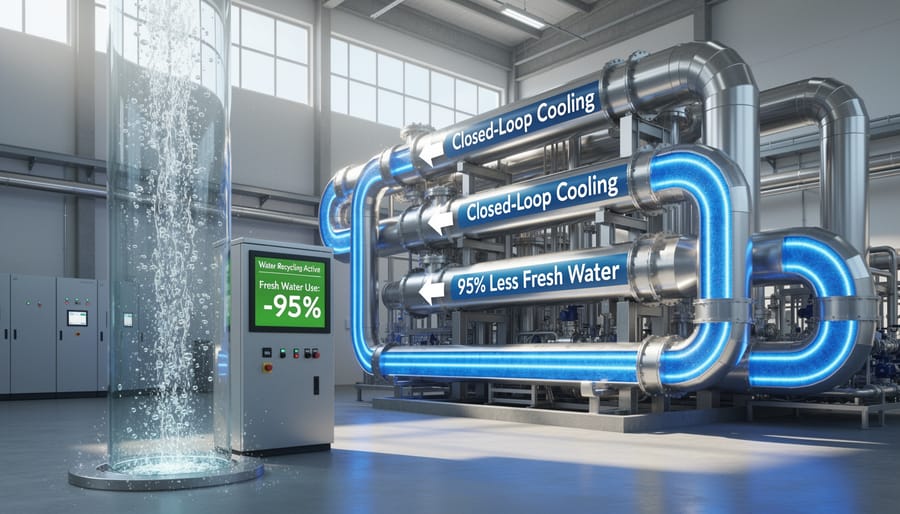
Imagine if your local data centre could operate like a thriving ecosystem, where water flows through cooling systems, gets cleaned, and circulates again rather than flowing straight to waste. That’s exactly what closed-loop water recycling systems achieve, and they’re transforming how Australian data centres manage one of our most precious resources.
These innovative systems work by capturing water used in cooling processes, treating it to remove contaminants and heat, then sending it back through the cooling infrastructure for another cycle. Instead of the traditional once-through approach that demands constant fresh water intake, closed-loop systems can reduce water consumption by up to 95 percent. For a medium-sized data centre in water-stressed regions like Perth or Adelaide, this could mean saving millions of litres annually.
The treatment process typically involves filtration to remove particles, chemical treatment to prevent scale buildup and corrosion, and cooling towers or heat exchangers to dissipate heat. Modern systems use advanced monitoring technology that tracks water quality in real-time, ensuring optimal performance while minimising chemical use and energy consumption.
Several Australian facilities have already embraced this approach with remarkable results. These closed-loop systems not only conserve water but also reduce operational costs over time, as treating and recycling existing water proves more economical than continuously purchasing and disposing of fresh supplies. The technology represents a win-win for both environmental stewardship and business sustainability, proving that responsible water management doesn’t require compromise.
Advanced Filtration and Chemical Treatment
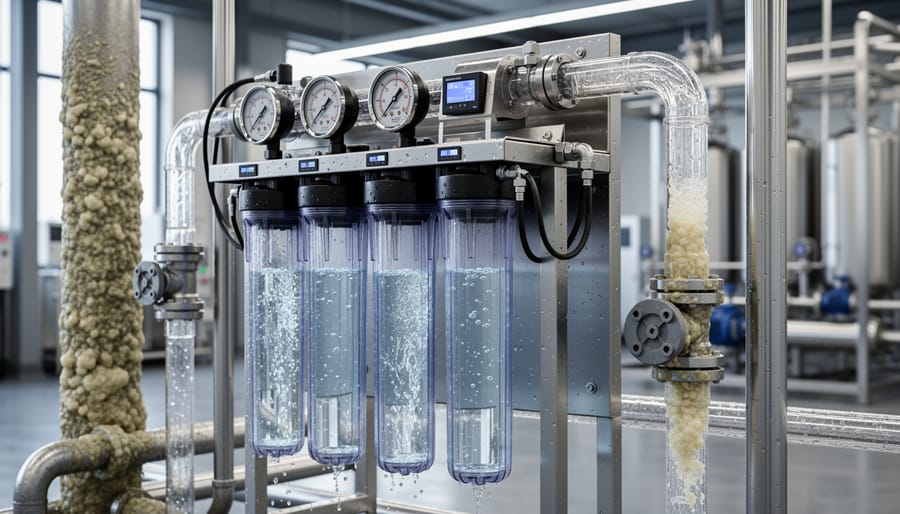
Modern data centres across Australia are turning to sophisticated water treatment systems that work smarter, not harder, to keep cooling systems running efficiently while protecting our precious water resources. Think of it as giving your cooling water a comprehensive health check, addressing problems before they start.
The challenge lies in managing three key threats: mineral scale buildup that reduces heat transfer efficiency, corrosion that damages expensive infrastructure, and biological growth like algae and bacteria that clog systems. Advanced filtration tackles these issues through multiple barriers. Cartridge filters and media filtration remove suspended solids, while newer technologies like ultrafiltration capture particles as small as 0.01 microns, dramatically reducing the need for chemical interventions.
Chemical treatment programs have evolved remarkably. Rather than relying on harsh traditional biocides, Australian facilities are increasingly adopting green chemistry alternatives. These include biodegradable scale inhibitors, non-phosphate corrosion inhibitors, and oxidizing biocides that break down quickly without harming downstream environments. Smart dosing systems using real-time sensors adjust chemical levels precisely, eliminating waste and reducing discharge impacts.
Leading facilities in Sydney and Melbourne are pioneering closed-loop systems where treatment chemicals are continuously recycled rather than discharged. This approach slashes both water consumption and chemical waste by up to 80 percent, proving that environmental responsibility and operational excellence go hand in hand.
The beauty of these advanced systems is their adaptability to Australia’s diverse water conditions, from Melbourne’s soft water to Perth’s mineral-rich supplies, creating tailored solutions that work with our unique environment rather than against it.
Greywater and Rainwater Harvesting
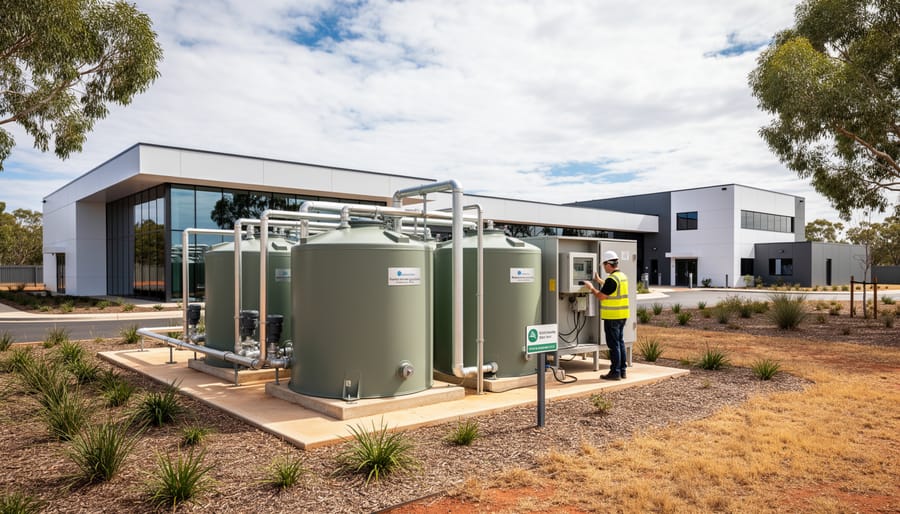
Australian data centres are increasingly turning to alternative water sources to reduce their environmental footprint and build resilience against drought conditions. This shift represents a significant opportunity for facilities to operate more sustainably while reducing strain on municipal water supplies.
Greywater systems are gaining traction across the country, with several Melbourne and Sydney facilities now treating wastewater from cooling towers and other processes for reuse. These systems typically involve filtration and basic treatment to remove contaminants before the water re-enters the cooling cycle. While greywater requires careful monitoring to prevent equipment corrosion and biological growth, the technology has matured considerably, making it a viable option for facilities of all sizes.
Rainwater harvesting presents another promising avenue, particularly in regions with adequate rainfall. Perth’s innovative data centres have demonstrated how rooftop collection systems can supply substantial volumes of water for cooling operations. The key is implementing proper pre-treatment, including sediment filtration and UV sterilization, to ensure water quality meets equipment specifications.
A growing number of Australian facilities are combining both approaches, creating hybrid systems that maximize water security. These installations often include storage tanks sized for several weeks of operation, providing crucial backup during dry periods. Community-minded operators are also sharing their learnings through industry forums, helping smaller facilities navigate the technical requirements and regulatory approvals needed to implement these systems successfully.
The initial investment typically pays for itself within three to five years through reduced water costs and increased operational independence.
Australian Data Centres Leading the Way
Case Study Snapshots
Across Australia, forward-thinking data centres are demonstrating that significant water savings are entirely achievable with the right approach. These success stories offer inspiration and practical insights for facilities considering similar improvements.
In Sydney’s western suburbs, a mid-sized colocation facility partnered with local water management specialists to overhaul their cooling tower treatment system. By implementing advanced filtration and real-time monitoring technology, they reduced water consumption by 42% within the first year. This translated to savings of approximately 15 million litres annually, enough to supply 50 average Australian households. The facility also cut chemical usage by 35%, reducing both costs and environmental impact while maintaining optimal cooling performance.
Melbourne has seen impressive results at a hyperscale data centre that integrated rainwater harvesting with treated recycled water systems. The facility now sources 60% of its operational water from non-potable sources, dramatically decreasing reliance on municipal supplies. Their closed-loop cooling system, combined with sophisticated water treatment protocols, achieved a Water Usage Effectiveness rating of 0.3, well below the industry average of 1.8. The project created local employment opportunities during installation and ongoing maintenance, strengthening community connections.
In regional Queensland, a smaller enterprise data centre serving agricultural clients implemented a greywater recycling programme that reduced their water bills by $45,000 annually. They’ve shared their learnings with neighbouring businesses, creating a ripple effect of water consciousness across the local business community.
These examples prove that regardless of size or location, Australian data centres can achieve meaningful water efficiency improvements. The combination of appropriate technology, committed management, and expert guidance makes water sustainability both environmentally responsible and economically sensible.
Lessons from Early Adopters
Australian data centres leading the charge in water-conscious operations are proving that sustainability and efficiency go hand in hand. Their experiences offer valuable insights for businesses considering similar transitions.
Melbourne’s NextDC facility demonstrated that closed-loop cooling systems can reduce water consumption by up to 85% compared to traditional once-through systems. Their maintenance team discovered that regular water quality monitoring actually prevented costly equipment failures, turning what seemed like an added expense into significant long-term savings. This real-world outcome shows how proactive water treatment protects both the environment and your bottom line.
Sydney-based operators found success by starting small. Rather than overhauling entire systems overnight, they implemented changes in phases, beginning with water recycling for non-critical cooling functions. This gradual approach allowed staff to develop expertise while building confidence in new technologies. The lesson here is clear: you don’t need to transform everything at once to make meaningful progress.
Community collaboration emerged as another crucial factor. Several Queensland facilities formed a regional working group to share learnings, troubleshoot challenges, and negotiate better rates with water treatment suppliers. This collective approach reduced costs and accelerated problem-solving for everyone involved.
Perhaps most importantly, early adopters emphasised transparency. By measuring and publicly reporting their water usage, these pioneers held themselves accountable while inspiring others to follow suit. Their willingness to share both successes and setbacks has created a supportive environment where Australian businesses can learn from each other’s experiences, making sustainable water treatment increasingly accessible across the industry.
What Businesses Can Do Right Now
Questions to Ask Your Data Centre Provider
When partnering with a data centre provider, you have every right to understand their water stewardship practices. Start by asking about their Water Usage Effectiveness (WUE) metrics – how many litres of water do they consume per kilowatt-hour of IT equipment energy? Leading Australian facilities are achieving WUE ratings below 1.0 L/kWh, setting a benchmark worth pursuing.
Dig deeper into their treatment processes. What systems do they use for recycling and treating water? Do they capture and reuse cooling tower blowdown? How often do they test water quality, and what’s their approach to managing chemical treatments safely?
Don’t hesitate to ask about their water source strategy. Are they using potable water, or have they invested in alternatives like recycled water or rainwater harvesting? Many forward-thinking Australian providers are working with local councils to access alternative water sources, reducing pressure on drinking water supplies.
Request transparency around their sustainability goals. What targets have they set for water reduction, and how are they tracking progress? Ask if they’re willing to share regular sustainability reports with clients – this demonstrates genuine commitment rather than greenwashing.
Finally, enquire about their engagement with the local community. Are they contributing to regional water security initiatives? The best providers understand they’re part of Australia’s broader sustainability journey, not operating in isolation.
Supporting Industry Change
As Australians, we have real power to reshape the digital landscape through our choices and voices. Every time we select cloud services, web hosting, or business software, we’re casting a vote for the infrastructure behind it. Start by asking your service providers about their data centre practices – questions about water usage, cooling systems, and sustainability commitments signal that customers care about these issues.
Businesses can include environmental criteria in their procurement processes, prioritising vendors who demonstrate water-efficient practices. The growing demand for transparency is already pushing major Australian data centre operators to publish sustainability reports and commit to water reduction targets. Companies like Equinix and NextDC have responded to customer expectations by implementing innovative cooling technologies and setting ambitious environmental goals.
Community action matters too. Local councils and business groups across Australia are forming sustainability networks that share knowledge about responsible digital infrastructure. By supporting businesses that prioritise environmental responsibility and joining conversations about sustainable technology, we create momentum for industry-wide change.
Consider switching to web hosting providers who operate from water-efficient data centres, or advocating within your organisation for greener IT infrastructure choices. These individual actions, multiplied across thousands of Australian businesses and consumers, send a powerful message that sustainable data management isn’t optional – it’s essential. Together, we’re building a digital future that respects our precious water resources while meeting our technological needs.
Every time we stream a video, send an email, or scroll through social media, we’re connected to vast data centres that quietly consume enormous amounts of water and energy. Understanding this relationship between our digital habits and environmental impact is the first step toward meaningful change. The good news is that Australia stands at an exciting crossroads, with innovative communities, forward-thinking businesses, and dedicated individuals already pioneering sustainable data infrastructure solutions.
From Melbourne to Perth, Australian data centres are beginning to embrace water-efficient cooling systems, greywater recycling, and renewable energy integration. These aren’t just corporate initiatives happening behind closed doors. They’re community-driven movements that reflect our shared values and commitment to preserving Australia’s precious water resources for future generations.
The transformation begins with awareness. When we recognize that our digital consumption has real environmental consequences, we can make informed choices about the services we use and the companies we support. Businesses can prioritize partnerships with data centres committed to sustainable water treatment practices. Individuals can advocate for greater transparency and environmental accountability from tech companies operating on Australian soil.
Australia has everything needed to become a global leader in sustainable data infrastructure: abundant renewable energy potential, world-class innovation, and a community that genuinely cares about environmental stewardship. By demanding better practices, supporting sustainable initiatives, and staying informed about water treatment technologies, we’re not just protecting our environment. We’re building a digital future that respects and nurtures the natural world that sustains us all.