
Smart charging transforms your electric vehicle from a simple transport choice into a money-saving asset that supports Australia’s renewable energy grid. While standard charging simply refills your EV battery whenever you plug in, smart charging systems automatically schedule power draw during off-peak hours when electricity costs as little as 8 cents per kilowatt-hour—potentially cutting your charging costs by 70% compared to peak rates.
For Australian EV owners, this technology pays for itself remarkably quickly. A typical household charging 12,000 kilometres annually can save between $400 and $800 yearly through optimised charging times alone. Add government rebates—currently available in most states for installing smart charging equipment—and your upfront investment shrinks to as little as $200 for professional hardware installation.
The financial case strengthens further when you consider vehicle-to-grid capabilities emerging across Australia. These systems let your EV battery sell stored energy back to the grid during peak demand periods, creating an additional revenue stream that some early adopters report reaches $600 annually.
Smart charging also future-proofs your investment. As Australia accelerates toward 82% renewable energy by 2030, grid operators increasingly reward households that charge flexibly, timing demand to match solar and wind generation. This community-minded approach reduces strain on aging infrastructure while maximising use of clean energy—turning your daily commute into active participation in Australia’s energy transition.
The question isn’t whether smart charging saves money, but rather how quickly you’ll start benefiting from it.
What Makes Charging ‘Smart’ (And Why It Matters)
Think of standard EV charging like plugging in your phone whenever the battery runs low—it simply transfers electricity at a constant rate until full. Smart charging, however, is more like having a personal energy manager that monitors electricity prices, grid demand, and your driving schedule to optimise when and how your vehicle charges.
The difference lies in connectivity and intelligence. Smart charging systems connect to your electricity network and respond to real-time signals. In practical terms, if you plug in your EV at 6pm in Melbourne, a standard charger begins drawing power immediately—right when households across the suburb are cooking dinner and grid demand peaks. A smart charger, however, might delay charging until 11pm when electricity is cheaper and greener, ensuring your car is still fully charged for your morning commute.
This intelligent approach delivers three significant benefits that matter to Australian EV owners.
First, the cost savings are tangible. Australians on time-of-use tariffs can save hundreds of dollars annually by charging during off-peak periods. A Sydney household might pay 15 cents per kilowatt-hour overnight compared to 45 cents during peak times—that’s a 200% difference directly impacting your running costs.
Second, smart charging prioritises maintaining battery health by managing charging speeds and temperatures. Rather than constantly fast-charging to 100%, smart systems can target optimal charge levels (typically 80%) and use gentler charging rates when time permits, potentially extending your battery’s lifespan by years.
Third, you’re actively supporting Australia’s renewable energy transition. When your smart charger draws power during periods of high solar or wind generation, you’re helping balance the grid and reducing reliance on coal-fired power stations. Some Australian energy retailers even offer financial incentives for EV owners who allow their smart chargers to participate in demand response programs—getting paid to charge smartly while strengthening our energy network for everyone.
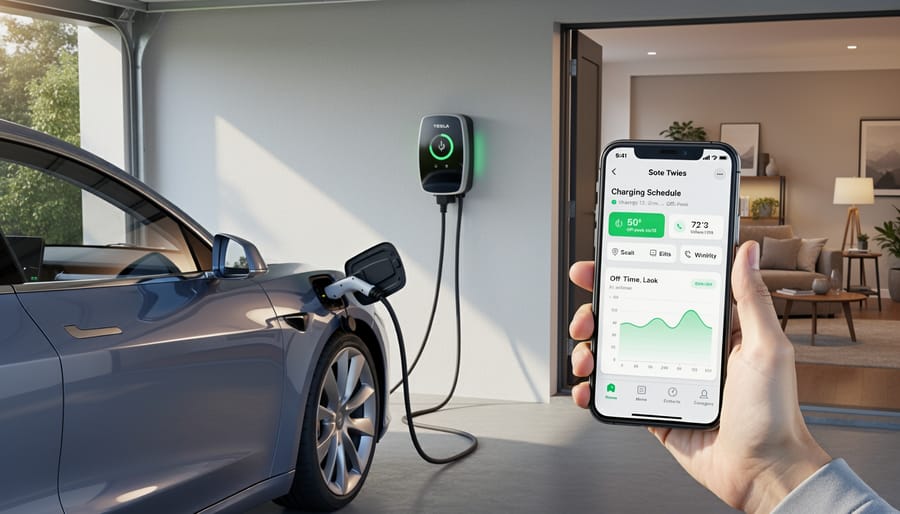
The Real Costs: Smart vs. Standard Charging in Australia
Time-of-Use Tariffs: Your Secret Weapon
Here’s the good news: while you’re sleeping, your EV could be charging at a fraction of the daytime cost. Smart charging systems work hand-in-hand with time-of-use tariffs to automatically schedule your charging during off-peak periods when electricity is cheapest.
Think of it as the difference between shopping during a sale versus paying full price. Australian energy retailers like AGL, Origin Energy, and Energy Australia offer time-of-use plans where off-peak rates (typically 10pm to 7am) can be 40-60% cheaper than peak periods. For example, AGL’s EV Night Saver plan offers rates as low as 8 cents per kWh during overnight hours, compared to 25-30 cents during peak times.
Let’s put that into perspective: charging a Tesla Model 3 with a 60kWh battery during peak hours might cost around $18, while smart charging during off-peak periods could reduce that to just $4.80. That’s over $13 saved per full charge, adding up to hundreds or even thousands of dollars annually for regular drivers.
Your smart charger handles this automatically. Simply plug in when you arrive home, set your departure time, and the system does the rest. It waits for off-peak rates to kick in, ensures your car is fully charged by morning, and even adjusts for varying electricity prices throughout the night. No manual scheduling, no midnight alarms, just consistent savings while you sleep.
Solar Integration: Charge for Free
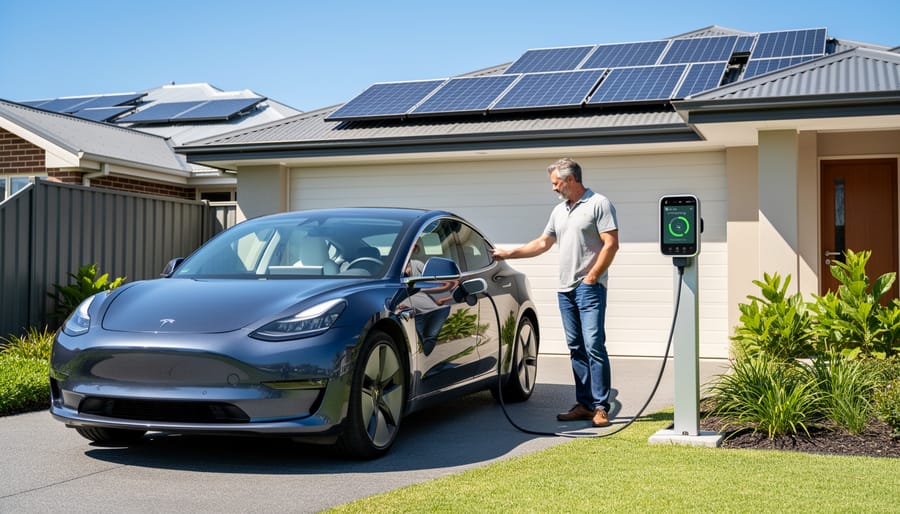
If you’ve already invested in rooftop solar, your smart charger becomes a game-changer. Modern smart charging systems can detect when your panels are generating surplus energy and automatically direct it to your EV, dramatically reducing—or even eliminating—your charging costs.
Here’s how the numbers stack up for Australian households: a typical solar system generates around 5-8 kWh of excess energy on sunny days. That surplus can add 30-50 kilometres of driving range daily, absolutely free. Over a year, a household in Queensland or Western Australia could realistically charge their EV for 70-80% of their driving needs using only solar-powered EV charging.
Let’s break down a real example. Say you’re driving 40 kilometres daily and your EV uses 15 kWh per 100km. That’s 6 kWh needed daily. With smart charging prioritizing your solar surplus during peak generation hours (typically 10am-3pm), you could save around $600-800 annually compared to grid charging. Communities across Australia are already achieving near-zero charging costs by combining generous solar feed-in arrangements with intelligent charging schedules—making clean transport genuinely affordable.
Smart Charging Technology: What You Need to Know
Level 1 vs. Level 2 Smart Chargers
Understanding the difference between Level 1 and Level 2 charging is essential for making the right choice for your household. Level 1 chargers use a standard 240V power outlet and deliver around 2.4kW, adding roughly 10-15 kilometres of range per hour. They’re perfect for Australians with shorter daily commutes, like driving to local shops or the nearby office, and work brilliantly when your EV sits parked overnight.
Level 2 smart chargers pack significantly more punch, operating at 7-22kW and adding 30-70 kilometres per hour depending on your model. For families managing school runs, weekend trips to regional areas, or multiple vehicles, this speed difference becomes genuinely important. A Sydney family we spoke with switched from Level 1 to Level 2 when their daily driving increased with hybrid work arrangements, finding they could fully charge overnight even after unexpected longer journeys.
Most Australian households with typical driving patterns under 50km daily will find Level 1 adequate initially. However, if you’re regularly travelling beyond your suburb or planning future EV additions, investing in Level 2 smart charging now provides flexibility and captures available state rebates while they’re on offer.
Wi-Fi, Apps, and Control Features
When choosing a smart charger, you’ll encounter countless app features—but which ones truly deliver value for Australian EV owners?
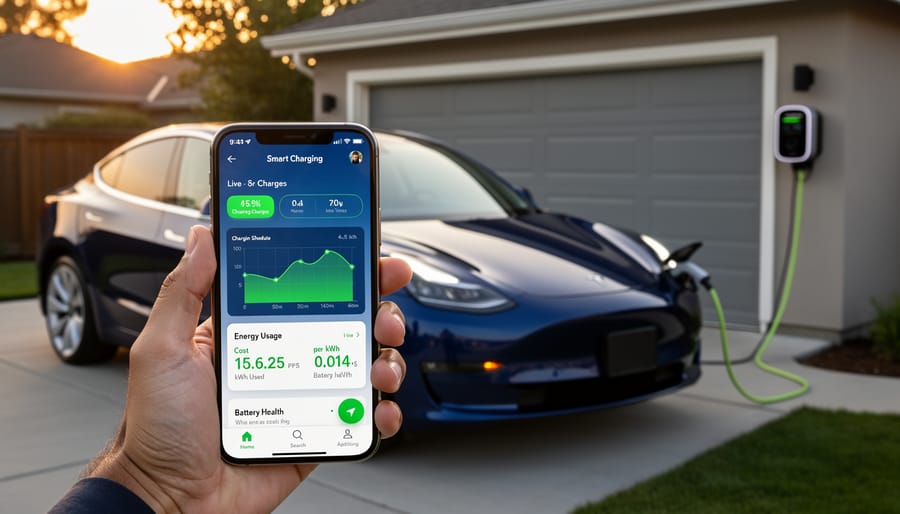
The essentials that genuinely matter include flexible scheduling capabilities that let you charge during off-peak periods when electricity is cheapest, often between 10pm and 7am across most Australian networks. Real-time energy monitoring shows exactly what you’re spending, helping you track savings and optimize your charging patterns over time. Remote start and stop functions mean you can respond quickly if your energy provider offers dynamic pricing or if solar production suddenly increases.
Look for chargers offering integration with home energy management systems and solar inverters—particularly valuable for Australians with rooftop panels who want to maximize self-consumption. Load balancing prevents circuit overload when multiple household appliances run simultaneously, a practical feature that protects your home’s electrical system.
What you can skip: gamification features, social sharing functions, and excessive data analytics that simply repackage basic information. Some manufacturers tout AI-powered optimization, but unless it connects with your specific energy provider’s tariff structure, it’s mostly marketing polish.
The best apps combine simplicity with genuine control, giving you actionable insights without overwhelming you with unnecessary complexity. Before purchasing, check user reviews specifically from Australian owners—they’ll reveal whether promised features actually work in our market conditions.
Vehicle-to-Grid (V2G): The Future is Here
Imagine your EV not just drawing power from the grid, but giving back during peak demand—earning you credits while supporting a cleaner energy system. That’s Vehicle-to-Grid (V2G) technology, and it’s already being trialed across Australia. Companies like AGL are running pioneering programs where participating EV owners can discharge stored battery power back to the grid when electricity prices spike, typically during hot summer afternoons when air conditioners strain the network.
For early adopters, V2G represents an exciting revenue opportunity. While mainstream rollout is still developing, current trials suggest households could earn several hundred dollars annually by supporting grid stability. You’ll need compatible hardware and a bidirectional charger, but as more EV models gain V2G capability and regulations evolve, this technology promises to transform your vehicle into a mobile energy asset. It’s community-powered sustainability at its finest—your morning commute becomes an investment in Australia’s renewable energy future.
Australian Government Incentives and Rebates for Home Charging
State-by-State Rebate Guide
Australia’s commitment to electric vehicle adoption shines through the range of smart charging incentives available across states and territories. Understanding what’s on offer in your area can significantly reduce your upfront investment and ongoing costs.
In New South Wales, the EV Fast Charging Grant provides rebates for eligible smart charging infrastructure, with programs regularly updated through the NSW Government’s Office of Energy and Climate Change. At a local level, this support is complemented by essential services such as car battery Liverpool retailers and installers, helping drivers maintain both conventional and electric vehicles as the transition progresses. Victorian residents benefit from the Zero Emissions Vehicle subsidy scheme, which includes provisions for home charging equipment when purchased alongside an eligible EV. Visit Solar Victoria’s website for current offerings.
Queensland drivers can explore the Zero Emission Vehicle Rebate Scheme, which occasionally extends to associated charging infrastructure. The Queensland Government’s energy website provides the latest details on eligibility criteria and application processes.
South Australia’s Home Battery Scheme has previously included smart charging components, and residents should check the SA Government’s energy website for current programs. Western Australia offers support through Synergy’s SmartCharge program, providing time-of-use tariffs that reward smart charging behavior, making the technology more financially attractive.
Tasmania’s approach focuses on network benefits, with TasNetworks providing guidance on optimal charging solutions. ACT residents have historically accessed substantial EV incentives and rebates, including support for charging infrastructure through the ACT Government’s zero-emissions vehicle strategy.
The Northern Territory government continues developing its EV support framework, with updates available through the Territory’s Department of Infrastructure, Planning and Logistics.
Remember, these programs evolve regularly as governments respond to uptake and community needs. Bookmark your state’s official energy department website and consider joining local EV community groups on social media where members share real-time updates about new incentives. Many electricity retailers also offer additional rebates or favorable tariffs for smart charging customers, so it’s worth comparing providers in your area to maximize your savings.
Stacking Incentives: Maximize Your Savings
The real magic happens when you stack multiple incentives together—turning smart charging from a good investment into an exceptional one. Think of it like building a financial layer cake, where each program adds another sweet saving to your bottom line.
Start with the federal government’s electric vehicle incentives, which can reduce your upfront costs significantly. Then layer on state-based programs. In New South Wales, for instance, the EV charging infrastructure rebate offers up to $3,000 for home charging installations. Victoria provides similar support through its Zero Emissions Vehicle subsidy scheme. South Australia and Queensland have their own programs too, so check what’s available in your area.
Don’t stop there—your local council might offer additional rebates or reduced permit fees for installing EV charging equipment. Many councils are actively encouraging the transition to electric transport as part of their climate action plans, and they’re putting money behind that commitment.
Energy retailers are competing for your business with time-of-use tariffs specifically designed for EV owners. Some offer dedicated EV charging rates as low as 8 cents per kilowatt-hour during off-peak periods. Others provide bill credits when you charge during solar-heavy afternoon windows, helping to stabilize the grid while padding your savings.
The Melbourne-based community of Brunswick recently demonstrated this stacking approach brilliantly, with residents combining state rebates, council incentives, and retailer programs to reduce their smart charging installation costs by over 60 percent. Your combination will depend on your location, but the potential is substantial—often saving thousands of dollars while future-proofing your charging setup. Take an afternoon to research what’s available in your postcode; the return on that time investment is remarkable.
Choosing the Right Smart Charger for Your Home
Key Features Worth Paying For
When you’re investing in a smart charger, certain features deliver genuine value for Australian EV owners while others are just marketing fluff. Here’s what’s actually worth your money.
Load management stands out as the most financially beneficial feature, especially if you’re planning to add solar panels or already have them installed. This intelligent technology monitors your home’s energy consumption and adjusts charging speeds to prevent overloading your electrical system. For households across Melbourne, Sydney, and Brisbane dealing with rising electricity costs, this feature can save hundreds annually by preventing demand charges and maximizing off-peak rates.
Solar integration transforms your smart charger from a simple plug-in device into an eco-friendly powerhouse. When your rooftop panels are generating excess energy during the day, compatible chargers automatically divert that sunshine straight into your EV’s battery. Many Australian households are already experiencing this satisfaction of driving on genuinely renewable energy, reducing both their carbon footprint and electricity bills simultaneously.
Don’t overlook weatherproofing specifications designed for our harsh climate. Australian summers deliver intense UV radiation and scorching temperatures that can degrade cheaper units within months. Look for IP ratings of IP65 or higher, which ensure your investment withstands everything from tropical downpours in Queensland to dusty conditions in regional areas.
Finally, verify compatibility with Australian EV models before purchasing. While most smart chargers work with common vehicles like the Tesla Model 3, Hyundai Ioniq 5, and MG ZS EV, some budget options have limited functionality. A comprehensive warranty of at least three years provides peace of mind that manufacturers stand behind their product quality.
Installation Considerations and Costs
Installing a smart charger is more straightforward than many Australian households expect, though understanding the costs upfront helps you plan effectively. The good news? Most installations are completed within a few hours, getting you on the road to smarter charging quickly.
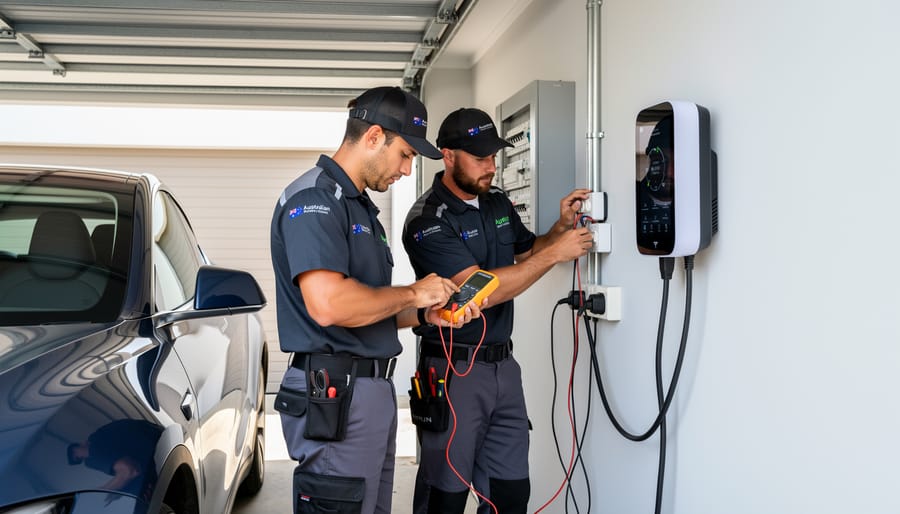
Your first step is connecting with a qualified electrician who holds the appropriate licence for EV charger installation. The Clean Energy Council maintains a directory of accredited installers across Australia, making it easier to find professionals familiar with smart charging systems in your local area. When you reach out, they’ll assess your home’s electrical panel capacity, which is crucial for determining your charging options.
Here’s what typically influences your investment: basic smart charger installations in Australian homes generally range from $1,500 to $3,000, including both the unit and labour. However, if your electrical panel requires upgrading to handle the additional load, costs may increase by $1,000 to $2,500. Think of it as future-proofing your home’s energy infrastructure while you’re already making sustainable changes.
Many Australian communities have formed local EV owner groups who share recommendations for reliable installers and negotiate group rates, demonstrating how collective action makes sustainable choices more accessible. Additionally, several state-based rebates can offset installation expenses significantly. Queensland’s zero-interest loans and Victoria’s solar homes program, for instance, help thousands of households overcome upfront cost barriers.
Remember, certified installers can also advise on positioning your charger to maximise solar integration and ensure compliance with local regulations, protecting both your investment and your home.
Making Smart Charging Work with Your Energy Plan
Your electricity plan can make or break the financial benefits of smart charging. The good news? Australian energy retailers are catching on, and several now offer EV-specific tariffs designed to reward you for charging at the right times.
Time-of-use tariffs are your best friend when it comes to smart charging. These plans divide your day into peak, shoulder, and off-peak periods, with dramatically different rates for each. In many Australian states, off-peak electricity can cost as little as 8-15 cents per kilowatt-hour compared to 40-50 cents during peak times. When your smart charger automatically shifts your charging to those cheap overnight hours, you’re essentially fueling your vehicle for the cost of a cup of coffee per 100 kilometers.
Several retailers have stepped up with EV-friendly offerings. Origin Energy’s EV Plan includes discounted off-peak rates specifically for overnight charging, while AGL’s EV Night Saver plan offers some of the lowest rates between 12am and 6am. Energy Australia has also entered the space with dedicated EV tariffs in select states. These plans typically require a smart meter, which most modern Australian homes now have or can easily install.
The real winners, though, might be those tapping into community energy initiatives. Programs like Localvolts connect EV owners directly with local renewable generators, offering wholesale pricing that can be significantly cheaper than traditional retail rates. Meanwhile, virtual power plant schemes in South Australia and Victoria are beginning to incorporate EVs, allowing participants to sell energy back to the grid during peak periods.
Before switching plans, grab three months of your electricity bills and compare your usage patterns against available tariffs. Use online comparison tools specific to your state, as regulations and offerings vary across Australia. Don’t be shy about calling retailers directly either – the EV market is competitive, and many will negotiate better rates to win your business. Some communities are even forming buying groups to negotiate collective discounts, turning individual purchasing power into community strength.
The Environmental Impact: Beyond Personal Savings
When you choose smart charging for your electric vehicle, you’re doing more than reducing your electricity bill—you’re joining thousands of Australians in strengthening our nation’s energy future. The collective impact of smart charging extends far beyond individual savings, playing a crucial role in Australia’s transition to cleaner energy.
Consider what happens during peak demand periods, typically between 6pm and 9pm when families arrive home, cook dinner, and turn on appliances. If thousands of EVs simultaneously plug in for fast charging during these hours, it places enormous strain on the electricity grid. Smart charging elegantly solves this challenge by spreading vehicle charging across off-peak hours, preventing grid overload and reducing the need for expensive infrastructure upgrades that ultimately cost all electricity users.
More importantly, smart charging unlocks the true potential of renewable energy. Australia boasts some of the world’s best solar resources, yet solar panels generate power during daylight hours when many EVs sit idle in driveways. By scheduling your charging for sunny afternoons or storing excess renewable energy for overnight use, smart charging systems help capture clean energy that might otherwise go to waste. This capability is transforming EVs from simple transport solutions into mobile energy storage units that support grid stability.
The numbers tell a compelling story. The Australian Energy Market Operator estimates that coordinated smart charging could reduce national grid emissions by up to 30% compared to unmanaged EV charging by 2030. That’s equivalent to removing hundreds of thousands of petrol vehicles from our roads. Communities across Melbourne, Sydney, and Brisbane are already demonstrating this potential through neighbourhood charging programs that prioritise renewable energy sources.
Your individual choice to adopt smart charging contributes directly to Australia’s emissions reduction targets while inspiring others in your community to follow suit. Together, we’re building a cleaner, more resilient energy system for future generations.
Real Stories: Australian EV Owners Share Their Smart Charging Experience
Sarah from Melbourne made the switch to smart charging six months ago and hasn’t looked back. “I was sceptical about the actual savings,” she admits, “but my energy bills dropped by about $45 monthly once I programmed my charger to run during off-peak hours between 11pm and 7am. It’s completely automated now—I just plug in when I get home and forget about it.”
For James, a Sydney-based delivery driver, the challenge was different. “I needed to ensure my van was always ready by 6am,” he explains. His smart charging system solved this by calculating exactly when to start charging based on his battery level and electricity rates. “It charges during the cheapest periods but always finishes by my departure time. I’m saving around $800 yearly while reducing my carbon footprint.”
Meanwhile, Karen in Perth discovered an unexpected benefit beyond cost savings. “When the Western Power outage hit our suburb last summer, my smart charger’s app alerted me immediately and adjusted my charging schedule,” she shares. “I never realised how much peace of mind I’d get from being able to monitor everything remotely.”
The Thompson family in Brisbane took advantage of Queensland’s solar feed-in tariffs by installing smart charging alongside their solar panels. “We’re essentially charging our two EVs for free during sunny days,” says David Thompson. “The system prioritises solar power first, then switches to off-peak grid power if needed. Our community EV group helped us understand the setup, and now we’re helping other families do the same.”
These stories reflect a growing community of Australian EV owners who’ve transformed their charging from a simple necessity into an opportunity for meaningful savings and environmental impact.
The good news? Smart charging isn’t a futuristic promise—it’s a proven technology that thousands of Australian households and businesses are already using to slash their energy bills and reduce their carbon footprint. Right now, you have an opportunity to join them and take advantage of government rebates that make this technology more affordable than ever.
Your first step is straightforward: check your eligibility for state-based incentives. Whether you’re in New South Wales, Victoria, Queensland, or another state, chances are there’s a rebate program waiting to reduce your upfront costs. Many Australians are surprised to discover they qualify for support they didn’t know existed.
Next, grab a recent electricity bill and run the numbers. Calculate what you’re currently paying for vehicle charging versus what you could pay with time-of-use tariffs and smart scheduling. The savings often speak for themselves—many EV owners report reducing their charging costs by 50 percent or more.
The transition to smart charging doesn’t require technical expertise or a complete home overhaul. Starting with a simple smart charger can deliver immediate benefits, with the option to expand into solar integration or battery storage as your needs evolve.
Australia’s EV community is growing rapidly, and those who act now are positioning themselves to benefit from both current incentives and long-term savings. The technology is accessible, the support systems are in place, and the financial case is compelling. Why wait? Your smarter, more sustainable charging journey can begin today.