
Your investment dollars hold more power than you might realize—they can either fund industries harming our planet or support businesses building a sustainable future. Ethical investing, also known as sustainable or responsible investing, means directing your money toward companies and funds that align with your values, particularly environmental protection, social responsibility, and good governance.
For Australians increasingly concerned about climate change, the Great Barrier Reef’s decline, and bushfire risks, ethical investing offers a practical way to make your finances part of the solution. Rather than simply avoiding “bad” companies, modern ethical investing options actively seek out businesses pioneering renewable energy, sustainable agriculture, and circular economy innovations.
The approach goes beyond feel-good intentions. Research consistently shows ethical investments can match or outperform traditional portfolios while reducing exposure to industries facing regulatory crackdowns and shifting consumer sentiment. When you invest ethically, you’re backing companies better positioned for long-term success in a world demanding sustainable practices.
This isn’t about sacrificing returns for principles—it’s about recognizing that environmental and social factors increasingly drive financial performance. Whether you’re starting your investment journey or reshaping an existing portfolio, understanding ethical investing opens doors to aligning your financial goals with the Australia you want to see: cleaner, greener, and more equitable. The choice isn’t between profit and planet anymore; it’s about investing in businesses that understand both are inseparable.

What Ethical Investing Actually Means
The Core Principles Behind Ethical Investment
At its heart, ethical investing operates on three foundational principles that help Australians align their money with their values. Think of these as different lenses through which you can view potential investments.
Negative screening is perhaps the most straightforward approach. This involves actively avoiding companies or industries that conflict with your values. Many Australian investors choose to exclude tobacco manufacturers, fossil fuel companies, gambling operations, or weapons producers from their portfolios. For instance, you might decide your super fund shouldn’t invest in coal mining operations that contribute to the climate challenges already impacting our communities, from bleaching the Great Barrier Reef to intensifying bushfire seasons.
Positive screening flips this approach on its head. Instead of focusing on what to avoid, you’re actively seeking out companies making a genuine difference. This might mean investing in Australian businesses pioneering solar technology, like those involved in building large-scale solar farms across Queensland and New South Wales. Or perhaps supporting companies with exceptional workplace diversity policies, strong Indigenous employment programs, or innovative water conservation practices suited to our dry continent.
Impact investing takes this commitment even further. Here, you’re not just avoiding harm or choosing better companies – you’re deliberately targeting investments designed to generate measurable environmental or social benefits alongside financial returns. Australian examples include community renewable energy cooperatives, affordable housing projects, or regenerative agriculture initiatives helping farmers restore degraded land while maintaining productivity.
These principles aren’t mutually exclusive. Many Australians combine all three approaches, creating a comprehensive ethical investment strategy that truly reflects their vision for a sustainable future. The beauty lies in choosing what resonates most deeply with your personal values and the Australia you want to help create.
Ethical Investing vs. ESG vs. Socially Responsible Investing
If you’re exploring investment options that align with your values, you’ve probably encountered several terms that seem interchangeable but have subtle differences. Let’s clear up the confusion.
Ethical investing is the broadest umbrella term. It refers to any investment approach where you consider moral, ethical, or personal values alongside financial returns. This might mean avoiding companies that harm animals, supporting renewable energy, or choosing businesses with fair labour practices. What’s considered “ethical” varies from person to person based on individual beliefs.
ESG investing takes a more structured approach. It evaluates companies based on three specific pillars: Environmental impact (like carbon emissions and waste management), Social responsibility (including worker safety and community relations), and Governance (such as board diversity and executive compensation). ESG uses measurable data and standardised ratings, making it more objective and increasingly mainstream among Australian superannuation funds.
Socially Responsible Investing (SRI) sits somewhere between the two. It typically combines values-based screening (excluding industries like tobacco or weapons) with positive selection (favouring companies doing social good). Many Australian investors use SRI to support businesses contributing to local communities.
Here’s what matters for you: these approaches often overlap significantly. An investment might tick all three boxes. When researching options, focus less on the exact terminology and more on understanding what criteria matter most to you. Does the fund exclude fossil fuels? Does it actively support renewable energy projects? These practical questions will guide you better than getting caught up in definitions. The key is finding investments that genuinely reflect your values whilst building your financial future.
Why Australian Investors Are Making the Switch
The Environmental Imperative
For Australians living on the frontlines of climate change, ethical investing isn’t just about financial returns—it’s about protecting the landscapes and ecosystems we call home. Every summer, we watch bushfires intensify. We witness the ongoing bleaching of the Great Barrier Reef. These aren’t distant threats; they’re happening in our backyards, and where we invest our money can either accelerate or slow these changes.
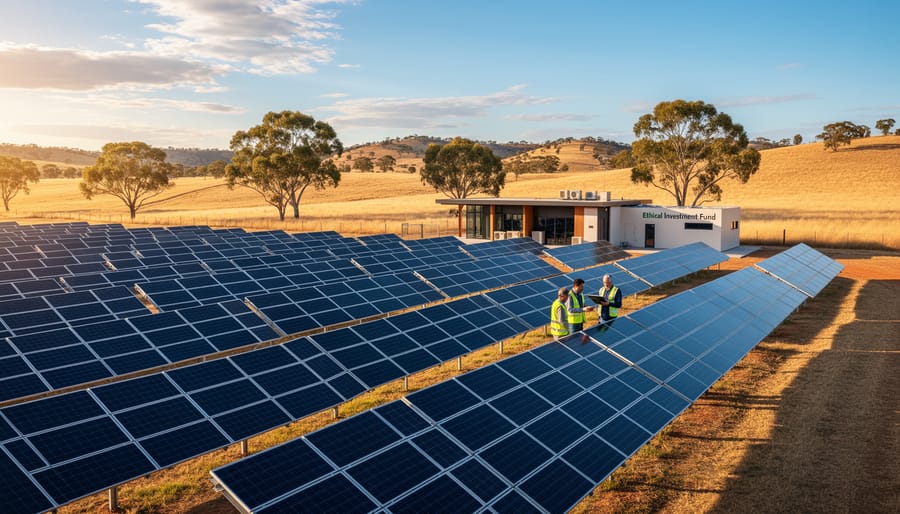
When you choose ethical investments, you’re actively directing capital toward solutions. Your superannuation and investment portfolio can fund solar farms across regional Queensland, wind energy projects in South Australia, or companies developing breakthrough carbon capture technology. At the same time, you’re withdrawing financial support from industries that contribute to environmental degradation.
Without realizing it, many traditional investment portfolios include shares in fossil fuel companies, intensive agricultural operations, or businesses with poor environmental track records. Understanding how your portfolio funds environmental harm is the first step toward making change.
The environmental imperative of ethical investing goes beyond personal values—it’s about collective action. When Australian investors increasingly choose funds that prioritize renewable energy and environmental protection, we send powerful market signals. We demonstrate that there’s robust demand for clean energy infrastructure and sustainable business practices. This shift doesn’t just protect our natural heritage; it positions Australia as a leader in the global transition to a low-carbon economy, creating jobs and opportunities for future generations while safeguarding the environments we cherish.
Financial Performance That Surprises Skeptics
Here’s a story that might surprise you: Australian ethical investment funds have consistently held their own against traditional portfolios, and often come out ahead. The myth that doing good means earning less simply doesn’t reflect reality in today’s market.
Recent data from the Responsible Investment Association Australasia shows ethical funds have delivered competitive returns across multiple asset classes over the past decade. In fact, many sustainable portfolios have outperformed their conventional counterparts during market volatility, proving remarkably resilient during economic downturns.
Why does this happen? Companies with strong environmental, social, and governance practices tend to be better managed overall. They’re thinking long-term, avoiding the risks that come with poor environmental practices, workplace issues, or governance scandals. When you invest in businesses genuinely committed to sustainability, you’re often backing companies with forward-thinking leadership and robust risk management.
Australian super funds have noticed this trend too. Major funds including Australian Ethical and Future Super have demonstrated that aligning investments with values doesn’t require sacrificing returns. These funds invest in renewable energy companies, sustainable agriculture, and businesses driving the circular economy, sectors experiencing tremendous growth as Australia transitions toward a more sustainable future.
The evidence is clear: ethical investing isn’t about choosing between your conscience and your financial goals. It’s about recognizing that companies building a sustainable future are often the ones building sustainable wealth. In today’s market, doing the right thing increasingly means doing well financially.
Key Strategies for Ethical Investment in Australia
Negative Screening: What to Avoid
Negative screening offers a straightforward way to align your investments with your values by actively avoiding companies that harm people or the planet. Think of it as setting boundaries for where your money can and cannot go.
Common exclusions include fossil fuel companies contributing to climate change, tobacco manufacturers, weapons producers, gambling operations, and businesses involved in human rights violations or animal cruelty. Many Australian ethical funds also screen out companies engaged in live animal exports, old-growth forest logging, and those with poor labour practices in their supply chains.
Here in Australia, we’re fortunate to have excellent resources for negative screening. The Responsible Investment Association Australasia (RIAA) maintains a comprehensive database of certified ethical investment options that have undergone rigorous screening processes. Their certification mark helps everyday Australians identify funds that genuinely exclude harmful industries rather than simply greenwashing their offerings.
Market Forces, an Australian organisation, provides valuable research on which banks and super funds invest in fossil fuels, making it easier to vote with your wallet. Similarly, the Australian Conservation Foundation’s Super Switch campaign offers practical guidance for moving your superannuation away from investments in coal, oil, and gas.
Most ethical investment platforms now provide detailed exclusion lists, so you can see exactly what’s being screened out. Some Australian ethical funds go beyond the basics, excluding everything from uranium mining to companies with excessive executive pay ratios. The key is finding a screening approach that resonates with your personal values while still building a diversified portfolio that serves your financial future.
Positive Screening: What to Support
Positive screening flips traditional investing on its head by actively seeking out companies doing genuine good. Rather than simply avoiding harmful industries, you’re putting your money behind businesses creating positive change – and Australia has some brilliant examples to champion.
Start by looking for companies with strong environmental credentials. This means businesses genuinely committed to reducing emissions, protecting biodiversity, and implementing circular economy practices where waste becomes a resource. Australian renewable energy companies like those developing solar and wind farms across our sun-drenched continent are prime candidates. Our local battery storage innovators are also making waves, helping solve the intermittency challenge that comes with renewable power.
Consider businesses championing sustainable agriculture – regenerative farming practices that rebuild soil health while producing food. Australia’s clean tech sector is thriving too, with companies developing water-saving technologies particularly relevant for our drought-prone climate.
Social impact matters equally. Look for companies with strong Indigenous employment programs, fair supply chains, and genuine commitments to diversity. B Corporations (B Corps) provide a helpful framework – these certified businesses meet rigorous social and environmental standards while maintaining profitability.
The approach mirrors choosing green providers in your daily life, but scaled to your investment portfolio. Australian green bonds offer another avenue, funding specific environmental projects from renewable energy to sustainable transport infrastructure.
Remember, positive screening isn’t just feel-good investing – many of these forward-thinking companies are positioning themselves brilliantly for our changing world. You’re backing tomorrow’s leaders while supporting the transition to a sustainable economy today.
Impact Investing for Direct Change
Impact investing takes ethical investing a step further by deliberately targeting investments that create measurable positive change. Rather than simply avoiding harmful industries, impact investors actively seek opportunities that generate environmental or social benefits alongside financial returns. Think of it as putting your money to work building the world you want to see.
In Australia, this approach is gaining momentum across diverse sectors. Community solar projects are excellent examples, where investors fund renewable energy installations that reduce local carbon emissions while providing returns through energy sales. These projects often prioritize lower-income communities, addressing both climate action and energy affordability simultaneously. Regional initiatives like community-owned solar farms in Queensland and Victoria demonstrate how everyday Australians can invest in clean energy infrastructure that directly benefits their neighbors.
Regenerative agriculture ventures represent another powerful impact investing avenue particularly relevant to our continent. These investments support farms transitioning from conventional practices to methods that restore soil health, increase biodiversity, and sequester carbon. Some Australian funds are specifically backing pastoralists implementing regenerative grazing techniques that improve land resilience whilst maintaining profitability. The beauty of these investments is their dual benefit: you’re helping heal degraded landscapes while supporting viable farming businesses.
Impact investments typically include clear metrics tracking their social or environmental outcomes, whether that’s tonnes of carbon offset, hectares restored, or households powered by renewable energy. This transparency allows investors to see exactly how their capital creates change, transforming abstract good intentions into concrete, measurable results that strengthen both communities and ecosystems.
Shareholder Activism and Engagement
Ethical investors aren’t just putting their money where their values are—they’re using their ownership stake to drive real change. When you own shares in a company, you gain voting rights on key decisions and the opportunity to engage directly with management about environmental and social practices.
This approach, called shareholder activism, has proven particularly effective in Australia. In 2021, shareholders at Santos, one of Australia’s largest gas producers, supported a climate resolution requiring the company to set emissions reduction targets aligned with the Paris Agreement. While the resolution wasn’t binding, it sent a powerful message that investors expect accountability on climate action.
Market Forces, an Australian environmental advocacy group, has successfully coordinated shareholder resolutions at major banks including Commonwealth Bank and Westpac, pushing them to phase out fossil fuel financing. These campaigns have contributed to all major Australian banks now restricting coal financing and strengthening climate policies.
You don’t need millions to make a difference either. Retail investors can join forces through community investment groups or participate in collective engagement campaigns. By attending annual general meetings, submitting questions, and voting your shares, you become part of a growing movement transforming corporate Australia from within. This hands-on approach turns investing from a passive activity into active environmental stewardship.
Getting Started With Your Ethical Investment Journey

Reviewing Your Superannuation Fund
Your superannuation is likely one of your largest investments, and it’s working behind the scenes every day. The good news? You have the power to ensure your retirement savings reflect your values. Many Australians don’t realise that traditional super funds may invest in industries like fossil fuels, tobacco, or weapons manufacturing. Taking a closer look at where your money goes is an important step in aligning your financial future with your environmental and ethical priorities.
Start by checking your current fund’s investment holdings. Most super funds publish this information on their websites, though it can sometimes be buried in lengthy Product Disclosure Statements. Look for their investment policy and see if they have exclusion screens or positive impact criteria. If this information isn’t readily available, that’s often a red flag.
Several comparison tools make switching to ethical super straightforward. Market Forces runs the Super Switch campaign with clear ratings on Australian super funds’ fossil fuel investments. The Responsible Returns website offers comprehensive comparisons of ethical super options, while CHOICE provides independent reviews focusing on both performance and sustainability credentials.
Australian Ethical, Future Super, and Christian Super are among the leaders in ethical superannuation, each with slightly different approaches to responsible investing. When comparing, consider both the fund’s values alignment and their performance track record, as ethical options increasingly demonstrate competitive returns.
Switching super funds is simpler than many people think. The process typically takes just 10-15 minutes online, and your new fund will handle the transfer. You’re taking a meaningful step toward building a sustainable future while securing your own.
Finding Ethical Investment Options in Australia
Good news – Australia’s ethical investment landscape has grown significantly, giving you genuine options to align your money with your values. You’ll find ethical managed funds, exchange-traded funds (ETFs), and investment platforms now widely available through major banks, specialist providers, and online platforms.
Australian providers like Australian Ethical, Future Super, and Christian Super have built strong reputations in this space, while mainstream platforms increasingly offer ethical screening options. Many Australian ETFs now track indices that exclude fossil fuels, tobacco, and weapons manufacturers, making it easier than ever to invest responsibly through your regular brokerage account.
However, with growing popularity comes the challenge of greenwashing – when companies exaggerate their environmental credentials. Here’s how you can verify genuine ethical credentials: Look for the Responsible Investment Association Australasia (RIAA) certification, which provides independent verification of ethical investment claims. The RIAA Certified logo means a fund has met rigorous standards for transparency and ethical screening.
Beyond certification, examine the investment’s Product Disclosure Statement for specific exclusions and positive screening criteria. Don’t hesitate to ask providers direct questions about their methodology – genuine ethical funds welcome transparency. Check whether they actively engage with companies to drive change or simply exclude certain industries.
Australian community investment platforms are also emerging, connecting local investors with projects like renewable energy cooperatives and social enterprises. These options let you see exactly where your money goes while building a more sustainable future together. Remember, your investment choice sends a powerful message about the economy we want to create.
Ethical investing isn’t just about protecting your wealth—it’s about using your financial power to shape the Australia we want to see. Every dollar you invest becomes a vote for the kind of future you believe in, whether that’s renewable energy lighting up Australian homes, sustainable agriculture feeding our communities, or businesses committed to protecting our unique natural heritage. The beauty of ethical investing is that you don’t have to choose between your values and your financial goals; you can pursue both with confidence.
Right now, Australia stands at a pivotal moment. Our choices today will determine whether we successfully transition to a sustainable economy or continue down an unsustainable path. While the challenge might seem overwhelming, the collective impact of individuals choosing ethical investments creates real change. When thousands of Australians redirect their superannuation and personal investments toward ethical options, we send a powerful message to the market about what we value as a nation.
Taking that first step is simpler than you might think. Start by reviewing your current super fund and investigating their ethical investment options. Ask questions, request transparency about where your money goes, and don’t hesitate to switch if your values aren’t being reflected. Talk to a financial adviser who understands ethical investing, and join the growing community of Australians proving that profitable investing and environmental responsibility go hand in hand.
Your financial future and Australia’s environmental future aren’t separate goals—they’re intertwined. Together, through ethical investing, we’re building the sustainable, prosperous Australia we want to leave for future generations. The question isn’t whether you can make a difference, but when you’ll begin.