
Sustainable waste management is a systematic approach to reducing, reusing, and recycling materials to minimise environmental impact while maximising resource recovery. Unlike traditional waste disposal that sends rubbish straight to landfill, this method treats discarded items as valuable resources that can re-enter the production cycle, cutting pollution and conserving natural materials in the process.
For Australian households and businesses grappling with overflowing bins and growing environmental concerns, understanding sustainable waste management isn’t just an academic exercise. It’s a practical framework that’s reshaping how communities across the country handle everything from food scraps to construction debris. With Australian landfills receiving approximately 67 million tonnes of waste annually, the pressure to find better solutions has never been more urgent.
What makes sustainable waste management different is its foundation in the waste hierarchy, a prioritised system that puts prevention first, followed by reuse, recycling, energy recovery, and only then disposal. This hierarchy guides decision-making at every level, from individual choices about packaging to council collection systems and industrial waste strategies.
Across Australia, we’re already seeing this approach in action. Community composting programs are turning waste into resources circular economy businesses are redesigning products for longevity, and innovative technologies are extracting value from materials once considered rubbish. This article breaks down exactly how sustainable waste management works, the core methods driving change, and what these practices look like on the ground in Australian communities. Whether you’re looking to improve your household habits or implement business-wide changes, you’ll find the foundational knowledge needed to make informed decisions about waste.
What Sustainable Waste Management Means
Sustainable waste management is a system that treats discarded materials as valuable resources rather than rubbish to be buried or burned. It’s about designing processes that keep products and materials in use for as long as possible, extracting maximum value from them, then recovering and regenerating what’s left at the end of their life. This approach stands in sharp contrast to conventional waste disposal, which follows a linear “take, make, throw away” model that sends most unwanted items straight to landfill.
The distinction matters because Australia faces significant landfill and recycling pressures with limited space for new disposal sites and growing volumes of waste from our consumption patterns. A sustainable approach recognises three interconnected dimensions: environmental (reducing pollution and conserving natural resources), economic (creating jobs and cutting waste disposal costs), and social (building healthier communities and fairer access to resources).
To understand how this system works, it helps to know a few core concepts:
- Circular economy
- An economic model where materials cycle continuously through production and consumption systems, eliminating waste by design rather than managing it after the fact.
- Waste hierarchy
- A priority framework that ranks waste management options from most to least preferred: avoid, reduce, reuse, recycle, recover energy, and finally dispose.
- Resource recovery
- The process of extracting usable materials or energy from the waste stream, turning discards into inputs for new products or power generation.
- Diversion rate
- The percentage of waste redirected away from landfill through recycling, composting, or other recovery methods. A higher rate signals a more sustainable system.
- Embodied energy
- The total energy consumed to produce, transport, and dispose of a product. Recovering and reusing materials saves this energy compared to making new items from scratch.
Australia’s particular challenges include our vast geography (making collection networks expensive), historically low landfill costs (which discouraged investment in alternatives), and contamination issues in recycling bins that complicate material recovery. Yet these same challenges create opportunities for innovation, community collaboration, and rethinking how we value what we once called waste.
How Sustainable Waste Management Works
The Prevention and Reduction Phase
Preventing waste before it’s created sits at the top of the waste hierarchy for good reason, it’s the most effective way to reduce environmental impact. This phase targets the root cause: designing products that last longer, choosing durable goods over disposables, and rethinking packaging from the outset.
Australian businesses are stepping up. Companies like Who Gives A Crap design toilet paper packaging that eliminates plastic entirely, while Keep Cup pioneered reusable coffee cups that have prevented millions of disposables from entering the waste stream. On the council side, the City of Sydney’s ‘borrow don’t buy’ programs for tools and party supplies help residents avoid purchasing items they’ll rarely use.
Consumption choices matter too. Buying quality items built for repair, choosing products with minimal packaging, and refusing unnecessary freebies all prevent waste at the source. The shift from single-use to reusable alternatives, from shopping bags to food containers, represents prevention in daily practice.
This phase requires the least infrastructure but the biggest mindset change: seeing waste prevention not as sacrifice, but as smarter resource use.
Collection and Sorting Systems
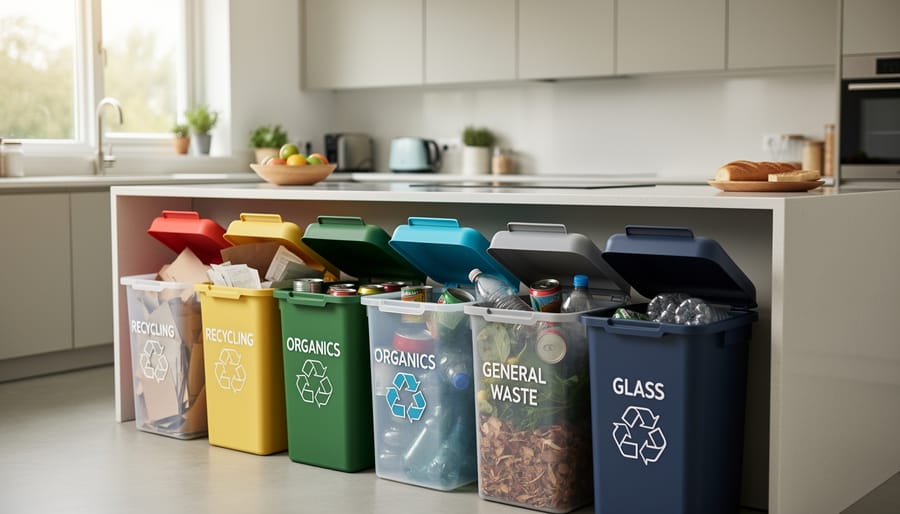
Modern bin systems have transformed how Australian households separate materials, with most councils now providing colour-coded bins for general waste, recycling, and organics. This isn’t just about convenience, it’s the first critical step in capturing materials before they’re lost to landfill.
Drop-off centres extend this network beyond the kerb. Battery collection points at supermarkets, e-waste drop-offs at transfer stations, and textile bins at shopping centres catch problem materials that don’t belong in household bins. These programs work because they meet people where they already are.
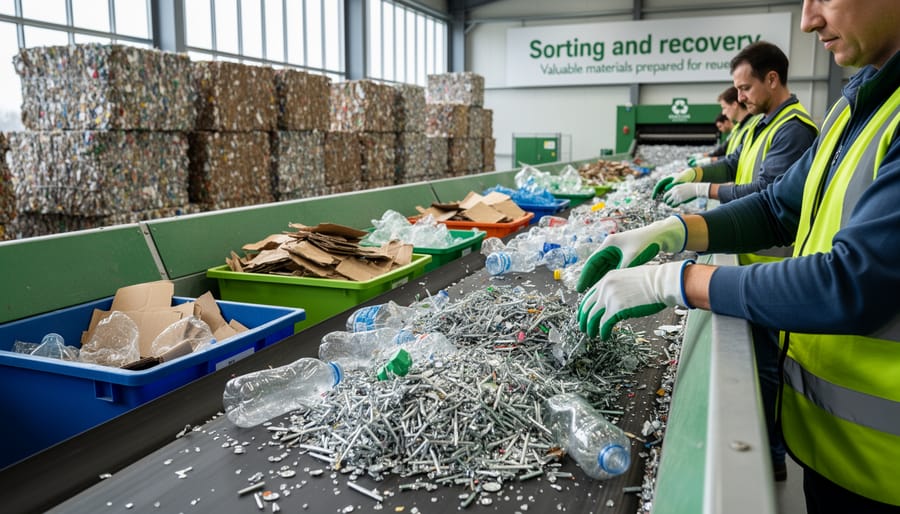
Technology plays a growing role once materials reach processing facilities. Optical scanners identify different plastics by their chemical signature, robotic arms pluck contaminants from conveyor belts, and AI systems are learning to spot valuable materials faster than human sorters ever could.
But the smartest sorting system means nothing if residents contaminate their bins. That’s where community participation becomes crucial. Clear bin labels, local waste education programs, and council apps that send collection reminders all help people get it right. When a neighbourhood consistently sorts well, recovery rates soar, sometimes capturing 80% of materials that would otherwise be buried.
Processing and Recovery
Once sorted materials arrive at processing facilities, the real transformation begins. Recycling plants use specialised machinery to clean, shred, and melt materials like plastics, glass, and metals, preparing them for manufacturing into new products. A plastic bottle collected from your kerb might be washed, chipped into flakes, and melted into pellets that become clothing fibres or new packaging within weeks.
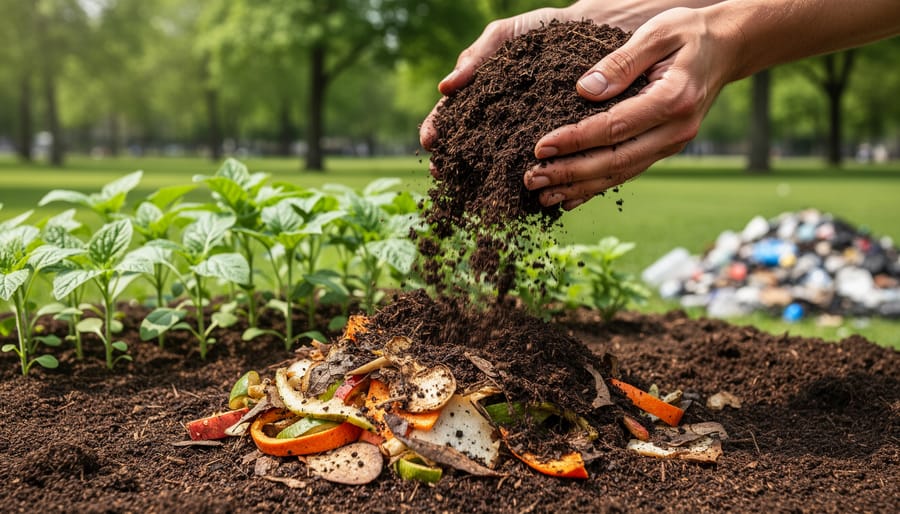
Composting operations handle organic waste differently. Food scraps and garden waste are layered in controlled environments where microorganisms break them down into nutrient-rich compost. Large-scale facilities monitor temperature, moisture, and oxygen levels to speed decomposition, turning what was once landfill-bound waste into soil conditioner for farms and gardens in roughly eight to twelve weeks.
Energy recovery facilities capture value from materials that can’t be recycled. Through processes like anaerobic digestion, organic waste produces biogas for electricity generation. Some thermal facilities convert non-recyclable waste into energy, though these remain less common in Australia than material recovery.
The key distinction: every tonne processed displaces virgin resource extraction, closing the loop between disposal and production.
The Core Components of a Sustainable Waste System
A sustainable waste system is more than bins and trucks. It’s a coordinated network of infrastructure, people, policies, and innovation working together to keep materials circulating rather than piling up in landfills. When these components align, communities can dramatically reduce waste while creating economic opportunities and protecting local environments.
Infrastructure That Actually Works
The foundation is physical infrastructure designed for recovery, not just disposal. Modern materials recovery facilities (MRFs) use optical sorters and AI-powered robotics to separate recyclables at speed and accuracy levels impossible a decade ago. Composting facilities handle organic streams at scale. Transfer stations become resource recovery hubs where residents drop off everything from electronics to textiles.
Brisbane’s Chandler Waste Management Centre demonstrates this approach, processing over 80,000 tonnes of green waste annually into compost and mulch that returns to local gardens and parks. The facility doesn’t just handle waste, it manufactures a product. Similar investments across regional councils mean even smaller communities can recycle organic waste rather than send it to landfill.
Policy and Regulatory Framework
Strong policies create the conditions for sustainable systems to thrive. Landfill levies make disposal expensive, pushing businesses and councils toward recovery options. Container deposit schemes turn beverage packaging from litter into currency. Procurement policies requiring recycled content in government projects create reliable markets for recovered materials.
Victoria’s ban on organic waste to landfill, staged from 2024 to 2027, forced councils and businesses to build composting capacity before the deadline. That regulatory pressure drove infrastructure investment that wouldn’t have happened through voluntary action alone.
Essential Components in Practice
A genuinely sustainable waste system integrates multiple elements:
- Robust collection infrastructure including multi-stream bins, drop-off centres, and specialised services for problem materials
- Clear policies and regulations that incentivise reduction and recovery while penalising disposal
- Community education programs teaching residents what goes where and why it matters
- Business partnerships connecting waste generators with processors and end markets
- Monitoring and reporting systems tracking diversion rates, contamination, and environmental outcomes
- Innovation and technology adoption improving sorting accuracy, expanding recovery options, and finding new uses for difficult materials
Community Engagement and Behaviour Change
Infrastructure and policy achieve nothing without people using them correctly. Education campaigns need to go beyond “what bin” basics to explain why contamination ruins entire loads and how recovered materials become new products. Successful councils run regular workshops, school programs, and digital platforms that make participation easy and rewarding.
The City of Sydney’s three-bin system works because residents understand it. Clear signage, multilingual resources, and bin audits with personalised feedback create a feedback loop that improves sorting quality over time. When people cultivate waste reduction habits and see their efforts matter, participation rates climb.
Innovation Closing the Loop
The final component is continuous improvement. Australian companies like Licella are developing chemical recycling to handle plastics that mechanical sorting can’t process. Researchers at CSIRO are creating building materials from coal ash and glass fines. Every innovation expands what’s recoverable and closes loops previously considered impossible.
When all these elements work together, infrastructure processing materials efficiently, policies creating the right incentives, communities participating actively, and innovation solving hard problems, waste systems become genuinely sustainable rather than just slightly better disposal.
Different Approaches to Sustainable Waste Management
Kerbside and Residential Programs
Most Australian households now interact with sustainable waste management through their weekly bin collection, but the system has evolved far beyond the single rubbish bin of decades past. The standard three-bin setup, red for general waste, yellow for recycling, and green for garden organics, forms the backbone of residential recovery, diverting millions of tonnes from landfill each year.
FOGO programs represent the next step, adding food scraps to the green bin alongside garden waste. Councils across New South Wales, Victoria, Queensland and South Australia have rolled out FOGO services, transforming potato peels and coffee grounds into compost that returns nutrients to Australian soil. Some areas have expanded to four-bin systems, separating glass to reduce contamination and improve recycling quality.
Problem waste collections handle items that don’t fit standard bins: old paint tins, batteries, electronics, mattresses, and household chemicals. Many councils run quarterly hard rubbish collections or permanent drop-off centres, ensuring hazardous materials are processed safely rather than dumped illegally.
Participation matters. When households rinse containers, separate materials correctly, and use their FOGO bin consistently, they directly feed the circular economy, turning yesterday’s waste into tomorrow’s products and soil amendments.
Commercial and Industrial Waste Solutions
Businesses generate vastly different waste streams than households, requiring tailored approaches that match their operations. Construction and demolition sites, for instance, produce tonnes of concrete, metal, timber and plasterboard, materials that can be crushed, sorted and returned to the supply chain rather than buried in landfill. Food service operations focus on separating organic waste for composting while tackling packaging challenges. Manufacturing facilities often deal with specific waste types like plastics, chemicals or textiles that need specialist processing.
Many Australian businesses now conduct waste audits to understand exactly what they’re discarding and where improvements lie. These audits reveal surprising opportunities: a Melbourne brewery discovered 80% of its waste was recyclable once proper systems were in place. Forward-thinking companies set zero-waste targets, redesigning processes to eliminate waste at the source rather than managing it after the fact.
The shift isn’t just environmental. Businesses find that recovering materials cuts disposal costs, meets customer expectations for sustainability, and often uncovers revenue streams from materials they once paid to throw away. Industry-specific solutions continue to evolve as companies share what works.
Community-Led Initiatives

Across Australia, communities are building their own solutions to waste without waiting for top-down directives. Repair cafés have sprung up in suburbs from Brunswick to Fremantle, where volunteers with soldering irons and sewing machines help neighbours fix broken appliances, clothes and furniture instead of binning them. These gatherings turn waste prevention into a social event, building skills while keeping perfectly repairable items out of landfill.
Tool libraries operate on a simple premise: why own a drill you use twice a year when you can borrow one? Communities in Adelaide, Sydney and Brisbane now run sharing schemes for everything from hedge trimmers to carpet cleaners, cutting both consumption and clutter.
Neighbourhood composting hubs take the pressure off household bins. Community gardens and schools host shared systems where locals drop off food scraps, which become soil for growing vegetables. ShareWaste connects people who compost with neighbours who have scraps but no space for a bin.
These grassroots efforts prove that waste reduction doesn’t require massive infrastructure. It needs people willing to share, fix and reimagine what’s possible in their own streets.
Technology-Driven Approaches
Technology is transforming how Australia processes and tracks waste. Automated sorting facilities use optical scanners and AI to separate materials faster and more accurately than manual systems. Some councils partner with apps that connect households to hard-rubbish collectors or repair services before items reach landfill. Waste-to-energy plants convert residual waste into electricity, though they remain limited here compared to Europe. Chemical recycling breaks down plastics into base chemicals for remanufacturing, offering a pathway for contaminated or multi-layer packaging that mechanical recycling can’t handle. Digital waste management platforms help businesses track their streams, find buyers for by-products, and measure diversion rates in real time.
Where Sustainable Waste Management Is Applied
Sustainable waste management isn’t confined to bins and recycling centres. It’s embedded across Australian society, from the council services we rely on to the industries that shape our economy. Here’s where you’ll find these principles at work:
- Local councils operate multi-stream kerbside collections, community recycling centres, and FOGO programs that divert thousands of tonnes from landfill annually
- Construction sites separate concrete, timber, metal and plasterboard for reprocessing, with some projects achieving 90 per cent diversion rates
- Cafes and restaurants compost food scraps, donate surplus meals to community organisations, and switch to reusable or compostable packaging
- Manufacturers redesign products for longevity and recyclability, establish take-back schemes, and use recovered materials as production inputs
- Farms turn agricultural waste into compost, biochar or stockfeed rather than burning or burying it
- Music festivals, sporting events and conferences provide recycling stations, ban single-use plastics, and work with specialist waste contractors to sort and recover materials on-site
- Schools run composting programs, worm farms and waste-free lunch initiatives that teach students circular thinking from an early age
In residential streets across Sydney, Melbourne, Brisbane and regional towns, colour-coded bins make waste recovery routine. Yellow lids for mixed recycling, red for general waste, and increasingly green or lime for organics. It’s simple infrastructure that redirects millions of tonnes each year.
The construction industry, responsible for around 40 per cent of Australia’s total waste, has become a proving ground for circular practices. Demolition contractors salvage bricks, strip timber for reuse, and crush concrete into road base. Some projects now plan for deconstruction from the outset, designing buildings that can be dismantled rather than demolished.
Commercial kitchens face unique waste challenges, but many are rising to meet them. They’re installing food digesters that break down scraps within hours, partnering with local farms to collect waste for animal feed, and tracking inventory to cut overordering. These efforts solve the waste crisis one meal service at a time.
Universities have become innovation hubs, running research projects on advanced recycling technologies while managing campus waste through student-led programs. These institutions model what’s possible when education and action combine.
Why It Matters for Australia
Australia generates over 75 million tonnes of waste each year, and how we handle it shapes our environmental future, our economic resilience, and the liveability of our communities. Sustainable waste management isn’t just good practice, it’s essential for protecting what makes this country unique.
Our natural environment faces direct threats from poorly managed waste. Landfills release methane, a greenhouse gas far more potent than carbon dioxide, contributing to climate change that’s already intensifying bushfires, droughts, and coral bleaching. Plastic pollution chokes our marine life, from seabirds to turtles, while microplastics infiltrate our waterways and soil. By keeping materials in use and out of landfills, we reduce these harms and preserve the landscapes and ecosystems Australians treasure.
Resource security matters more than ever. Australia imports many raw materials despite being resource-rich, and global supply chains remain fragile. When we recover and reuse materials locally, we become less dependent on overseas markets and volatile commodity prices. A zero waste economy creates local jobs in collection, sorting, reprocessing, and manufacturing, industries that can’t be offshored.
The economic opportunity is substantial. Australia currently sends billions of dollars worth of recoverable materials to landfill each year. Capturing that value creates employment across regional and urban areas, supports innovation in recycling technology, and builds industries that export expertise to our Asia-Pacific neighbours facing similar challenges.
Community health improves when waste systems work properly. Cleaner air and water, reduced contamination, and well-managed facilities mean healthier neighbourhoods. Communities that embrace sustainable practices also report stronger social connections through shared initiatives like repair events, composting programs, and local sharing networks.
For a country as fortunate as Australia, sustainable waste management reflects our responsibility to future generations and our capacity to lead by example.
Common Questions About Sustainable Waste Management
People often have practical questions about how sustainable waste management actually works in their daily lives and whether the effort truly makes a difference. Here are answers to the most common concerns Australians raise about sustainable waste practices.
Is sustainable waste management just another word for recycling?
No, recycling is just one component of sustainable waste management. The system prioritises avoiding and reducing waste first, then reusing items, and only then recycling materials that can’t be avoided or reused. It also includes composting organics, recovering energy, and designing products to last longer.
What actually happens to my recycling in Australia?
Most recycling collected in Australian bins goes to material recovery facilities where it’s sorted by type (paper, cardboard, plastics, metals, glass), then processed and sold to manufacturers who turn it into new products. Some materials are processed locally, while others are exported to countries with reprocessing facilities, though Australia is building more domestic capacity.
Is waste-to-energy sustainable?
Waste-to-energy sits low on the waste hierarchy because it’s better to avoid, reuse, or recycle materials first. However, it can play a role in recovering energy from waste that genuinely can’t be processed any other way, provided emissions are properly controlled and it doesn’t discourage better waste prevention efforts.
How much does sustainable waste management cost compared to landfill?
While setting up recycling and composting infrastructure requires upfront investment, sustainable systems often cost less over time because materials retain value and landfill levies keep rising. Many councils have found that diverting waste from landfill through better sorting and processing actually reduces their long-term costs while creating local jobs.
The contamination question deserves special attention because it’s a source of genuine frustration. When non-recyclable items end up in recycling bins, entire loads can be rejected and sent to landfill. Common culprits include plastic bags, soft plastics, food-contaminated packaging, and items like batteries or clothing that need separate collection streams. The solution isn’t complicated: rinse containers, keep different waste types separate, and check your council’s guidelines when you’re unsure. Most councils now have detailed online guides showing exactly what goes in which bin.
If you’re wondering where to start, the simplest entry point is mastering your household bin system. Learn what your council accepts in each bin, set up a small compost system or use your organics bin properly, and reduce what you buy in the first place. From there, you can explore your local transfer station for items that don’t fit the kerbside system, join community repair or sharing initiatives, and support businesses committed to sustainable packaging. Progress comes from consistent small actions rather than waiting for perfect knowledge before taking the first step.
Sustainable waste management isn’t just about bins and recycling plants, it’s a complete rethink of how we value materials, design systems, and build community resilience. From the waste hierarchy guiding every decision to the repair cafés bringing neighbours together, Australia is proving that treating waste as a resource creates real environmental, economic, and social benefits.
The good news? You’re already part of this shift. Every time you choose products with less packaging, sort your bins correctly, or support a business committed to circular practices, you’re strengthening the system. Start by checking what your council collects, many offer FOGO bins, e-waste drop-offs, and problem waste programs you might not know about. Look for repair workshops, sharing libraries, and composting hubs in your area. When shopping, back companies transparent about their waste reduction efforts.
Australia has everything needed to lead in sustainable waste management: innovative communities, growing infrastructure, and a landscape worth protecting. The challenge isn’t figuring out if it works, we’ve seen it succeed from Canberra to Byron Bay. It’s about more of us choosing to participate.
Your household, workplace, or community group can be the next success story. The systems are ready. The knowledge is accessible. What’s needed now is momentum, and that starts with one person deciding their waste deserves better than landfill.