
Map your business emissions by categorizing them into three scopes: Scope 1 covers direct emissions from company vehicles and owned equipment, Scope 2 includes purchased electricity and energy, while Scope 3 encompasses your supply chain footprint from suppliers to waste disposal. Australian SMEs typically find that 60-80% of their carbon footprint sits in Scope 3, making supplier engagement crucial from day one.
Choose a framework that matches your business size and sector complexity. The Greenhouse Gas Protocol remains the global standard, offering flexibility for small operations, while Australian businesses can align with the National Greenhouse and Energy Reporting scheme guidelines even before reaching mandatory reporting thresholds. Climate Active certification provides a clear pathway for SMEs wanting credible carbon neutral claims that resonate with Australian consumers increasingly demanding transparency.
Start collecting data where you already have records: utility bills, fuel receipts, and freight invoices. Most accounting software now integrates carbon tracking modules, transforming financial data you’re already managing into emissions estimates. This approach eliminates the need for separate complex systems and builds carbon literacy across your team naturally.
Calculate emissions using Australian-specific conversion factors from the Department of Climate Change, Energy, the Environment and Water, which account for our unique energy grid mix and agricultural conditions. These localized factors ensure your carbon footprint reflects actual Australian operating conditions rather than generic global averages.
Implementing a carbon accounting framework positions your business ahead of emerging Australian mandatory climate disclosure requirements while unlocking immediate operational savings. The average SME discovers 15-25% energy cost reductions through baseline measurement alone, turning environmental responsibility into competitive advantage. Your framework becomes the foundation for meaningful reduction targets, stakeholder reporting, and participation in Australia’s growing community of climate-committed businesses.
What Is a Carbon Accounting Framework? (And Why Your Business Needs One)
Think of a carbon accounting framework as your business’s GPS for emissions – it’s a structured system that helps you track, measure, and understand your company’s carbon footprint. Just as you wouldn’t navigate a road trip without knowing your route, you can’t effectively reduce emissions without knowing where they’re coming from.
At its heart, a carbon accounting framework measures greenhouse gases across three categories, known as Scopes. Scope 1 covers direct emissions from sources you own or control – think of the ute you drive for deliveries or the gas heating in your office. Scope 2 includes indirect emissions from the electricity you purchase to run your operations. Scope 3 is broader, encompassing everything in your value chain, from the products you buy to how customers use what you sell. For most Australian SMEs, Scope 3 often represents the largest chunk of emissions, yet it’s frequently overlooked.
Take Melbourne-based café owner Sarah, who thought her carbon footprint was minimal because she didn’t own a factory. When she started tracking emissions properly, she discovered that her coffee beans’ transport, dairy suppliers, and even takeaway packaging contributed significantly to her overall impact. Understanding these three scopes helped her identify where she could make the biggest difference.
For Australian SMEs, having a framework isn’t just about environmental responsibility anymore. It’s becoming essential for business survival. Major corporations like Woolworths and Wesfarmers now require suppliers to report emissions data. If you’re in their supply chain or aspiring to be, carbon accounting opens doors. Beyond compliance, customers increasingly choose businesses that demonstrate genuine climate action – a 2023 survey found 73% of Australian consumers prefer environmentally responsible brands.
Additionally, frameworks help you spot efficiency opportunities. That Brisbane logistics company that started tracking emissions discovered their delivery routes were costing them 20% more in fuel than necessary. By optimising routes to reduce emissions, they simultaneously cut costs.
A carbon accounting framework transforms climate action from an overwhelming challenge into manageable, measurable steps. It gives you clarity on where you stand today and a roadmap for where you need to go – essential tools for any Australian business navigating our rapidly changing economy.
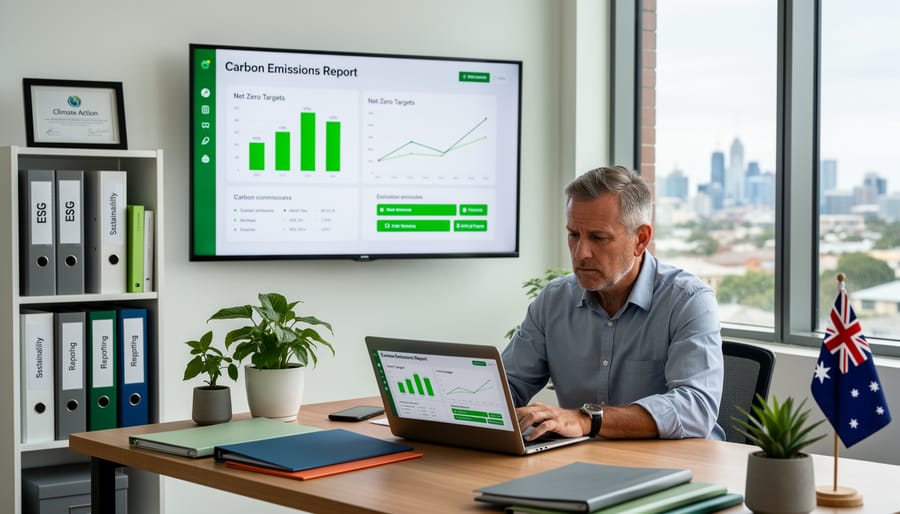
The Real Cost of Ignoring Carbon Accounting
The financial and competitive risks of sidestepping carbon accounting are becoming increasingly real for Australian SMEs, and they’re arriving faster than many business owners realise.
Take the story of a Melbourne-based manufacturing supplier who discovered their largest client, a national retailer, had introduced mandatory sustainability reporting requirements for all vendors. Without the ability to provide emissions data within the requested timeframe, they lost a contract worth $400,000 annually to a competitor who could demonstrate their carbon credentials. This scenario is playing out across Australian boardrooms as major corporations align with the government’s commitment to net zero by 2050.
The Australian Competition and Consumer Commission is also tightening its scrutiny on greenwashing claims, meaning businesses making environmental statements without proper carbon accounting face potential legal consequences and reputational damage. The penalties can be severe, with companies risking millions in fines for misleading environmental claims that aren’t backed by solid data.
Beyond immediate business relationships, the lending landscape is shifting dramatically. Australian banks, including the Big Four, are increasingly offering preferential rates and dedicated green financing products to businesses demonstrating climate action through verified emissions reporting. SMEs without carbon accounting frameworks are essentially locking themselves out of these opportunities, potentially paying higher interest rates or missing growth capital altogether.
There’s also the talent dimension. Recent surveys show that 73% of Australian workers, particularly younger generations, prefer employers with strong sustainability credentials. Without a carbon framework to showcase your environmental commitment, you’re limiting your ability to attract and retain skilled staff in an already competitive market.
The upcoming mandatory climate reporting requirements, initially targeting larger businesses but expected to eventually cascade to smaller enterprises, mean that early adopters gain a significant head start. Those who wait will face rushed implementation under pressure, likely at higher costs and with less strategic benefit. The choice isn’t whether to implement carbon accounting, but whether you’ll do it proactively on your terms or reactively when options narrow.
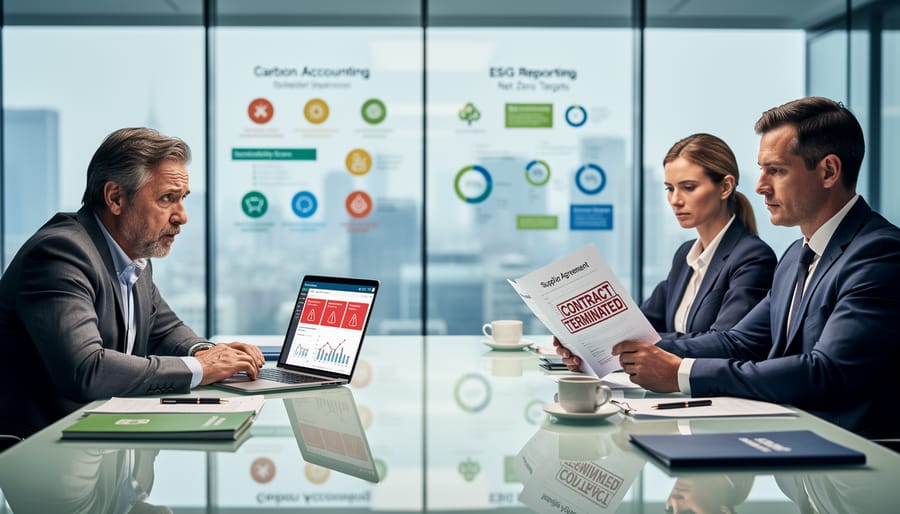
Choosing the Right Framework for Your Australian SME
The Greenhouse Gas Protocol: The Global Standard
If you’re an Australian SME wondering where to start with carbon accounting, the Greenhouse Gas Protocol is your answer. Developed by the World Resources Institute and World Business Council for Sustainable Development, it’s the most widely-used global framework for measuring emissions, and here’s the good news: it’s absolutely suitable for small businesses.
Think of the GHG Protocol as a universal language for carbon accounting. It divides emissions into three scopes: Scope 1 covers direct emissions from sources you own or control, like company vehicles. Scope 2 includes indirect emissions from purchased electricity. Scope 3 encompasses everything else in your value chain, from supplier emissions to product transportation.
For Australian SMEs, implementing this framework doesn’t require expensive consultants or complex software. Start with Scope 1 and 2, which are more straightforward to measure. Gather your energy bills, fuel receipts, and refrigerant records. Many Australian businesses find they can complete their first carbon inventory using free calculators aligned with the GHG Protocol.
The beauty of this framework is its flexibility. Whether you’re a Melbourne café or a Sydney marketing agency, you can scale the methodology to fit your operations. Plus, using a globally recognized standard means your efforts will be credible to customers, investors, and potential partners who increasingly value transparent climate action.
ISO 14064: For SMEs Seeking Certification
ISO 14064 is an international standard specifically designed for greenhouse gas accounting and verification, making it particularly valuable for Australian SMEs serious about credible carbon reporting. While related to ISO 14001 certification, this framework focuses exclusively on quantifying and reporting emissions.
For most Australian SMEs, ISO 14064 certification makes sense when you’re working with larger clients requiring verified emissions data, seeking to participate in carbon markets, or wanting third-party validation of your climate commitments. Think of it as giving your carbon accounting the stamp of credibility that stakeholders trust.
The certification process involves establishing your organizational boundaries, measuring emissions across relevant scopes, documenting your methodology, and undergoing independent verification. While more resource-intensive than informal tracking, it needn’t be overwhelming. Many Australian businesses start by implementing basic carbon accounting systems, then pursue certification once their processes mature.
Consider beginning with simplified frameworks to build internal capability before investing in full ISO 14064 certification. This staged approach helps your team develop confidence while demonstrating genuine commitment to transparency. The certification ultimately strengthens your competitive position, particularly as corporate supply chains increasingly demand verified environmental data from Australian suppliers.
Australian-Specific Options: NGER and State Programs
For Australian SMEs, understanding local reporting requirements is essential for staying compliant while contributing to our nation’s climate goals. The National Greenhouse and Energy Reporting (NGER) scheme is Australia’s primary federal mechanism for tracking emissions, but here’s the good news: most small and medium businesses won’t trigger mandatory reporting obligations.
NGER applies to facilities emitting 25,000 tonnes of CO2 equivalent or consuming 100 terawatt hours of energy annually, or corporations exceeding 50,000 tonnes emissions or 200 terawatt hours energy use. If your business falls below these thresholds, NGER reporting isn’t compulsory, though voluntary participation helps establish credible emissions tracking practices.
State-based initiatives offer more accessible entry points for SMEs. Victoria’s Climate Change Strategy and New South Wales’ Net Zero Plan include resources specifically designed for smaller enterprises. Many councils across Australia now provide free carbon accounting workshops and tools tailored to local businesses, creating supportive communities around emissions reduction.
Even if you’re not legally required to report, understanding these frameworks positions your business advantageously. Many larger Australian companies increasingly require suppliers to demonstrate emissions accountability, making voluntary carbon accounting a competitive advantage. Starting now, while obligations remain voluntary, gives you time to build expertise before potential future threshold changes affect your operations.
Building Your Carbon Accounting Framework: A Step-by-Step Approach
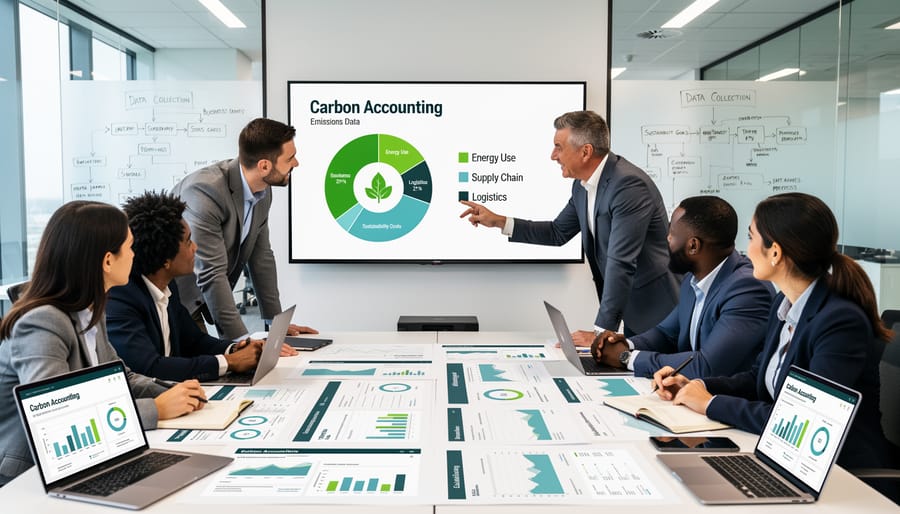
Step 1: Define Your Boundaries and Set Your Baseline
Before you can measure your emissions, you need to decide where to draw the line. Think of it like mapping your business’s carbon footprint – you wouldn’t start a journey without knowing your boundaries, right?
Start by establishing your organizational boundary. For most Australian SMEs, this means choosing between operational control (facilities you manage) or equity share (proportional ownership) approaches. A Melbourne café, for instance, might include emissions from their kitchen equipment, refrigeration, and company vehicle, but exclude their landlord’s building operations.
Next, identify your emission scopes. Scope 1 covers direct emissions like fuel in your delivery van or natural gas heating. Scope 2 includes purchased electricity – significant for Australian businesses given our grid’s energy mix. Scope 3 encompasses everything else: supply chain, waste, employee commuting. As a starting point, focus on Scopes 1 and 2 where data’s most accessible.
Your baseline year becomes your measuring stick for progress. Choose a recent 12-month period where you have reliable data. Sydney-based packaging company BioPak used their 2019 operations as a baseline, gathering electricity bills, fuel receipts, and delivery logs to calculate their starting emissions.
Don’t aim for perfection initially – start with what you can measure accurately, then expand your boundaries as your carbon accounting matures.
Step 2: Identify and Measure Your Emission Sources
Getting started with carbon accounting might feel daunting, but most Australian SMEs find their main emission sources fall into predictable categories. Begin by examining your energy consumption, including electricity and gas bills for your premises. Your transport footprint covers company vehicles, employee commuting, and freight deliveries. Don’t overlook waste management initiatives, which encompass everything sent to landfill, recycling, or compost.
For measurement, you’re in luck because several accessible tools exist specifically for Australian businesses. The Climate Active Carbon Neutral Standard provides free calculators that convert your utility bills and fuel receipts into carbon dioxide equivalents. Many accounting software platforms now integrate carbon tracking features, automatically categorizing expenses by emission type.
Start simple by gathering 12 months of utility bills, fuel receipts, and waste service invoices. These documents contain the data needed to establish your baseline. Your industry peers are likely facing similar challenges, and many business networks now share practical measurement templates. Remember, perfect accuracy isn’t the goal initially. What matters is creating a consistent system you can improve over time while building momentum within your team around sustainability efforts.
Step 3: Collect and Organize Your Data
Now comes the practical part that many Australian SMEs find most challenging: gathering your emissions data. The good news? You likely already have most of what you need sitting in your filing cabinet or inbox.
Start by collecting your utility bills (electricity, gas, and water), fuel receipts from company vehicles, and records of business travel. These documents contain the raw data you’ll transform into meaningful emissions insights. Create a simple system for capturing this information as it arrives – perhaps a dedicated folder or cloud storage location where team members can upload receipts and bills.
For many small businesses, a well-structured spreadsheet is your best friend. The Australian Government’s Climate Active program offers free carbon accounting templates specifically designed for SMEs, which calculate emissions automatically once you input your data. These tools translate kilowatt-hours and litres into carbon dioxide equivalents, doing the complex mathematics for you.
If spreadsheets aren’t your strength, several affordable platforms cater to Australian businesses, including tools like Trace and CarbonAI, which integrate with your accounting software and automatically track emissions from invoices and receipts. Many offer free trials, letting you test before committing.
Remember, you’re building a system that works for your business, not competing with multinational corporations. Start with what feels manageable, gathering three to six months of data initially. This foundation becomes more valuable as you consistently add to it, revealing patterns and opportunities you might otherwise miss.
Step 4: Calculate and Document Your Carbon Footprint
Now comes the practical part where numbers meet action. Using the data you’ve collected, it’s time to calculate your actual emissions by applying emission factors – essentially conversion rates that translate your activities into CO2 equivalent.
The Australian Government’s National Greenhouse Accounts provide comprehensive emission factors specific to our context, including electricity grid variations between states (recognising that coal-heavy grids produce different emissions than renewable-rich ones). The Clean Energy Regulator also offers detailed resources and calculators designed for Australian businesses.
Here’s how to approach the calculations: multiply your activity data by the relevant emission factor. For example, if your Sydney office used 5,000 kWh of electricity, you’d multiply this by NSW’s grid emission factor to determine your Scope 2 emissions from that source. Sum all your calculations across Scopes 1, 2, and 3 to get your total carbon footprint.
Documentation is crucial – not just for compliance, but for tracking progress. Create a simple spreadsheet or use carbon accounting software to record your data sources, emission factors used, calculation methods, and dates. This transparency builds credibility with stakeholders and makes year-on-year comparisons straightforward. Think of it as building a story of your sustainability journey, one calculation at a time.
Tools and Resources to Make Carbon Accounting Easier
Good news: you don’t need expensive consultants or complex software to start your carbon accounting journey. Australia offers fantastic resources specifically designed for businesses like yours, and many won’t cost you a cent.
The Australian Government’s Climate Active program provides free carbon accounting tools and calculators tailored to various business sizes and sectors. Their step-by-step guides walk you through measuring emissions from everything from office energy to business travel. Think of it as having a carbon accounting mentor in your pocket, available 24/7.
For those ready to invest in software, platforms like Trace, Emitwise, and locally-developed CarbonInvoice offer affordable solutions starting from around $50 monthly. These tools integrate with your existing accounting software, automatically tracking emissions from purchases and operations. It’s like having an extra team member who never sleeps, constantly monitoring your carbon footprint.
Small Business Victoria and similar state-based programs often run free workshops and webinars on sustainability topics, including carbon accounting. These sessions connect you with other business owners facing the same challenges, creating valuable peer networks. Last year, a Melbourne café owner I spoke with discovered her most cost-effective emission reduction strategies through connections made at one such workshop.
Don’t overlook industry associations either. Groups like the Australian Chamber of Commerce and Industry provide sector-specific guidance and often negotiate group discounts on carbon accounting services for members.
The Clean Energy Regulator’s website offers comprehensive fact sheets explaining compliance requirements in plain language, while community organisations like 1 Million Women provide supportive forums where businesses share practical tips and celebrate wins together.
Starting small with free resources builds confidence before investing in premium tools as your needs grow.
Common Pitfalls (And How Australian SMEs Can Avoid Them)
Let’s be honest – even the most enthusiastic Australian SME can stumble when setting up carbon accounting. The good news? Most pitfalls are completely avoidable once you know what to watch for.
The most common mistake we see is inconsistent data collection. Picture this: one month you’re tracking electricity bills religiously, the next you’re relying on estimates because invoices got buried in someone’s inbox. This creates a patchy picture that’s nearly impossible to compare year-on-year. The solution? Set up simple, recurring calendar reminders for data collection and designate one team member as your sustainability champion. Even dedicating just an hour each month makes all the difference.
Many SMEs also focus solely on Scope 1 and 2 emissions – the ones directly under their control – while completely overlooking Scope 3. This is understandable since Scope 3 covers your entire supply chain and can feel overwhelming. However, for most Australian businesses, Scope 3 actually represents the largest portion of their carbon footprint. Start small by identifying your top three suppliers or business travel emissions. You don’t need perfect data immediately; reasonable estimates get you moving in the right direction.
Another trap is building an overcomplicated system from day one. You’re a small business, not a multinational corporation. Starting with a massive spreadsheet tracking 50 different emission sources will only lead to burnout. Begin with your biggest impact areas – typically energy use, fleet vehicles, and major suppliers – then expand gradually as your confidence grows.
Finally, we see businesses complete their first carbon audit, then file it away and forget about it. Carbon accounting only delivers value when it’s regularly updated and reviewed. Quarterly check-ins keep your data fresh and help you spot trends before they become problems. Think of it like checking your business financials – essential for informed decision-making.
Remember, every Australian SME working on carbon accounting started exactly where you are now. These challenges are part of the journey, not roadblocks.
Turning Your Carbon Data Into Action
Having accurate carbon data is just the beginning—the real impact happens when you transform those numbers into meaningful change. The beauty of a solid carbon accounting framework is that it reveals exactly where your emissions are coming from, giving you a clear roadmap for reduction.
Start by identifying your emission hotspots. Your framework data will show which activities contribute most to your carbon footprint. For many Australian businesses, this might be energy consumption from premises, transportation, or supply chain logistics. Look for the low-hanging fruit first—opportunities that deliver significant reductions without major investment. Often, reducing energy costs through efficiency improvements provides both environmental and financial benefits.
Once you’ve identified priorities, set realistic, time-bound targets. Rather than aiming for perfection immediately, establish milestones you can actually achieve. Perhaps it’s a 20% reduction in office energy use within 12 months, or transitioning 30% of your fleet to electric vehicles over two years. The key is making your targets specific and measurable using your framework’s baseline data.
Consider bigger strategic moves too. For businesses with significant electricity consumption, renewable energy adoption through rooftop solar or purchasing green power can dramatically slash emissions. Companies with vehicle fleets might explore fleet electrification as technology costs continue falling and charging infrastructure expands across Australian cities and regions.
Your carbon data also becomes a powerful communication tool. Share your findings and progress with customers, employees, and suppliers. Transparency builds trust and often inspires others in your network to take similar action. Many Australian businesses are discovering that sustainability credentials open doors to new contracts, particularly as larger corporations increasingly require climate accountability throughout their supply chains.
Don’t go it alone—connect with the growing community of Australian businesses committed to emissions reduction. Organizations like Business Leaders for Climate Action and local sustainability networks offer peer support, shared learning, and collective purchasing power. Many regional councils also run programs helping SMEs navigate their sustainability journey, often with grants or subsidized consulting support.
Remember, every tonne of carbon reduced matters. Your framework gives you the tools to measure progress, celebrate wins, and continuously improve. That’s how data becomes action, and action becomes real environmental impact.
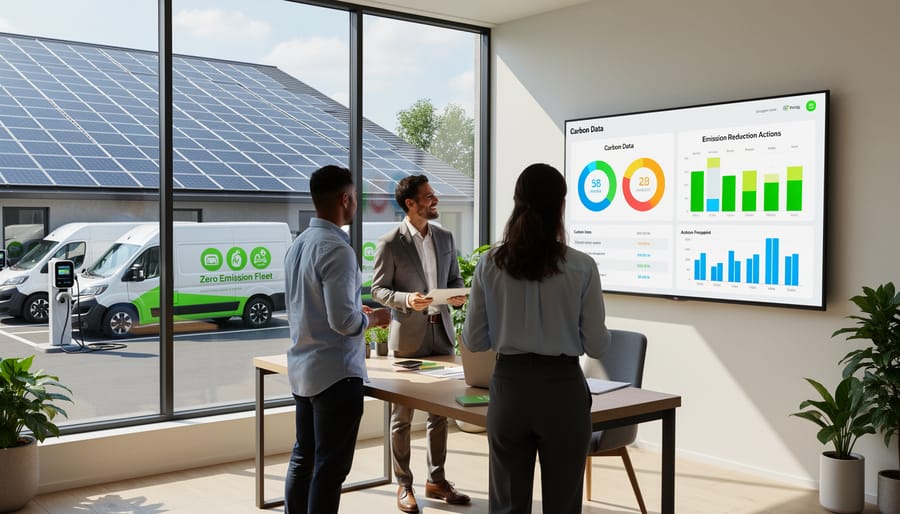
Starting your carbon accounting journey might feel like a big leap, but here’s the encouraging truth: thousands of Australian SMEs just like yours are already doing it, and they’re discovering it’s more manageable than they ever imagined. You don’t need a team of environmental scientists or a massive budget. What you need is the willingness to take that first step, and you’ve already done that by reading this far.
The benefits extend well beyond compliance. Businesses across Australia are finding that carbon accounting opens doors to new opportunities, from government contracts requiring sustainability credentials to partnerships with larger corporations committed to supply chain emissions reduction. Your customers increasingly choose businesses that demonstrate environmental responsibility, and your carbon accounting framework becomes a powerful story you can share with pride.
Remember, you’re not alone in this journey. Australia’s growing community of climate-conscious businesses is here to support you, share learnings, and celebrate progress together. Whether you start with a simple spreadsheet tracking your energy bills or engage a consultant to guide you through certification, what matters most is beginning.
Every tonne of carbon you measure is a tonne you can manage. Every reduction, no matter how small, contributes to Australia’s collective climate action. The framework you choose today shapes not just your business’s future, but the legacy we’re all creating for the next generation.
So take that first step. Start measuring. Start improving. Join the movement of Australian businesses proving that profitability and environmental responsibility go hand in hand. Your carbon accounting journey starts now.