
Every time you order something online, that package embarks on a journey spanning thousands of kilometres—but it’s the final few that matter most. Last mile delivery, the transportation of goods from a distribution hub to your doorstep, accounts for over 50% of total shipping costs and generates a staggering 25% of urban traffic emissions in Australian cities. This final leg isn’t just the most expensive part of the supply chain; it’s also the most environmentally damaging.
Picture Melbourne’s bustling streets at midday: dozens of delivery vans circling the same blocks, drivers double-parking to drop off single parcels, engines idling while they search for addresses. Multiply this scene across Sydney, Brisbane, and Perth, and you’ll understand why last mile delivery has become one of our cities’ most pressing sustainability challenges. In Australia alone, we’re expecting e-commerce parcel volumes to double by 2026, which means the problem will only intensify without intervention.
Yet this challenge presents an extraordinary opportunity. Across our communities, innovative solutions are already taking root—from cargo bike deliveries weaving through Sydney’s CBD to consolidated delivery lockers reducing multiple trips to single stops. Australian businesses are discovering that sustainable last mile delivery isn’t just good for the planet; it’s good for their bottom line and customer relationships.
Understanding last mile delivery means recognising both its environmental impact and the practical solutions within our reach. Whether you’re a consumer wanting to make better choices or a business owner seeking to reduce your logistics footprint, the power to transform this critical link in the supply chain starts with knowledge. Together, we can reimagine how goods move through our cities—one delivery at a time.
What Is Last-Mile Delivery?

The Journey of Your Package Across Australia
Let’s follow a typical delivery journey through Melbourne to see how last mile delivery works in practice. Imagine a parcel departing from a distribution centre in Dandenong early morning, destined for a home in Brunswick. This final leg, though only about 35 kilometres, represents the most complex part of the entire delivery process.
Your package begins its day sorted alongside hundreds of others, loaded onto delivery vans around 6am. The driver’s route is carefully planned by algorithms that determine the most efficient path through suburbs like Richmond, Fitzroy, and Carlton. However, efficiency doesn’t always mean sustainability. Traditional delivery routes often involve backtracking, double-parking on busy Sydney Road, and multiple failed delivery attempts when recipients aren’t home.
This is where last mile delivery becomes both a logistical challenge and an environmental opportunity. Each stop involves starting and stopping the engine, navigating narrow streets lined with terrace houses, and sometimes circling blocks searching for parking. In dense urban areas across Brisbane, Sydney, and Melbourne, delivery vehicles contribute significantly to local emissions and traffic congestion.
Progressive Australian communities are reimagining this journey. Some Melbourne councils now support micro-distribution hubs where electric cargo bikes complete the final kilometres. Others encourage consolidated delivery points in apartment buildings. When your parcel finally reaches your doorstep, it’s travelled through a system ripe for sustainable transformation, and your choices as a consumer can help drive that change forward.
Why It’s Called the ‘Last Mile’ (Even When It’s 20km)
The term “last mile” might seem puzzling when your online order travels 20 kilometres across Sydney or Melbourne to reach your doorstep. It’s a term borrowed from telecommunications, referring to the final leg of connectivity reaching individual homes. In delivery, it describes that crucial journey from a distribution hub to your front door, and despite the misleading name, it’s the most resource-intensive part of your package’s entire journey.
Here’s the surprising reality: while your parcel might have travelled thousands of kilometres efficiently stacked in shipping containers and freight trucks, this final stretch accounts for up to 53% of total shipping costs. Why? Instead of one truck carrying hundreds of packages to a single destination, last mile delivery involves multiple vehicles making numerous stops across sprawling Australian suburbs and regional areas, each dropping off just one or two items.
The environmental impact mirrors these economics. Those delivery vans navigate stop-start traffic, make U-turns in quiet streets, and often arrive at empty homes requiring return trips. For Australian communities, this translates to increased urban congestion, higher carbon emissions per package, and more diesel fumes in our neighbourhoods. Understanding this disproportionate impact is the first step toward supporting smarter, more sustainable delivery solutions that benefit both our communities and our environment.
The Environmental Cost of Getting Packages to Your Door
Carbon Emissions and Urban Air Quality
Last mile delivery vehicles contribute significantly to Australia’s urban carbon footprint, with delivery vans and trucks accounting for approximately 25% of transport emissions in our major cities. In Sydney alone, the surge in online shopping has added an estimated 150,000 additional delivery vehicle trips daily, releasing tonnes of CO2 and nitrogen oxides into our atmosphere. Melbourne and Brisbane face similar challenges as e-commerce continues its rapid growth.
The impact extends beyond climate concerns. Diesel delivery vehicles release particulate matter and nitrogen dioxide that directly affect the air we breathe in our neighbourhoods. Studies from Australian cities show that areas with high delivery traffic experience air quality levels that sometimes exceed national safety standards, particularly during peak shopping periods like Christmas and end-of-financial-year sales.
This matters for Australia’s commitment to net-zero emissions by 2050. Transport already represents 18% of our national emissions, and last mile delivery is the fastest-growing segment within this sector. Without intervention, delivery-related emissions could triple by 2030 as online shopping becomes increasingly convenient.
However, there’s genuine reason for optimism. Many Australian logistics companies are now actively reducing vehicle emissions through electric vehicle fleets and smarter route planning. Communities and businesses working together can transform last mile delivery from an environmental challenge into an opportunity for cleaner, healthier cities. The solutions exist—we simply need collective action to implement them.
Traffic Congestion and Infrastructure Strain
Every day, thousands of delivery vans navigate Australian streets, and while we appreciate the convenience, there’s a hidden cost to our communities. In Sydney’s CBD alone, delivery vehicles account for approximately 30% of traffic during peak hours, contributing significantly to urban congestion challenges that affect everyone’s commute.
The impact extends beyond frustrating delays. Each delivery van makes an average of 180 stops daily, often double-parking in residential streets and loading zones, creating bottlenecks that ripple through entire neighbourhoods. In Melbourne’s inner suburbs, local councils report that delivery vehicle parking violations have increased by 40% since 2019.
Our road infrastructure bears the burden too. The constant stop-start nature of last mile delivery accelerates road wear, particularly in suburban areas not designed for heavy commercial traffic. Brisbane City Council estimates that delivery-related road maintenance costs have risen by 25% over the past three years, diverting funds from community projects and green spaces that benefit residents.
Understanding these challenges helps us recognise why exploring sustainable delivery alternatives matters for building liveable, vibrant Australian cities.
Packaging Waste Mountains
Here’s the reality we’re facing together: every time a package arrives at our doorstep, it brings along an unwelcome companion – packaging waste. In Australia, online shopping has contributed to a staggering increase in packaging materials entering our waste stream. Recent data shows Australians generate approximately 2.5 million tonnes of plastic packaging waste annually, with a significant portion coming from e-commerce deliveries. Our cardboard recycling bins tell the story too, with council collections reporting up to 30% increases in cardboard waste since the pandemic-fueled online shopping boom. Each last-mile delivery typically involves multiple layers of protection – cardboard boxes, plastic bubble wrap, foam inserts, and tape – much of which ends up in landfill despite our best recycling efforts. The challenge isn’t just the volume; it’s that much of this packaging is designed for single use, creating mountains of waste that our communities must manage while the environmental cost continues to climb.
How Australian Cities Are Reimagining Last-Mile Delivery

Electric Cargo Bikes Taking Over Inner-City Streets
Across Australia’s bustling inner cities, a quiet revolution is transforming last mile delivery. Electric cargo bikes are weaving through traffic, proving that sustainable logistics aren’t just possible—they’re practical.
In Melbourne’s CBD, Australia Post has deployed a fleet of electric cargo bikes that can carry up to 100 kilograms of parcels. These nimble vehicles navigate the city’s laneways and bike paths, often completing deliveries faster than traditional vans stuck in peak-hour congestion. The trial has been so successful that it’s expanding to inner suburbs like Fitzroy and Carlton.
Sydney’s Inner West Council has partnered with local delivery startup Zoom2u to offer electric cargo bike services for small businesses. Cafés in Newtown and Marrickville now receive daily fresh produce deliveries without adding to the area’s notorious parking woes. The initiative has slashed delivery emissions by 90 percent compared to diesel vans.
Brisbane City Council is taking things further, installing dedicated cargo bike parking bays in the CBD and offering grants to businesses adopting pedal-powered logistics. Local courier company Delivr Brisbane operates entirely on electric cargo bikes, servicing everything from document runs to meal deliveries across Fortitude Valley and South Bank.
These real-world examples demonstrate that electric cargo bikes aren’t a fringe solution—they’re becoming the backbone of efficient, emission-free urban delivery networks that benefit communities, businesses, and our shared environment.
Micro-Fulfillment Centres in Your Neighbourhood
Imagine a small warehouse tucked between your local café and gym, quietly revolutionising how your online orders arrive. Micro-fulfillment centres are compact distribution hubs strategically positioned in suburban areas, slashing the distance parcels travel to reach your doorstep. Instead of trucks making 50-kilometre round trips from distant warehouses, deliveries now originate just a few suburbs away.
This innovation is transforming Australian logistics. In Sydney’s inner west, several retailers have established neighbourhood hubs that cut delivery distances by up to 70 percent, dramatically reducing fuel consumption and vehicle emissions. Melbourne’s Footscray recently welcomed a micro-fulfillment centre serving the western suburbs, enabling same-day deliveries with minimal environmental impact.
The benefits extend beyond emissions reduction. These local hubs create neighbourhood employment opportunities and reduce urban traffic congestion during peak hours. Some centres even utilise electric cargo bikes for the final stretch, making deliveries virtually emission-free.
Australian startups are leading this shift, partnering with community spaces and shopping centres to embed fulfillment operations where people actually live. This hyperlocal approach means your groceries, books, or household essentials travel metres rather than kilometres, proving that convenience and sustainability can genuinely work hand-in-hand when we rethink traditional distribution models.

Smart Parcel Lockers and Collection Points
Across Australia, smart parcel lockers are transforming how we receive packages while tackling one of last mile delivery’s biggest sustainability challenges: failed deliveries. When couriers make multiple attempts to deliver parcels to empty homes, they’re burning extra fuel and pumping unnecessary emissions into our air. It’s a waste nobody wins from.
Australia Post has rolled out thousands of parcel lockers in convenient locations like shopping centres, train stations, and petrol stations nationwide. These bright yellow hubs allow you to collect parcels whenever suits you, meaning delivery drivers can drop multiple packages in one efficient stop rather than crisscrossing suburbs hoping someone’s home. The environmental maths is compelling: one locker location can replace dozens of individual delivery attempts.
Private companies are joining the movement too. Amazon’s network of lockers continues expanding, while innovative startups are partnering with local businesses to create neighbourhood collection points. Your corner café or pharmacy might already double as a parcel pickup spot, strengthening community connections while reducing delivery vehicle kilometres.
For businesses, encouraging customers to use collection points can significantly shrink your carbon footprint. Many Australian e-commerce companies now highlight locker delivery as their eco-friendly option at checkout, and customers are increasingly choosing it. It’s convenient, secure, and eliminates that frustrating “sorry we missed you” card.
The beauty of this solution lies in its simplicity. By consolidating deliveries into central points, we’re making last mile delivery work smarter, not harder, creating cleaner air for all Australians while maintaining the convenience we’ve come to expect.
What Australian Businesses Are Doing Right (And Wrong)
Local Success Stories Worth Celebrating
Across Australia, innovative businesses are proving that sustainable last mile delivery isn’t just possible—it’s profitable and community-building too.
Take Ecofreight Logistics in Melbourne, who’ve transformed commercial deliveries using a fleet of electric cargo bikes and vans powered entirely by renewable energy. What makes their model genuinely sustainable isn’t just the zero-emission vehicles, though. They’ve created delivery hubs in strategic suburban locations, meaning most parcels travel under five kilometres to their final destination. This micro-hub approach reduces congestion, cuts emissions by 87% compared to traditional diesel vans, and supports local employment. Their drivers are full-time employees with fair wages, not gig workers—proving environmental sustainability and social responsibility go hand in hand.
In Sydney’s inner west, The Green Grocer Collective has reimagined grocery delivery entirely. They source from local farms within 100 kilometres, deliver in reusable crates by bicycle courier, and operate on set neighbourhood routes twice weekly. Customers know exactly when to expect deliveries, eliminating the inefficiency of on-demand service. The crates get collected on the next delivery run, creating a closed-loop system. Since launching three years ago, they’ve diverted over 50,000 single-use boxes from landfill whilst supporting 23 local farms.
Brisbane’s Bundle Refill demonstrates how packaging innovation transforms last mile delivery. Their refillable household products arrive in returnable stainless steel containers, collected and sanitised for reuse. The genius lies in their deposit system—customers pay upfront for containers, getting refunds upon return, which ensures a 94% return rate.
These businesses share common threads: they’ve designed sustainability into their core model rather than bolting it on afterwards, they prioritise community connection over speed alone, and they’re transparent about their impact. Most importantly, they’re thriving commercially, showing that sustainable last mile delivery works.
Spotting Greenwashing in Delivery Promises
Not all “green” delivery promises are created equal. As Australian consumers increasingly demand sustainable options, some retailers are stretching the truth about their environmental credentials. Here’s how to spot the difference.
Watch for vague claims like “eco-friendly delivery” without specifics. Genuine initiatives provide measurable details. For instance, Australia Post clearly states their electric vehicle numbers and carbon offset programs, while some retailers simply slap a green leaf on their website.
Look for transparency around carbon calculations. Companies like Who Gives A Crap explain exactly how their carbon-neutral deliveries work, including third-party verification. Red flags include unsubstantiated “carbon neutral” claims without showing offsetting methods or delivery consolidation practices.
Check if retailers offer concrete choices rather than just marketing spin. The Good Guys, for example, lets you select slower delivery options to reduce multiple trips, while some competitors advertise “sustainable shipping” but still default to express delivery that increases vehicle emissions.
Ask questions too. Businesses committed to genuine change welcome conversations about their practices. If you’re met with silence or corporate jargon when asking about delivery emissions or packaging materials, that’s telling. Together, we can hold retailers accountable and support those truly walking the sustainability walk.
How You Can Make Your Deliveries More Sustainable
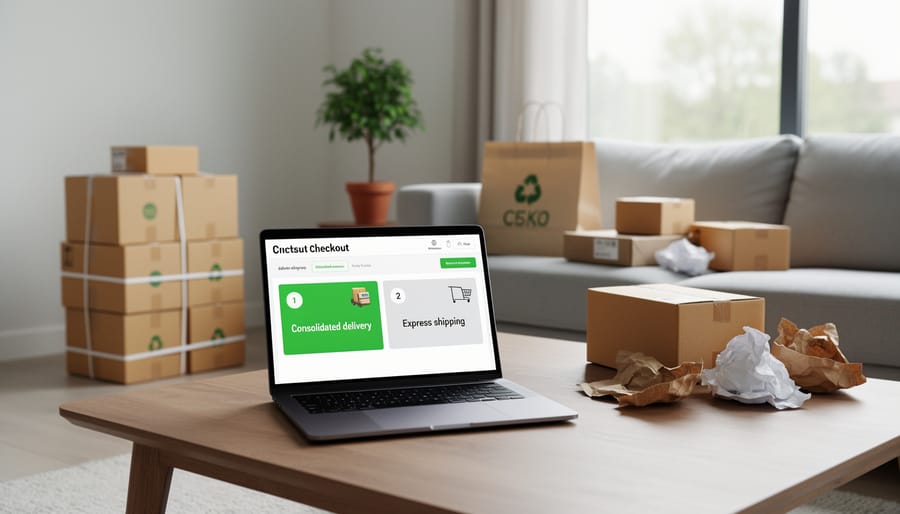
Choosing Slower, Greener Delivery Options
Here’s the good news: you have more power than you might think when it comes to greening your last mile deliveries. Every time you shop online, you’re making a choice that ripples through the supply chain.
Think of it this way—express shipping means a delivery van making a special trip just for your package, burning fuel and adding emissions. Consolidated deliveries, on the other hand, are like carpooling for parcels. When you choose standard shipping over express, you’re allowing retailers to group multiple orders together, reducing the number of vehicles on the road and cutting carbon emissions significantly.
Many Australian retailers now offer eco-friendly delivery options at checkout. Look for terms like ‘carbon neutral delivery’, ‘grouped delivery’, or even ‘green shipping’. Some businesses are getting creative, offering incentives like small discounts if you’re willing to wait an extra day or two for your order to be bundled with others heading to your neighbourhood.
Companies like Sendle and Australia Post have introduced carbon-offset delivery services, where they invest in environmental projects to balance their emissions. While not perfect, it’s a step in the right direction.
The shift is simple: pause before clicking ‘next day delivery’ and ask yourself if you truly need it urgently. Choosing slower shipping isn’t just environmentally responsible—it’s a small act of community care that adds up across millions of deliveries.
Supporting Businesses with Sustainable Delivery Practices
You have real power in shaping Australia’s delivery landscape by choosing where you shop. Look for retailers displaying carbon-neutral delivery badges or offering consolidated shipping options that group orders together. Many Australian businesses now partner with delivery services using electric vehicles or cargo bikes, particularly in metropolitan areas like Melbourne and Sydney.
Check company websites for transparent sustainability statements outlining specific environmental commitments rather than vague green claims. Retailers genuinely committed to sustainable last mile delivery often provide tracking showing delivery vehicle types and carbon offset programs. During checkout, opt for slower delivery speeds when possible, as this allows couriers to optimize routes and reduce emissions.
Consider supporting local businesses using community-based delivery networks or those participating in click-and-collect programs that eliminate the final delivery leg entirely. Your choices send powerful market signals, encouraging more Australian retailers to prioritize environmental responsibility in their delivery operations while building a stronger, more sustainable logistics ecosystem for our communities.
The Collection Point Revolution
Here’s a brilliant shift happening across Australian communities: we’re rethinking how parcels reach us. Collection points, parcel lockers, and click-and-collect services are transforming last mile delivery from a carbon-heavy individual affair into a shared community solution.
Picture this: instead of five delivery vans visiting five homes on your street, one van makes a single stop at your local parcel locker. Australia Post’s 24/7 Parcel Lockers now number over 600 nationwide, while supermarkets like Coles and Woolworths have embraced click-and-collect options that slash individual trips. These shared collection points can reduce delivery vehicle emissions by up to 70% compared to traditional door-to-door service.
The beauty of this revolution? It fits our lifestyles perfectly. Grab your parcel when you’re already out shopping, heading to the gym, or dropping kids at school. Many Aussie shoppers are discovering these options offer more convenience than waiting home for deliveries, while simultaneously reducing their carbon footprint. It’s a win-win that’s building momentum across suburbs and city centres alike.
The transformation of last-mile delivery isn’t just inevitable—it’s already underway in Australian communities. From Melbourne’s cargo bike couriers to Sydney’s electric delivery vans, we’re witnessing the early stages of a logistics revolution that promises cleaner air, quieter streets, and more liveable cities.
But this shift requires all of us to play our part. Every time you choose a consolidated delivery option, support a local business using sustainable delivery methods, or opt for pick-up points instead of door-to-door service, you’re voting for the kind of urban environment you want to live in. These seemingly small choices ripple outward, signaling to businesses and policymakers that Australians value sustainability alongside convenience.
Consider supporting retailers who’ve embraced eco-friendly delivery practices, whether through carbon-neutral shipping options or local distribution networks. Engage with your local council about creating more delivery hubs and bike-friendly infrastructure. Share your experiences with sustainable delivery services—word-of-mouth remains one of the most powerful drivers of change.
The vision for Australia’s future is within reach: cities where delivery vehicles hum quietly on electric power, where cargo bikes weave through dedicated lanes, and where smart logistics mean fewer trucks clogging our streets. Imagine neighbourhoods where children breathe cleaner air and where the convenience of e-commerce doesn’t come at the expense of our environment.
This future isn’t a distant dream—it’s being built right now, one delivery at a time. Together, we can ensure that last-mile delivery becomes a cornerstone of sustainable urban living across Australia.