
Every time you fill up at the servo, only about 20-30% of the fuel you’re paying for actually moves your car forward. The rest? Lost as heat, friction, and wasted energy through your engine and exhaust system. This startling reality affects the roughly 19 million conventional petrol and diesel vehicles on Australian roads today, quietly draining wallets and impacting our environment with every journey.
Most Australians assume their vehicle operates reasonably well because it starts reliably and gets them where they need to go. Yet beneath the bonnet, conventional internal combustion engines waste approximately 70-80% of the energy contained in every litre of fuel. That means for every dollar you spend filling your tank, roughly 70-80 cents vanishes without contributing to your actual transport needs. For the average Australian household spending $3,000-$4,000 annually on fuel, that’s potentially $2,400 going nowhere.
Understanding this inefficiency matters now more than ever. With fuel prices fluctuating and growing awareness of transport emissions contributing to climate change, Queenslanders, Victorians, and Australians nationwide are increasingly questioning whether their current vehicle truly serves their needs. The conventional car that seemed practical five years ago might be costing significantly more than necessary, both financially and environmentally.
This exploration of conventional vehicle efficiency reveals why these losses occur and how they compare to energy efficient vehicle choices becoming more accessible across Australia.
The Surprising Truth About Petrol and Diesel Efficiency
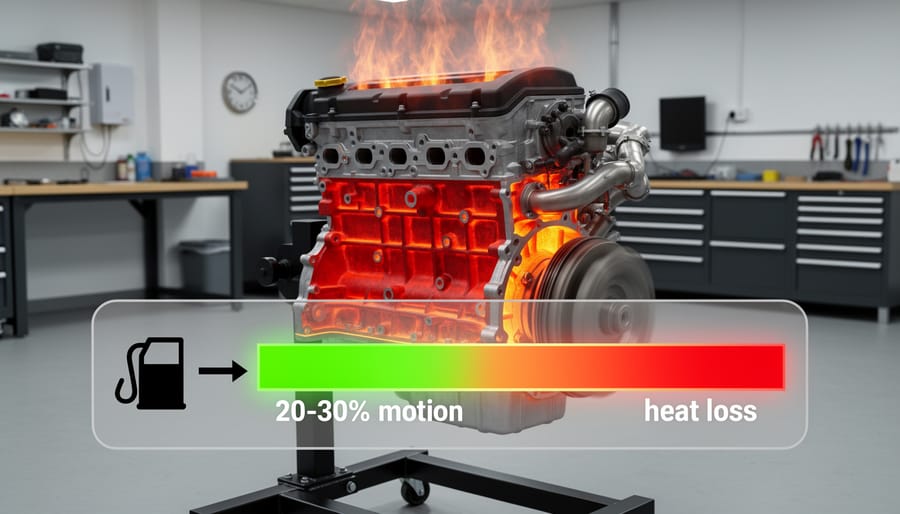
Where Your Fuel Money Actually Goes
Every time you fill up at the service station, you’re probably wondering where all that money actually goes. The answer might surprise you: most of it quite literally disappears as heat and wasted energy long before it moves your car forward.
Here’s the reality. In a typical petrol or diesel vehicle, only about 20-30% of the energy in your fuel actually reaches the wheels to move your car. The rest? It’s lost along the way, and understanding where helps explain why you’re filling up so often.
The biggest culprit is your engine itself. Between 60-70% of the fuel’s energy transforms into heat rather than motion. That’s right—roughly two-thirds of what you’re paying for at the bowser simply warms up your engine, radiator, and eventually the atmosphere around your car. When petrol costs hover around $2 per litre across Australian cities, that means for every $100 you spend filling up, about $65 evaporates as waste heat.
But the energy losses don’t stop there. Drivetrain friction—the mechanical resistance as power transfers from your engine through the gearbox and axles to your wheels—claims another 10-15%. Every gear, bearing, and connection loses a bit more of that precious energy you’ve paid for.
Then there’s idling. Australians sitting in traffic or waiting at the shops burn fuel producing absolutely zero forward motion. Some studies suggest urban drivers can waste up to 15% of their fuel this way.
Finally, aerodynamic drag and rolling resistance consume energy continuously, especially at highway speeds. The faster you travel, the harder your engine works just to push air aside.
For an average Australian household spending $3,500 annually on fuel, that’s potentially $2,275 lost to inefficiency alone. That’s money that could support your family, local community initiatives, or investment in more efficient transport solutions.
How Australian Driving Conditions Make It Worse
Here in Australia, we face a perfect storm of conditions that push conventional vehicle efficiency even lower than the already disappointing factory figures. Understanding these local challenges helps explain why many Australians are seeing such high fuel costs and environmental impact.
Our vast distances are perhaps the biggest factor. The average Australian driver covers around 13,700 kilometres annually, with many regional drivers logging far more. Those lengthy highway trips between cities and towns mean our engines work harder for longer periods, consuming significantly more fuel than shorter urban journeys.
Then there’s our climate. Air conditioning isn’t a luxury in Australian summers—it’s essential. Running your car’s air con can reduce fuel efficiency by up to 20 percent, and when temperatures regularly hit 35 degrees or higher across much of the country, that efficiency penalty becomes a daily reality for months on end. Your engine works overtime to keep you cool, burning through extra litres at every trip to the shops or school run.
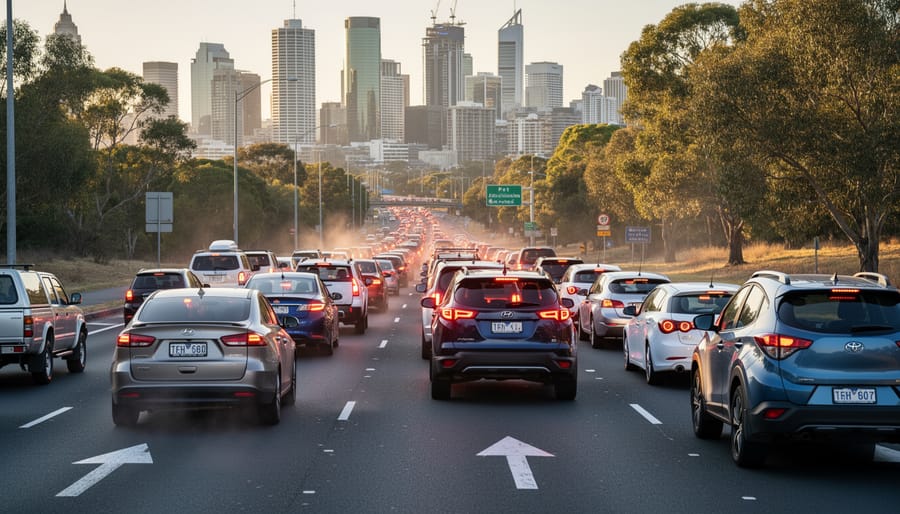
Our major cities present their own challenges. Sydney, Melbourne, and Brisbane consistently rank among the world’s most congested urban centres. Stop-start traffic is where conventional engines perform worst, idling at lights and crawling through peak-hour gridlock. That beautiful theoretical highway efficiency rating? It rarely materialises in real-world Australian driving.
These uniquely Australian conditions mean the gap between advertised efficiency and actual performance becomes even wider for us, making the case for more efficient alternatives increasingly compelling for households and businesses alike.
Comparing Real-World Fuel Economy: The Numbers Don’t Lie
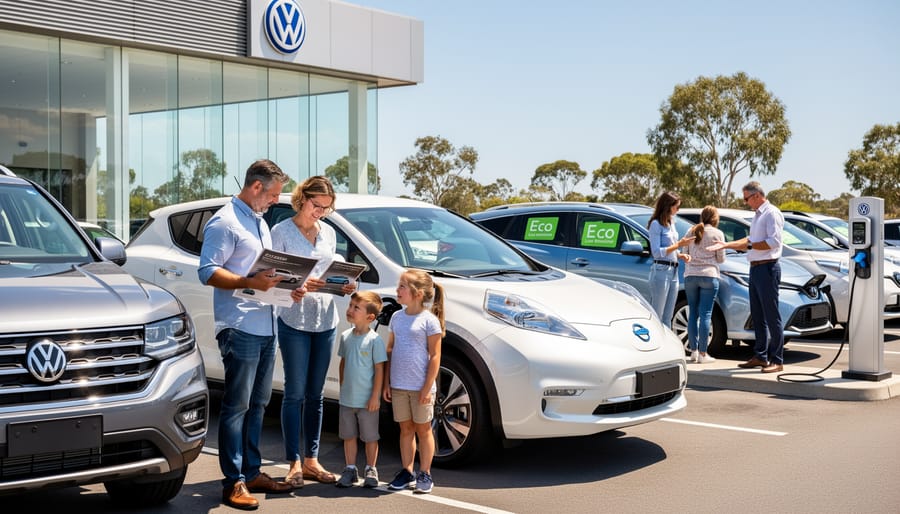
Small Cars vs SUVs: The Efficiency Gap
The efficiency gap between vehicle types in Australia tells a revealing story about where our fuel dollars actually go. Let’s look at three popular vehicles you’ll see in any suburban car park and what they really cost to run.
The Toyota Corolla sedan, Australia’s perennial favourite small car, achieves around 6.5 litres per 100km in combined city and highway driving. For the average Australian driver covering 13,000 kilometres annually, that translates to roughly 845 litres of petrol yearly. At current fuel prices hovering around $1.80 per litre, you’re looking at approximately $1,520 in annual fuel costs.
Step up to the medium SUV category with the Mazda CX-5, and the picture changes considerably. This popular family hauler uses about 7.8 litres per 100km, consuming around 1,014 litres annually for the same distance. That pushes your fuel bill to roughly $1,825 per year, around $300 more than the Corolla.
The real eye-opener comes with utes like the Ford Ranger, Australia’s best-selling vehicle. These workhorses typically consume 8.5 to 9.5 litres per 100km, translating to 1,105 to 1,235 litres yearly. Your annual fuel cost climbs to between $1,990 and $2,225, nearly $700 more than the small car option.
This efficiency gap isn’t just about vehicle size. It reflects fundamental physics: heavier vehicles with larger engines and less aerodynamic profiles simply require more energy to move. For Australian families considering their next vehicle purchase, understanding these real-world differences helps make informed choices that benefit both household budgets and our shared environment.
The Carbon Cost of Conventional Vehicles
Let’s put those fuel consumption figures into perspective. That average Australian petrol car burning 8-11 litres per 100km produces approximately 2.3 kilograms of CO2 emissions per litre of petrol. For someone driving the typical 13,300 kilometres annually, that’s around 2.5 tonnes of carbon dioxide released into our atmosphere each year.
To make this relatable, imagine a household with two conventional vehicles. Together, they’re contributing roughly 5 tonnes of carbon emissions annually, just from daily transport. That’s significant when you consider Australia’s per capita emissions reduction targets aim to reach net zero by 2050.
Here’s the real eye-opener: a single household’s car emissions can represent nearly half of their total carbon footprint, sitting alongside energy use and consumption. For Melbourne families commuting from the outer suburbs, or Perth residents travelling across our sprawling city, those numbers climb even higher. When we understand that every tank of fuel represents about 60 kilograms of carbon released, the environmental cost of conventional vehicles becomes impossible to ignore. The encouraging news? Recognising this impact is the first step toward making more sustainable transport choices.
Why Conventional Vehicles Keep Wasting Energy
The Stop-Start Problem in Australian Cities
If you’ve ever sat in peak-hour traffic on the M1 through Brisbane, crawled along the Eastern Freeway in Melbourne, or inched across the Harbour Bridge in Sydney, you’ve experienced firsthand how Australia’s city driving patterns create the perfect storm for fuel inefficiency.
Here’s what’s happening under the bonnet: every time you brake, all that energy you’ve just burned fuel to create transforms into heat through your brake pads and dissipates uselessly into the air. Then, when the traffic moves again, your engine works hardest to accelerate from standstill, guzzling fuel at its least efficient rate. This cycle repeats dozens, sometimes hundreds of times during a typical urban commute.
Research shows that conventional vehicles can consume up to 40 percent more fuel in stop-start city conditions compared to steady highway driving. For everyday Aussie commuters, this means the majority of our petrol budget literally goes up in smoke and heat rather than getting us where we need to go. It’s a frustrating reality that’s costing our wallets and our environment simultaneously.
What This Means for Australian Drivers Today
The True Cost of Inefficiency on Your Budget
Let’s break down what inefficiency actually costs Australian drivers. With average fuel prices hovering around $1.80 per litre across most capital cities, the numbers add up faster than you might think.
Consider Sarah from Brisbane, who drives a conventional SUV averaging 11 litres per 100km. Covering the typical Australian average of 13,300km annually, she’s using approximately 1,463 litres of fuel each year. At current prices, that’s $2,633 spent at the pump annually. Over a decade of ownership, Sarah’s looking at $26,330 just in fuel costs.
Compare this to her neighbour Tom, who drives a more efficient sedan using 7 litres per 100km. His annual fuel bill sits at $1,694, saving him nearly $1,000 every year. That’s $9,390 saved over the same ten-year period – enough for a fantastic family holiday or significant home improvements.
The real eye-opener comes when we factor in Australia’s longer distances. Rural and regional drivers often cover 20,000km or more annually. For them, the difference between an efficient and inefficient vehicle can mean an extra $1,500 each year vanishing into the fuel tank.
These aren’t just numbers on a spreadsheet. They represent real money that could strengthen household budgets, support local businesses, or fund community projects. When inefficiency costs thousands annually, choosing a more efficient vehicle becomes not just an environmental decision, but a smart financial one that benefits both your wallet and our shared future.
Better Options Are Already Here
The good news is that you don’t have to settle for 20% efficiency anymore. The Australian market has evolved dramatically, and energy-efficient vehicles are no longer futuristic concepts – they’re here, they’re practical, and they’re already being embraced by communities across the country.
Let’s talk numbers that truly make a difference. Modern hybrid vehicles, like the Toyota Camry Hybrid that’s become a common sight on Australian roads, can achieve real-world efficiency of around 40%. That’s double what conventional vehicles manage. Plug-in hybrids push this even further, offering the flexibility of petrol for long trips while running on electricity for daily commutes. And electric vehicles? They’re operating at roughly 80-90% efficiency – a complete game-changer when you consider what we’ve just learned about conventional engines.
What does this mean for your wallet? A typical Australian household driving 15,000 kilometres annually could save between $1,500 and $2,500 yearly on fuel costs by switching to an EV, even accounting for electricity costs. Those savings compound year after year.
Many Australians worry about making the switch, and those concerns are completely valid. “What about charging infrastructure?” It’s improving rapidly. Australia now has over 3,000 public charging stations, with networks expanding along major highways and in regional centres. Queensland’s Electric Super Highway and similar initiatives in other states are making long-distance travel increasingly feasible.
“Can I afford one?” The upfront cost has been a barrier, but it’s narrowing. Several electric and hybrid models are now available under $50,000, and some states offer incentives that reduce costs further. When you factor in lower running costs – EVs need no oil changes, have fewer moving parts, and require less maintenance – the total cost of ownership often favours efficient vehicles within just a few years.
Communities across Australia are already making this transition. From Brisbane’s growing network of neighbourhood charging points to Melbourne’s expanding electric bus fleet, we’re building the infrastructure together. Perth households are installing solar panels and pairing them with EVs, essentially fuelling their cars from sunshine.
The shift isn’t about abandoning what’s familiar overnight. It’s about recognising that better options exist right now, and they’re becoming more accessible every month. Whether you choose a hybrid as your next vehicle or go fully electric, you’ll be joining thousands of Australians who’ve discovered that efficiency isn’t just good for the planet – it’s practical, economical, and surprisingly straightforward.
Understanding the true efficiency of conventional vehicles is the first step toward making choices that benefit both your wallet and our environment. The reality is stark but empowering: conventional petrol and diesel vehicles waste approximately 70-80% of the energy contained in every litre of fuel you purchase. That means only about 20-30% actually moves your car forward, while the rest disappears as heat through the engine, exhaust system, and other mechanical losses.
This inefficiency isn’t about individual driving habits or vehicle maintenance—it’s built into the fundamental design of internal combustion engines. Even the newest conventional vehicles on Australian roads face these thermodynamic limitations. For environmentally conscious Australians, this knowledge transforms how we view our transport choices and opens doors to more sustainable alternatives.
The good news? You’re not alone in this transition. Communities across Australia are actively supporting the shift toward more efficient transport options. From car-sharing programs in Melbourne to electric vehicle charging networks expanding across Queensland, Australian community initiatives are making sustainable choices increasingly accessible and practical.
Armed with this understanding of conventional vehicle inefficiency, you can now make informed decisions that align with your values. Whether that means exploring hybrid or electric options, utilizing public transport more frequently, or supporting local sustainability programs, every choice contributes to a cleaner, more efficient future for Australia. The power to drive change truly rests with you.