
Every day, over 200,000 heavy trucks traverse Australian roads, moving everything from fresh produce to building materials across our vast continent. These vehicles currently account for nearly one-third of our transport emissions, but a transformation is already underway that will reshape how freight moves through our communities.
Zero-emission trucks powered by batteries and hydrogen fuel cells are no longer concepts from tomorrow. They’re operating on Australian roads right now, proving themselves capable of handling the demanding distances and payloads our country requires. Major freight companies are placing orders, state governments are building charging infrastructure along key corridors, and the technology has reached a tipping point where economics and environmental responsibility align.
This shift matters deeply for every Australian community. Beyond cleaner air in the suburbs where trucks pass through daily, zero-emission freight represents thousands of new jobs in manufacturing, infrastructure development, and vehicle maintenance. Regional centers positioned along major freight routes have unprecedented opportunities to become hubs in this new transport network, attracting investment and expertise.
The changes happening now will define Australian freight for the next fifty years. Queensland’s Brisbane-to-Gladstone corridor is already establishing hydrogen refueling stations. Victoria has committed to electrifying its port access routes. Western Australia is trialing battery-electric trucks in mining operations, where the business case proves compelling even without environmental considerations.
Understanding these technologies, their real-world performance, and the infrastructure developing across Australia helps businesses plan strategic transitions while communities can engage with projects that will shape their regions. The question is no longer whether zero-emission trucks will replace diesel fleets, but how quickly we can make this transition work for Australian conditions and communities.
Why Australia’s Freight Corridors Need a Zero-Emission Makeover
The Real Cost of Diesel on Our Major Routes
Every day, thousands of diesel-powered heavy-duty trucks thunder along Australia’s busiest freight corridors, carrying the goods that keep our economy moving. But this essential service comes at a significant cost to our environment and communities.
Along routes like the Melbourne-Sydney corridor and the Brisbane-Townsville highway, diesel trucks contribute substantially to air pollution that affects everyone living and working nearby. These vehicles emit nitrogen oxides, particulate matter, and carbon dioxide that drift into residential areas, schools, and local businesses. Studies show that communities within 500 metres of major freight routes experience higher rates of respiratory issues and cardiovascular problems, with children and elderly residents particularly vulnerable.
The environmental impact extends far beyond local air quality. Heavy-duty trucks account for approximately 28 percent of transport emissions in Australia, despite representing only a small fraction of vehicles on our roads. A single diesel truck travelling the 900-kilometre Melbourne-Sydney route produces around 270 kilograms of carbon dioxide. Multiply that by the thousands of trips made annually, and the scale of the challenge becomes clear.
Beyond health concerns, diesel trucks generate significant noise pollution that disrupts sleep patterns and affects quality of life for communities along these corridors. The economic cost of health impacts, environmental damage, and climate-related expenses runs into billions of dollars annually across Australia. Reducing emissions from our freight network isn’t just environmentally responsible—it’s essential for protecting the wellbeing of Australian communities and building a sustainable future for our children.
What Zero-Emission Actually Means for Freight
When we talk about zero-emission trucks, we’re referring to heavy vehicles that produce no tailpipe emissions while operating. Unlike traditional diesel trucks that release carbon dioxide, nitrogen oxides, and particulate matter into our air, zero-emission vehicles run on clean energy technologies that keep our freight corridors and communities healthier.
There are two main technologies powering this transformation across Australia. Battery-electric trucks use large rechargeable batteries to power electric motors, much like your phone but on a much larger scale. They’re charged at dedicated stations and are particularly suited to shorter routes with predictable schedules, making them ideal for urban and regional freight movements.
Hydrogen fuel cell trucks take a different approach. They generate electricity onboard by combining hydrogen with oxygen, producing only water vapor as a byproduct. These vehicles can refuel relatively quickly and handle longer distances, making them promising for interstate freight corridors.
Both technologies offer genuine zero emissions at the tailpipe. However, it’s worth noting that the overall environmental benefit depends on how the electricity or hydrogen is produced. Thankfully, Australia’s growing renewable energy sector means we’re increasingly powering these trucks with sun and wind.
The Technologies Making Zero-Emission Trucking Possible
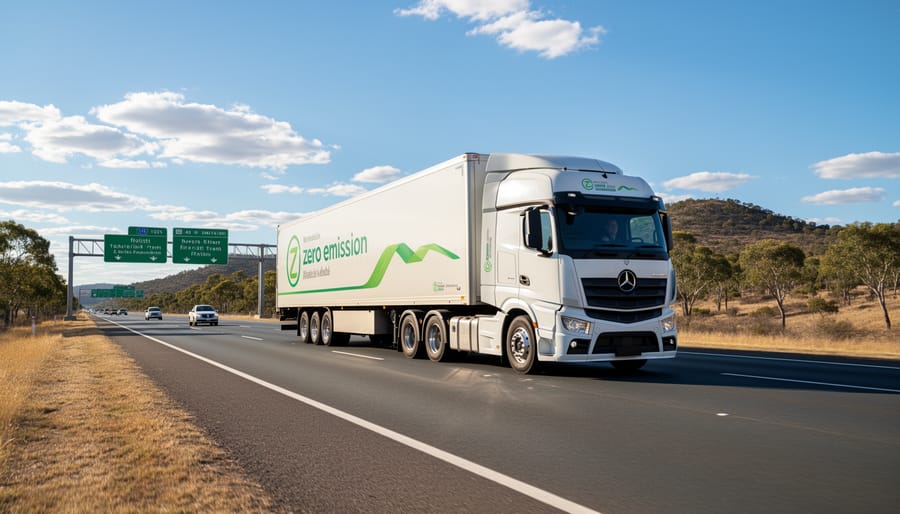
Battery-Electric Trucks: Power That’s Ready Now
Battery-electric trucks are transforming Australian freight right now, not in some distant future. These vehicles work much like the electric buses you might have seen around your city, but they’re built for the rigours of heavy-duty hauling. Instead of diesel engines, they run on large battery packs that power electric motors, delivering impressive torque and surprisingly quiet operation.
Today’s electric trucks typically offer ranges between 200 and 400 kilometres on a single charge, which perfectly suits many urban and regional delivery routes. While that might sound limiting compared to diesel, consider this: most freight movements in Australia’s eastern corridor involve shorter, predictable runs where trucks return to depots nightly. That’s where charging happens, often during off-peak electricity hours when renewable energy is abundant and costs are lower.
Several Australian companies are already putting electric trucks to work. Linfox is trialling electric vehicles across their fleet, while Australia Post has committed to electrifying delivery routes in metropolitan areas. Coles and Woolworths are testing electric refrigerated trucks for their distribution networks, proving these vehicles can handle demanding temperature-controlled freight.
The charging infrastructure is growing steadily, with depot-based charging leading the way. Fast-charging stations along major freight routes are also expanding, particularly between Sydney, Melbourne and Brisbane. While the upfront cost remains higher than diesel equivalents, the significantly lower running costs, reduced maintenance needs and available government incentives are making electric trucks an increasingly viable choice for forward-thinking Australian businesses.
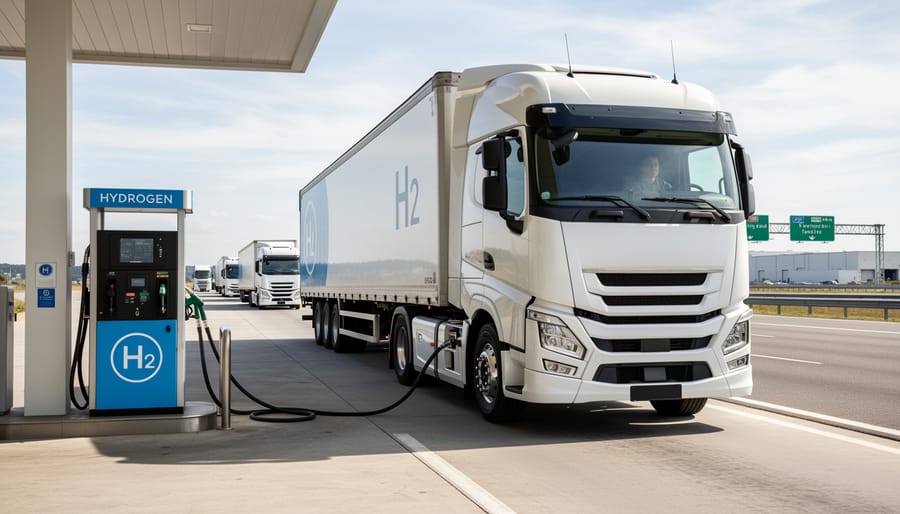
Hydrogen Fuel Cell Trucks: The Long-Haul Solution
For long-haul freight operators covering vast distances across Australia, hydrogen fuel cell trucks are emerging as a game-changing solution that addresses the limitations of battery-electric vehicles. While electric trucks excel in urban deliveries, hydrogen technology offers the extended range and rapid refueling times that heavy-duty transport requires.
Here’s how it works: hydrogen fuel cells generate electricity by combining hydrogen with oxygen, producing only water vapor as emission. This means trucks can travel 400-800 kilometres between refueling stops, with refueling taking just 10-15 minutes—comparable to diesel vehicles. For Australian transport companies managing routes between Melbourne and Sydney or Brisbane to Townsville, this technology makes zero-emission freight genuinely practical.
The challenge? Building the refueling infrastructure. Australia currently has limited hydrogen refueling stations, though several promising pilot projects are underway. The Hydrogen Highway project connecting Brisbane, Sydney, and Melbourne is establishing strategic refueling points along these critical freight corridors. Meanwhile, mining companies in Western Australia are testing hydrogen trucks for hauling operations, demonstrating the technology’s potential in our unique conditions.
Toyota and Hyundai have already delivered pilot hydrogen trucks to Australian operators, with local success stories beginning to emerge. These early adopters are gathering crucial real-world data about performance in our climate and across our distances.
While the infrastructure is still developing, many industry experts predict hydrogen will play a vital role in decarbonizing heavy transport within the next decade. For freight businesses, watching these developments closely could inform future investment decisions as Australia builds its hydrogen economy.
Which Technology Fits Which Job?
Battery-electric trucks are ideal for urban deliveries and shorter routes up to 400km, where overnight charging at depots works perfectly. Think of local freight runs between Melbourne and Geelong, or Sydney metro operations. They’re quieter for residential areas and have lower running costs. Hydrogen fuel cell trucks shine for long-haul freight exceeding 500km, like the Melbourne to Brisbane corridor, where quick refuelling matters and payload capacity is critical. The choice depends on your routes, infrastructure access, and turnaround times. Many Australian logistics operators are finding battery-electric suits their urban fleets, while planning hydrogen for interstate runs. Consider your specific operations rather than adopting a one-size-fits-all approach.
Australia’s Zero-Emission Freight Corridors Take Shape
The Melbourne-Sydney Green Corridor Initiative
Australia’s most ambitious zero-emission freight project is taking shape along our busiest trucking route. The Melbourne-Sydney Green Corridor Initiative represents a collaborative effort between governments, energy providers, and logistics companies to transform this critical 900-kilometre stretch into a fully sustainable freight pathway.
At the heart of the project is a network of rapid charging stations and hydrogen refuelling hubs being strategically positioned every 150-200 kilometres. Energy Australia and Origin Energy are leading the charging infrastructure rollout, with the first five sites already operational in regional centres including Goulburn and Albury. These aren’t your standard charging points either – they’re capable of adding 400 kilometres of range in under 45 minutes, designed specifically for heavy-duty vehicles.
Major freight operators Linfox and Toll Group have committed to deploying over 200 zero-emission trucks along the corridor by 2026. Their involvement signals serious industry confidence in the technology’s viability for long-haul operations.
The initiative’s roadmap sets ambitious targets: 25 percent of corridor freight emissions eliminated by 2028, rising to 75 percent by 2035. Local communities along the route are already experiencing benefits, with reduced noise pollution and improved air quality in truck-heavy towns. This isn’t just infrastructure – it’s reshaping how our nation moves goods while building a cleaner future together.
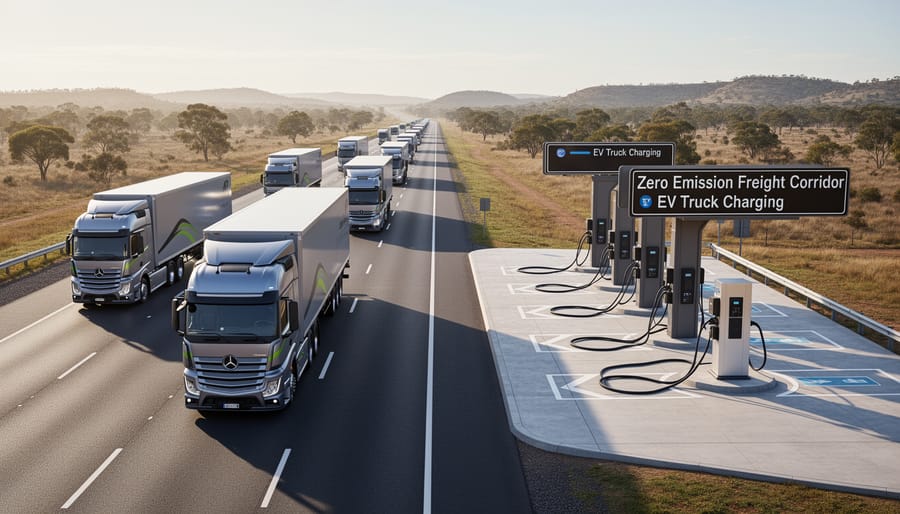
Queensland’s Hydrogen Highway Vision
Queensland is carving out an ambitious pathway toward zero-emission freight with its Hydrogen Highway Vision, a transformative project connecting major ports to inland agricultural and mining regions. The initiative centres on establishing a network of hydrogen refueling stations along key freight routes, starting with the Bruce Highway corridor linking Brisbane to Gladstone and Townsville.
The Queensland Government has committed funding to support the first phase of infrastructure development, recognising that heavy vehicles travelling long distances between regional centres need accessible refueling options. Early priority locations include Rockhampton, Mackay, and Toowoomba, strategic hubs where freight trucks currently pause for diesel.
Local communities stand to benefit significantly from this transformation. Regional towns hosting refueling stations will create new employment opportunities in maintenance, operations, and supporting services, while also improving air quality along busy freight corridors. The agricultural sector, particularly sugarcane and grain exporters, are watching closely as cleaner transport could reduce their carbon footprint while maintaining reliable supply chains to ports.
Several pilot projects are already underway, with mining companies in Central Queensland testing hydrogen-powered haul trucks. These real-world trials are building confidence among transport operators that zero-emission technology can handle Australia’s demanding conditions and distances.
Other Corridors in Development
Exciting developments are underway across Australia as freight operators and governments recognise the potential of zero-emission transport. The Brisbane to Cairns route is gaining attention as a vital corridor for Queensland’s economy, with several pilot programs testing battery-electric trucks for shorter regional hauls. Down south, the Adelaide to Melbourne freight link is emerging as another priority pathway, particularly for agricultural and manufacturing sectors committed to reducing their carbon footprint.
Western Australia is exploring opportunities along the Perth to Geraldton corridor, where abundant solar resources could power charging infrastructure. Meanwhile, regional NSW routes connecting agricultural hubs to Sydney are attracting interest from cooperatives eager to demonstrate sustainable practices to their communities. These developing corridors represent more than infrastructure projects—they’re creating opportunities for regional employment, strengthening local economies, and building the skilled workforce Australia needs for our clean transport future. As these routes progress from planning to reality, they’ll form an interconnected network making zero-emission freight accessible nationwide.
Who’s Already Making the Switch (And What They’ve Learned)
Australian Businesses Leading the Charge
Across Australia, forward-thinking businesses are already proving that zero-emission trucks aren’t just a distant dream—they’re practical, profitable, and making a real difference today.
Take Linfox, one of Australia’s largest logistics companies, which has committed to introducing electric trucks into its fleet. Operating primarily on urban delivery routes in Melbourne and Sydney, they’ve found that electric vehicles significantly reduce operating costs while meeting their sustainability targets. The company reports that drivers appreciate the quieter cabins and smoother acceleration, while customers value the reduced carbon footprint of their deliveries.
In Queensland, Toll Group has partnered with local councils to trial hydrogen-powered trucks along key freight corridors between Brisbane and the Gold Coast. Their motivation stems from both environmental responsibility and future-proofing their operations against rising fuel costs and tightening emissions regulations. Early results show impressive reliability, with the trucks maintaining performance even during Queensland’s challenging summer conditions.
Meanwhile, smaller operators are joining the movement too. Brisbane-based Green Fleet Logistics made headlines by becoming one of the first entirely zero-emission freight companies in Australia. Founder Sarah Mitchell explains that switching to electric trucks has actually strengthened her business, attracting environmentally conscious clients and reducing maintenance downtime by nearly 40 percent compared to diesel vehicles.
These pioneers demonstrate that transitioning to zero-emission trucks isn’t just about doing the right thing for our environment—it’s becoming a smart business decision that positions Australian companies as leaders in sustainable transport.
The Honest Truth About Challenges
Let’s be real – the shift to zero-emission trucks isn’t without its hurdles, and pretending otherwise wouldn’t serve anyone. Right now, Australia’s charging and hydrogen refuelling infrastructure remains patchy, particularly along regional freight corridors where these trucks need to travel. The upfront investment is considerably higher than diesel alternatives, which can feel daunting for smaller operators already working on tight margins.
Range anxiety is legitimate too. While battery technology is improving rapidly, some electric trucks still can’t match the 1,000-kilometre stretches diesel vehicles handle easily. Cold mornings in the high country or scorching Western Australian summers can affect battery performance, adding another layer of complexity.
Here’s the encouraging part: operators aren’t waiting for perfect conditions. Many are starting with shorter urban routes, building confidence and infrastructure knowledge before tackling longer hauls. Fleet managers are forming networks to share real-world learnings about charging schedules, route planning, and maintenance costs. Some are partnering with renewable energy providers to offset charging expenses, turning a cost challenge into an opportunity.
The Australian Trucking Association and state governments are actively mapping infrastructure needs, with several pilot programs underway. Yes, there are obstacles, but the community is tackling them together, one practical solution at a time.
The Infrastructure Puzzle: Charging and Refueling Networks
Where We Are Now with Charging Infrastructure
Australia’s charging infrastructure for zero-emission trucks is still in its early stages, but we’re seeing genuine momentum across key freight corridors. Currently, most heavy-duty charging stations are concentrated around major urban centres like Sydney, Melbourne, and Brisbane, with the Hume Highway corridor between Sydney and Melbourne leading the way as a priority route for infrastructure development.
Several pilot charging hubs have been established at strategic rest stops and freight depots, though they’re not yet widespread enough to support long-haul operations across all routes. The good news is that governments and private operators are actively investing in expanding this network. Queensland recently announced plans for charging stations along the Bruce Highway, while Western Australia is exploring options for the Perth to Kalgoorlie route.
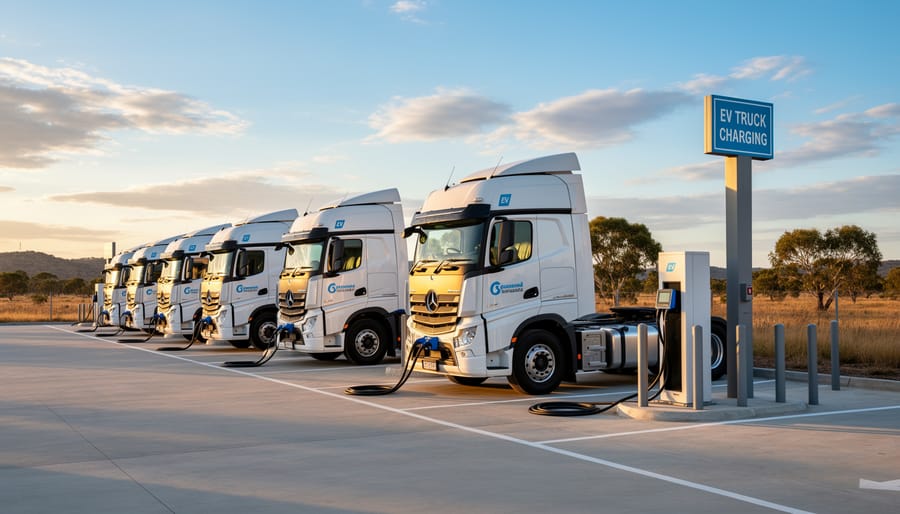
The charging stations being installed are designed specifically for heavy vehicles, offering high-powered charging that can add significant range within a driver’s mandatory rest break. Industry collaboration is crucial here, with logistics companies, energy providers, and infrastructure developers working together to identify the most critical locations.
While we’re not quite ready for seamless coast-to-coast electric freight journeys, the foundations are being laid. Community support and early adopters in regional areas are helping drive this expansion, proving that sustainable freight transport is becoming a practical reality rather than just a future possibility.
The Hydrogen Refueling Network Challenge
Here’s the reality: hydrogen-powered trucks are ready to roll, but Australia’s refuelling infrastructure is still catching up. Currently, we have just a handful of public hydrogen refuelling stations nationwide, creating a classic “chicken and egg” challenge for fleet operators considering the switch.
The good news? Collaborative partnerships are accelerating solutions. The Queensland government, working with industry partners, is developing a hydrogen superhighway between Brisbane and Gladstone, targeting freight routes where zero-emission trucks can make the biggest impact. In Victoria, the H2V project is establishing refuelling hubs along key transport corridors.
What makes these initiatives work is the community approach. Transport companies, energy providers, and government bodies are sharing the infrastructure investment burden, recognizing that none can succeed alone. For instance, several major retailers are jointly funding refuelling stations at distribution centres, creating networks their suppliers can access too.
The challenge remains significant, with experts estimating we’ll need hundreds of stations to support widespread adoption. However, Australian ingenuity is shining through. Some regional communities are exploring renewable hydrogen production from local solar and wind farms, potentially turning remote areas into refuelling destinations while creating local jobs. The network is growing, and every new station strengthens the case for zero-emission freight.
How Government Policy Is Accelerating (Or Slowing) Progress
Australia’s journey toward zero-emission trucks is gaining momentum, though the pace varies across different levels of government. Understanding these policy shifts helps us see where opportunities lie and how quickly change might arrive.
At the federal level, the Australian Government has committed to reducing transport emissions as part of broader climate targets. The National Electric Vehicle Strategy, released in 2023, acknowledges heavy vehicles as a priority area, though specific mandates for zero-emission trucks remain limited compared to light vehicles. Federal funding programs like the Future Fuels Fund are beginning to support charging and hydrogen infrastructure along key freight routes, creating the foundation for wider adoption.
State governments are taking more direct action. New South Wales has set a target for all new government heavy vehicle purchases to be zero-emission by 2030, demonstrating leadership through procurement. Queensland’s Zero Emission Vehicle Strategy includes provisions for freight vehicles, while Victoria has invested in electric truck trials and hydrogen hub development in regional areas.
The COAG Transport and Infrastructure Council has established working groups examining national consistency in heavy vehicle standards, which will help avoid the fragmented approach that slowed electric car adoption. This coordination matters for businesses operating across state borders.
Perhaps most significantly, several states are developing Low Emission Zones in urban areas, which will eventually restrict diesel truck access in city centres. While these regulations might feel challenging initially, they’re creating the market certainty that manufacturers and fleet operators need to invest confidently.
Industry partnerships are also emerging, with government co-funding demonstration projects that prove the technology works in Australian conditions. These collaborations between public agencies, logistics companies, and vehicle manufacturers are accelerating practical knowledge and building the business case for early adopters across our freight sector.
What This Means for Your Business or Community
For Businesses: Making the Business Case
Let’s be upfront: transitioning to zero-emission trucks requires significant initial investment. Electric heavy vehicles currently cost 2-3 times more than diesel equivalents, and charging infrastructure adds another layer of expense. However, the financial picture is shifting rapidly for Australian operators willing to look beyond the purchase price.
The operational savings tell a compelling story. Fleet operators report fuel cost reductions of 60-70%, while maintenance expenses drop by up to 40% thanks to fewer moving parts. For businesses running predictable routes along major freight corridors, these savings can offset higher upfront costs within 5-8 years.
Government incentives are sweetening the deal considerably. The Australian Renewable Energy Agency offers grants covering up to 50% of eligible project costs, while several states provide registration discounts and expedited approvals for zero-emission vehicles. Some councils also waive infrastructure connection fees for charging installations.
Zero-emission trucks make strongest financial sense for operators with consistent routes under 400km, access to depot charging, and logistics operations centered around metropolitan areas. Early adopters are also discovering competitive advantages through securing contracts with sustainability-focused clients and future-proofing against increasingly stringent emissions regulations expected throughout the 2020s.
The question isn’t whether to transition, but when your business is positioned to make the move strategically.
For Communities: Cleaner Air and Quieter Roads
Communities along major freight routes are set to experience remarkable improvements in air quality and noise levels as zero-emission trucks replace diesel fleets. For residents in suburbs like Altona North in Melbourne or Botany in Sydney, where heavy vehicles rumble through daily, this shift means cleaner air for children playing outside and quieter streets for everyone.
Traditional diesel trucks emit harmful particulate matter and nitrogen oxides that contribute to respiratory issues, particularly affecting vulnerable community members. Zero-emission alternatives eliminate these local pollutants entirely. The noise reduction is equally significant, with electric trucks operating at a fraction of the decibel levels of diesel engines, especially during acceleration and idling.
Towns along the Hume Highway and Pacific Highway corridors can anticipate fewer vibrations affecting buildings and reduced traffic-related stress for residents. These changes complement broader sustainable transport options emerging across Australia, creating healthier living environments for thousands of families. Local councils are already reporting community enthusiasm for pilot programs, recognizing that freight doesn’t have to compromise livability.
The shift to zero-emission trucks across Australia isn’t just a distant possibility—it’s already underway, gathering momentum with each new trial, charging station, and policy announcement. From Melbourne to Perth, businesses and communities are proving that sustainable freight transport is both achievable and beneficial, creating cleaner air for our cities and regional towns while building new opportunities in green technology and infrastructure.
Yes, challenges remain. The upfront costs, charging infrastructure gaps, and range limitations for certain routes require ongoing attention and investment. But these hurdles are shrinking as technology advances, government support strengthens, and early adopters demonstrate what’s possible. The conversations have shifted from “if” to “when” and “how,” which represents significant progress.
For businesses considering this transition, start by assessing your current fleet operations and identifying routes suitable for electric vehicles. Connect with industry groups and pilot programs in your state—there’s a growing community of freight operators sharing insights and lessons learned. Even small steps, like hybrid vehicles or route optimization, contribute to the broader goal.
If you’re an individual passionate about sustainable transport, your voice matters too. Support businesses that prioritize clean logistics, advocate for charging infrastructure in your community, and stay informed about developments in your region. These collective actions create the market demand and political will that accelerate change.
The road to zero-emission freight is being paved right now, and every Australian has a role to play in this transformative journey. Together, we’re building a cleaner, healthier future for generations to come.