
If you’ve come across the term “stormwater industrial general permit” while researching industrial site compliance, you need to know this upfront: Australia doesn’t use this permit system. The terminology belongs to the United States Environmental Protection Agency’s Multi-Sector General Permit (MSGP) framework, and searching for it in an Australian context will lead you down the wrong regulatory path.
Australian industrial sites managing stormwater operate under entirely different state-based licensing systems. Each state and territory administers its own environmental protection legislation, with requirements varying significantly depending on your location, industry sector, and site activities. In Victoria, you might need an EPA licence under the Environment Protection Act. In New South Wales, the framework operates through environment protection licences. Queensland uses environmental authorities. The language, thresholds, and compliance pathways differ across borders, and there’s no single “industrial general permit” that covers stormwater discharges nationally.
This matters because many Australian businesses encounter U.S.-based stormwater guidance through international corporate policies, overseas consultants, or global industry standards. While the underlying goal is identical (preventing polluted stormwater from industrial sites reaching waterways), directly applying American permit requirements to Australian operations creates confusion and potentially leaves you non-compliant with the actual regulations governing your site.
This guide clarifies what Australian industrial operators genuinely need to know about stormwater management requirements in 2026, how to identify your obligations under your state’s framework, and when international best practices can legitimately inform your local compliance strategy without creating regulatory mismatch.
Understanding the International Permit Framework
The term “stormwater industrial general permit” originates from the United States regulatory framework, where it serves as a core tool under the National Pollutant Discharge Elimination System (NPDES). In the U.S., industrial facilities that discharge stormwater into waterways require authorization under the Clean Water Act. Rather than issuing individual permits to every industrial site, the U.S. Environmental Protection Agency developed a streamlined approach through the Multi-Sector General Permit (MSGP).
EPA’s 2021 MSGP covers 29 industrial sectors, from manufacturing and mining to transportation and food processing. Facilities meeting specific criteria can file a Notice of Intent and operate under the standardized conditions of the general permit instead of applying for a site-specific authorization. The permit requires operators to develop Stormwater Pollution Prevention Plans (SWPPPs), conduct regular inspections, monitor discharge quality, and implement controls to minimize pollutants entering waterways.
Australian operators researching stormwater compliance may encounter this terminology through international corporate policies, multinational standards, or overseas case studies. Understanding the MSGP framework proves valuable for identifying best-practice pollution prevention techniques and monitoring approaches. However, it’s crucial to recognize that Australia doesn’t operate under this permit system. Australian industrial stormwater management is regulated entirely through state and territory environment protection authorities, each with distinct licensing schemes, approval processes, and compliance requirements that differ fundamentally from the U.S. model.
How Australia Regulates Industrial Stormwater
NSW Industrial Stormwater Requirements
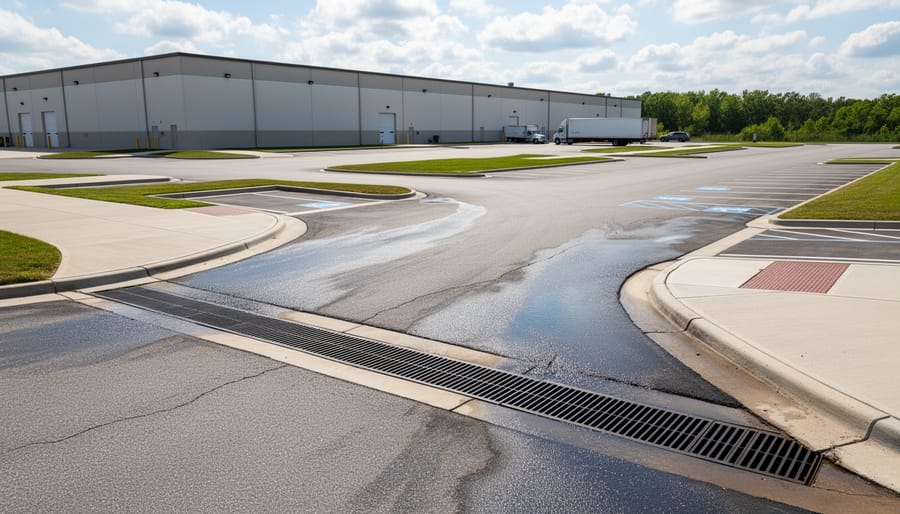
In New South Wales, industrial facilities that could discharge pollutants to stormwater must hold an environment protection licence under the Protection of the Environment Operations Act 1997. The NSW EPA issues licences to scheduled activities including chemical manufacturing, metal processing, waste facilities, and large-scale operations that pose pollution risks. These licences set specific conditions for stormwater discharge points, requiring operators to implement pollution controls, install sediment traps and oil separators, monitor water quality at discharge locations, and maintain detailed records. Unlike international permit systems, NSW operates a site-specific licensing approach where conditions reflect each facility’s risk profile and catchment sensitivity. Operators typically need stormwater management plans documenting how they prevent contamination from raw materials, process areas, and storage zones reaching natural waterways.
Victorian and Queensland Frameworks
Victoria and Queensland manage industrial stormwater through state-specific licensing systems that operate differently from general permit models seen overseas.
EPA Victoria administers environment protection through works approvals and operating licenses for prescribed industrial premises. Industrial sites must incorporate stormwater management into their environmental management plans, with requirements varying based on activity type, discharge risk, and receiving water sensitivity. Victoria’s framework emphasizes pollution prevention at source rather than end-of-pipe treatment, requiring operators to demonstrate best practice environmental management.
Queensland’s Department of Environment and Science issues environmental authorities under the Environmental Protection Act 1994. Industrial operators apply for site-specific approvals that include stormwater discharge conditions tailored to their operations and local waterway protection needs. Queensland’s risk-based approach means higher-risk industries face stricter monitoring and reporting obligations, while lower-risk sites may operate under standard environmental conditions with less intensive oversight.
Both states require operators to develop and maintain stormwater management plans as part of their license conditions, though the specific format and content requirements differ between jurisdictions.
Other State and Territory Approaches
Western Australia’s Department of Water and Environmental Regulation administers industrial stormwater controls through works approvals and licenses under the Environmental Protection Act 1986, with specific conditions based on site risk categories. South Australia’s Environment Protection Authority requires environmental authorisations for prescribed industrial activities, embedding stormwater management obligations within broader site approvals rather than standalone permits.
Tasmania manages industrial stormwater through activity-based permits under the Environmental Management and Pollution Control Act 1994, with conditions tailored to facility type and environmental risk. The Northern Territory’s Environment Protection Authority issues waste discharge licenses that cover stormwater releases from industrial sites, focusing on protecting sensitive catchments and coastal waters. In the Australian Capital Territory, the Environment Protection Authority regulates industrial stormwater through environmental authorisations under the Environment Protection Act 1997, often integrated with broader operating licenses for industrial facilities.
Core Requirements for Industrial Sites in Australia
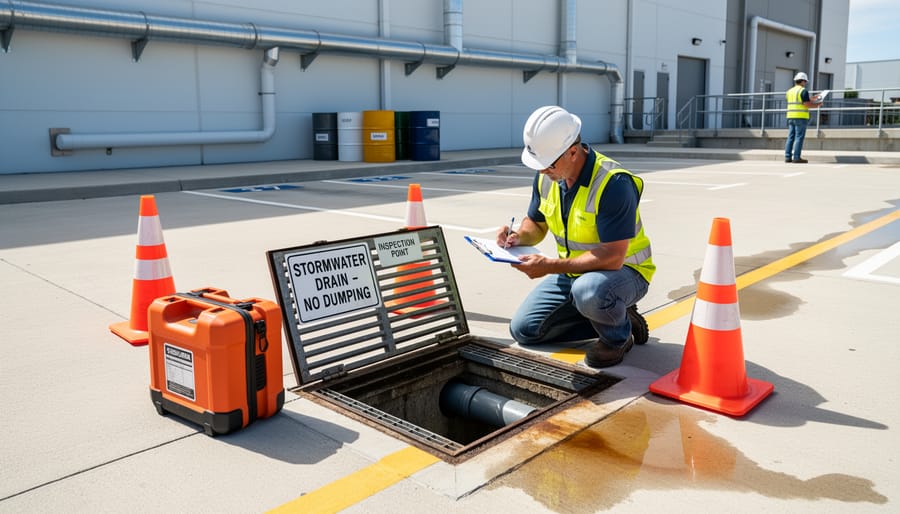
Despite the variation in state-based systems across Australia, industrial operators face several consistent obligations when managing stormwater on their sites. Understanding these common requirements helps businesses maintain compliance while protecting local waterways and communities.
Every industrial facility handling materials that could contaminate stormwater must develop and maintain a comprehensive Stormwater Management Plan (SWMP). This living document identifies potential pollutant sources on your site, maps drainage patterns, documents control measures, and establishes monitoring protocols. State regulators expect your plan to be site-specific rather than templated, reflecting your actual operations and the waterways you discharge to.
Pollution prevention sits at the heart of Australian industrial stormwater regulation. Operators must implement practical controls to prevent stormwater pollution before it occurs, not simply treat contaminated runoff. This means covering storage areas, installing bunding around chemical tanks, implementing good housekeeping practices, and training staff on spill prevention. State EPAs prioritise source control over end-of-pipe treatment.
Regular monitoring forms another universal requirement. Industrial sites typically need to test stormwater quality at discharge points, keeping records of pH, total suspended solids, oils and greases, and industry-specific contaminants. The frequency varies by state and industry sector, but quarterly sampling represents a common baseline. You’ll report this data to your state regulator, often annually or when threshold exceedances occur.
Emergency response preparedness is non-negotiable. Your site must maintain spill kits, train personnel in incident response, and have procedures for notifying authorities when pollution incidents occur. Most states require immediate reporting of significant spills or unlawful discharges.
Finally, Australian operators must keep detailed records demonstrating compliance, including inspection logs, maintenance schedules, staff training registers, and corrective action documentation. These records typically need retention for five to seven years depending on your state, forming your evidence base during regulatory audits or community inquiries.
Developing Your Stormwater Management Plan
Creating a robust stormwater management plan is your roadmap to regulatory compliance and environmental responsibility. Whether you’re operating in NSW, Victoria, or Queensland, state authorities expect you to demonstrate systematic control over stormwater leaving your site.
Start with a thorough site assessment. Walk your facility during both dry and wet conditions, mapping where water flows, where it pools, and where it exits your property. Identify all potential pollutant sources: chemical storage areas, loading docks, waste handling zones, vehicle maintenance areas, and outdoor material stockpiles. Document existing drainage infrastructure, noting any deficiencies or areas where contaminated runoff could reach stormwater systems.
Your assessment should include testing to establish baseline water quality. This data helps you understand current pollutant levels and measure improvement over time. Many businesses discover their sustainability efforts failing because they skip this foundational step and implement controls without understanding what they’re actually controlling.
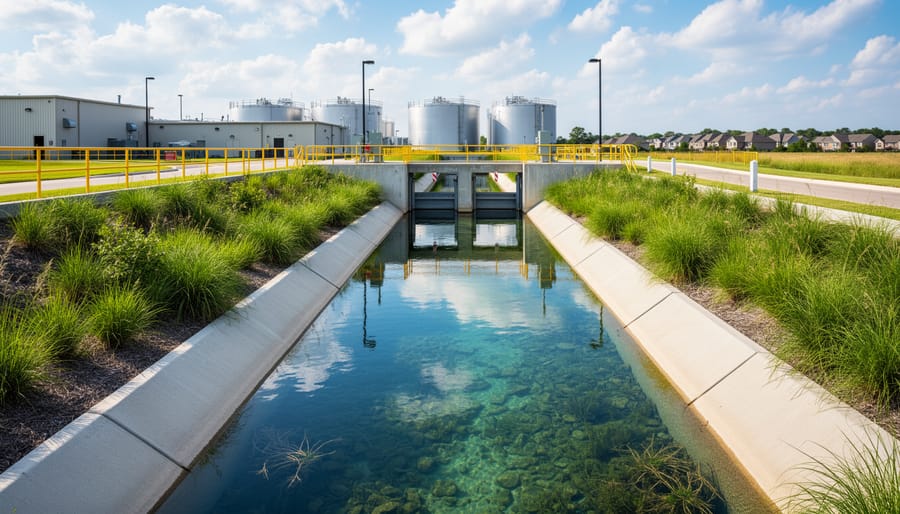
Next, design and implement appropriate controls for each identified risk. These might include covered storage for chemicals, bunded areas around tanks, sediment traps, oil-water separators, vegetated swales, or first-flush diversion systems. Match controls to your specific pollutants and site conditions rather than copying generic templates.
Documentation forms the backbone of your plan. State regulators require written procedures covering routine inspections, monitoring schedules, maintenance tasks, staff training programs, and emergency response protocols. Your plan should specify who does what, when, and how they record their actions. Include site maps showing drainage patterns, control measures, and monitoring points.
Build in regular review cycles. Inspect your controls monthly at minimum, and always after significant rainfall. Update your plan when you modify operations, expand facilities, or discover controls aren’t performing as expected. Keep inspection logs, monitoring results, and maintenance records for the period your state authority requires, typically three to five years.
Engage your team throughout. Operators who understand why controls matter and how to maintain them become your first line of defence against stormwater pollution.
Learning from International Best Practices
International frameworks offer valuable insights for Australian industrial operators, even though they don’t directly apply here. The U.S. EPA’s Multi-Sector General Permit provides detailed industry-specific guidance that can enhance your local compliance efforts.
The MSGP’s sector-specific benchmark values for monitoring pollutants offer useful reference points. While your state EPA sets the actual limits you must meet, comparing your monitoring results against international benchmarks helps identify potential issues early. Mining operations, for instance, can review MSGP requirements for sediment control and apply innovative techniques within their NSW or Queensland licensing conditions.
Industry-specific control measures from international permits often address challenges Australian sites face. The MSGP’s guidance for concrete batch plants on wash water management, or automotive facilities on parts cleaning runoff, translates well to local conditions. You’re not implementing U.S. requirements, you’re adapting proven pollution prevention methods to meet your state’s environmental protection standards.
The monitoring frequency and parameter selection used in international frameworks can inform your own stormwater management plan. If the MSGP requires quarterly monitoring for specific pollutants in your industry sector, discuss whether similar testing would strengthen your compliance program with your state regulator.
Study international best practice as a resource library, not a rulebook. Extract the technical solutions, adapt them to Australian rainfall patterns and site conditions, and integrate them into your state-mandated stormwater management plan. This approach combines global innovation with local compliance.
Common Questions About Industrial Stormwater Permits in Australia
Does Australia use ‘industrial general permits’ for stormwater?
No. Australia doesn’t use the term ‘industrial general permit’, that’s specific to the U.S. EPA system. Australian industrial sites obtain environment protection licenses or approvals directly from their state or territory EPA, with requirements varying by jurisdiction.
How do I know which state regulations apply to my facility?
Your obligations are determined by where your industrial site physically operates. Contact the EPA in your state or territory, they’ll clarify whether you need a license, what category your activities fall under, and what stormwater management requirements apply.
What typically triggers the need for a stormwater permit in Australia?
Most states require environmental licenses when your industrial activities pose a risk of stormwater pollution, manufacturing, metal finishing, waste processing, chemical storage, and mineral processing commonly trigger requirements. Thresholds vary by state and industry sector.
Can community groups verify if a local industrial site complies with stormwater regulations?
Yes. State EPA websites maintain public registers of licensed facilities, and you can request information about a site’s compliance history. If you observe suspected pollution, report it to your state EPA’s pollution hotline, they investigate complaints and can take enforcement action.
Beyond these common questions, many industrial operators wonder about typical costs. Licensing fees vary significantly by state and facility size, NSW environment protection licenses range from several hundred to several thousand dollars annually, while Victoria’s tiered system bases fees on the environmental risk your activities pose. Budget for both the initial application costs and ongoing compliance expenses like monitoring, reporting, and infrastructure maintenance.
If you’re working with international parent companies or following overseas guidelines, clarify the differences between U.S. ‘general permit’ frameworks and Australian state-based systems early. What works under an EPA MSGP in the United States won’t directly transfer here, you’ll need to adapt those practices to meet your specific state regulator’s requirements and documentation standards.
While the term ‘stormwater industrial general permit’ refers specifically to international regulatory systems, particularly the U.S. EPA’s Multi-Sector General Permit, Australian industrial operators work within well-established state and territory frameworks that achieve the same environmental protection goals through different mechanisms. Understanding this distinction matters because it helps businesses focus their compliance efforts on the actual requirements they face rather than trying to apply overseas permit systems that don’t exist here.
Your pathway to compliant industrial stormwater management starts with your state EPA or environment department. These authorities provide clear guidance, application processes, and support tailored to your industry sector and local waterway conditions. Engaging early with regulators typically leads to better outcomes than treating compliance as a box-ticking exercise.
Beyond meeting regulatory requirements, effective stormwater management represents an opportunity to demonstrate environmental leadership within your community. Industrial sites that implement robust pollution prevention measures protect the rivers, creeks, and coastal waters that define Australian landscapes. Many businesses find that green initiatives around stormwater not only safeguard local ecosystems but also reduce operational costs through better water management and waste prevention.
Australian industry networks and environmental consultants specializing in stormwater can help you navigate state-specific requirements while learning from international best practices. The goal is straightforward: keep pollutants out of stormwater, protect waterways, and contribute to healthier communities.