
Check your eligibility for government energy upgrade programs targeting households earning under $180,000 annually, with enhanced support for concession card holders and renters. Many Australian states offer rebates covering 50-100% of smart thermostat, LED lighting, and energy monitoring system costs—transforming everyday homes into efficient spaces that slash power bills by up to $600 yearly.
Contact your state energy authority directly to access rebate applications before June 2024 deadline extensions expire. Victoria’s Energy Upgrades program, NSW’s Energy Savings Scheme, and Queensland’s PeakSmart initiatives provide immediate rebates at point-of-purchase through accredited installers, eliminating upfront payment barriers that typically prevent low-income households from accessing energy-saving technology.
Bundle multiple upgrades in a single application to maximize rebate values. Installing smart thermostats alongside insulation, solar hot water, or heat pump systems often unlocks bonus incentives worth additional thousands. Accredited energy assessors visit homes free of charge, identifying which combinations deliver greatest bill reductions for your specific property and usage patterns.
Your journey toward lower energy costs starts with understanding that these rebates exist specifically to support Australian families facing cost-of-living pressures. Community energy groups across suburbs from Penrith to Frankston have helped thousands of neighbors navigate applications, proving that sustainable living isn’t reserved for wealthy households. The technology pays for itself through reduced bills within 2-3 years, creating lasting financial relief while reducing household emissions—a genuine win for both your family budget and our shared environment.
The Real Cost of Energy Poverty in Australian Homes
For many Australian families struggling to make ends meet, energy bills represent more than just another expense—they’re a constant source of stress that forces impossible choices. Research shows that low-income households spend up to six times more of their income on energy than wealthier families, with some dedicating 10% or more of their budget just to keeping the lights on and homes habitable.
The impact goes far beyond the financial. Across our communities, families in inefficient homes face a harsh reality: rationing heating during freezing winters and forgoing cooling during dangerous heatwaves because they simply can’t afford the electricity bills. This isn’t just uncomfortable—it’s a genuine health crisis. Children in cold, damp homes miss more school days due to respiratory illnesses, while elderly residents face increased risks of hypothermia and heat stress.
Here’s what makes this especially frustrating: these are often the homes that need upgrades most desperately. Older rental properties and poorly insulated houses leak energy like sieves, with outdated appliances consuming power at alarming rates. Yet the upfront costs of improvements feel impossibly out of reach for the very people who would benefit most from lower bills.
The climate connection matters too. When we help these households upgrade to energy-efficient systems and smart home technology, we’re not just reducing their bills—we’re making meaningful progress on Australia’s emissions reduction targets. Low-income homes collectively represent significant energy consumption, and bringing them up to modern efficiency standards creates a ripple effect of positive change.
This is precisely why smart home rebates and energy upgrade programs exist. They’re designed to bridge that gap, transforming energy efficiency from an unattainable luxury into an accessible reality for families who need it most.
What Smart Home Energy Upgrades Actually Mean (Without the Tech Jargon)
Let’s cut through the confusion around smart home technology. These aren’t just gadgets for tech enthusiasts—they’re practical tools that help everyday Australians save money and energy, and many qualify for rebates that make them surprisingly affordable.
At the heart of most smart home upgrades sits the smart thermostat. Think of it as a learning assistant for your heating and cooling system. It recognizes when you’re typically home or away, adjusts temperatures automatically, and can be controlled from your phone. Many Australian households save 10-20% on their energy bills within the first year. The beauty is they work equally well whether you’re in a house or exploring energy upgrades for renters that won’t complicate your bond return.
Smart lighting systems go beyond simply switching bulbs. LED bulbs with smart controls let you dim lights, set schedules, or turn everything off remotely when you’ve rushed out the door. They use 75% less energy than old incandescent bulbs and last years longer.
Energy monitoring devices are like having a personal energy detective in your home. These plug-in gadgets or circuit-board attachments show exactly which appliances are energy hogs. Many Australians discover their old second fridge in the garage costs them hundreds yearly—knowledge that drives smart decisions.
Solar panels paired with smart inverters represent a bigger investment but deliver substantial returns. The smart inverter optimizes how your panels capture sunlight and manages battery storage if you have one. Some even integrate with smart charging technology for electric vehicles, maximizing your solar power usage.
Modern smart appliances—fridges, washing machines, and dishwashers—schedule energy-intensive tasks during off-peak hours when electricity costs less. They’re not about fancy touchscreens; they’re about timing energy use intelligently.
The encouraging news? Government rebates often cover significant portions of these upgrades, making them accessible to households who’ll benefit most from lower energy bills.
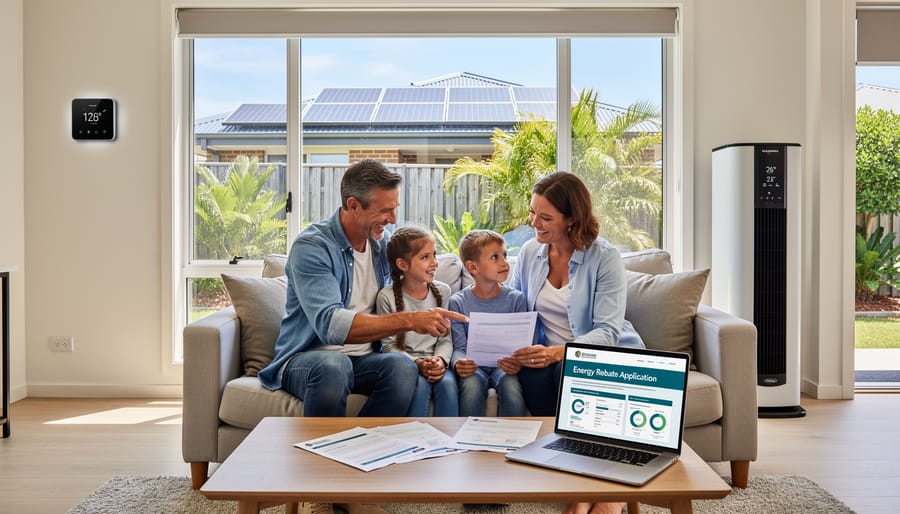
Australian Government Rebates and Incentives You Can Access Right Now
Federal Programs and National Schemes
While individual states lead the charge on smart home rebates, Commonwealth programs provide an essential foundation for energy upgrades across Australia. Understanding these national initiatives can help you stack benefits and maximise your savings.
The federal government’s commitment to reducing household emissions means several programs support everyday Australians making the switch to energy-efficient technology. The Small-scale Renewable Energy Scheme creates financial certificates (STCs) when you install eligible solar panels, solar water heaters, or heat pumps. These certificates translate into upfront discounts, typically reducing solar installation costs by $2,500 to $3,500 depending on your system size and location. Your installer usually handles the paperwork, making this one of the most accessible federal benefits available.
For households experiencing energy hardship, the Energy Efficient Communities Program periodically opens funding rounds supporting community organisations that help vulnerable residents upgrade to efficient appliances and lighting. While you can’t apply directly, connecting with local community energy groups means you’ll hear about opportunities as they arise.
The federal Low Income Household Rebate operates differently across jurisdictions, with some states administering additional top-ups to Commonwealth funding. This annual credit appears directly on your electricity bill, providing immediate relief while you plan longer-term efficiency upgrades.
Looking ahead, proposed federal initiatives around home electrification and energy efficiency continue evolving. Staying informed through the Clean Energy Regulator’s website ensures you won’t miss new opportunities. These national programs work best when combined with state rebates, creating a comprehensive support network for your smart home journey.
State and Territory-Specific Rebates
Navigating smart home rebates across Australia can feel overwhelming, but understanding what’s available in your state or territory is your first step toward making energy-efficient upgrades more affordable. Each region offers unique programs tailored to local energy challenges and community needs.
In New South Wales, the Energy Savings Scheme stands out as a comprehensive initiative helping households access discounts on everything from smart thermostats to LED lighting systems. Low-income households and those holding concession cards can often receive additional support through approved providers who manage the paperwork on your behalf. This makes the process surprisingly straightforward, even if you’re new to energy efficiency programs.
Victorian residents benefit from the Victorian Energy Upgrades program, which has helped thousands of families reduce their energy bills while upgrading to smarter home technology. The program works with accredited providers who visit your home, assess opportunities for improvement, and install eligible products at significantly reduced costs. Community groups across Melbourne and regional Victoria often run information sessions to help locals understand their options.
Queensland takes a particularly inclusive approach through its energy efficiency programs designed specifically for concession holders. If you hold a Pensioner Concession Card or other eligible concession, you may qualify for free or heavily subsidised smart home devices including programmable thermostats and energy monitoring systems.
South Australia, Western Australia, Tasmania, Northern Territory, and the ACT each run their own versions of energy efficiency schemes, though availability and specific offerings vary. South Australian households can access rebates through Retailer Energy Productivity Scheme providers, while Western Australians should explore the Household Energy Efficiency Scheme. Tasmanian residents benefit from energy efficiency programs run through Aurora Energy, and ACT households can tap into the Sustainable Household Scheme offering interest-free loans for energy upgrades.
The key is connecting with local community organisations and approved providers in your area who understand the specific programs available and can guide you through eligibility requirements without the confusion.
Utility Company and Community Programs
Beyond the major state and federal programs, your local community offers hidden gems of support that many Australian households never discover. Energy retailers often run their own rebate schemes separate from government programs—some offer free smart thermostats or discounted LED bulb packages when you sign up for specific plans. It’s worth ringing your current provider to ask what’s available, as these deals rarely get advertised widely.
Local councils across Australia are stepping up with their own initiatives too. Many run seasonal programs offering subsidised energy audits or bulk-buy discounts on smart power boards and water-saving devices. Community housing providers sometimes coordinate group purchases, reducing costs for entire neighborhoods. These grassroots programs understand local needs and can be more flexible with eligibility criteria than larger schemes.
For low-income households, several community organizations provide targeted assistance that goes beyond simple rebates. Good Shepherd and StepOne have helped thousands of Australians access energy upgrades through no-interest loan schemes paired with installation support. Some programs even include follow-up visits to ensure you’re maximizing your savings. Check with your local community center or Neighborhood House—they often know about programs before they’re publicly announced and can help with applications. This community-centered approach means you’re never navigating the rebate maze alone.
Who Qualifies as ‘Low-Income’ for These Rebates
Understanding who qualifies for smart home rebates is simpler than you might think, and chances are, if you’re reading this, you may already be eligible. These programs are designed to support Australian households facing cost-of-living pressures, and the criteria are intentionally inclusive to help those who need energy bill relief most.
If you hold a Centrelink concession card, you’re likely eligible. This includes Pensioner Concession Cards, Commonwealth Seniors Health Cards, Health Care Cards, and DVA Gold Cards. These cards are your gateway to most state-based energy upgrade programs, acting as proof that you’re part of a priority group for assistance.
Income thresholds vary by state and program, but generally, households earning below $80,000 to $100,000 annually may qualify for certain rebates. Some programs specifically support recipients of the Age Pension, Disability Support Pension, Carer Payment, JobSeeker, or Youth Allowance. Single parents, Indigenous households, and people with disabilities often receive priority consideration, recognizing the unique energy challenges these communities face.
What documentation will you need? Most programs require your concession card number, recent energy bills showing your account details, proof of home ownership or landlord consent, and sometimes a recent Centrelink income statement. Keep these documents handy before starting your application to streamline the process.
Here’s the encouraging part: many community organizations and local councils offer free assistance with applications. If paperwork feels overwhelming, you’re not alone, and help is available. Neighborhood houses, Aboriginal community controlled organizations, and disability advocacy groups often have staff trained to guide you through eligibility checks and application processes. This sense of community support means accessing these life-changing rebates doesn’t have to be a solo journey. Check your state’s energy ministry website for specific requirements, as programs update regularly to support more Australians.

Your Step-by-Step Journey from Application to Installation
Ready to transform your home into an energy-efficient haven? The journey from application to installation is more straightforward than you might think, and we’re here to walk you through it step by step.
Start by identifying which programs suit your situation. Visit your state government’s energy website or the Australian Government’s Energy.gov.au portal to explore available rebates in your area. Many states offer specific programs for low-income households, pensioners, and concession card holders. Make a list of programs you’re eligible for, as you can often combine multiple rebates.
Next, gather your documentation before you begin. You’ll typically need proof of income or concession card details, recent energy bills, property ownership or rental documents, and identification. Having these ready saves time and reduces application delays. Keep both digital and physical copies handy.
When applying, read the fine print carefully. Some programs require you to use pre-approved installers or purchase specific product models. Many applications are now online, making the process quicker than ever. If you’re unsure about any requirements, don’t hesitate to ring the program helpline. The staff are there to help, and it’s better to clarify questions upfront than face rejection later.
Approval timelines vary between programs. Victorian Energy Upgrades often provide instant discounts through participating retailers, while some state rebates may take 4-8 weeks for processing. Budget your timeline accordingly, especially if you’re coordinating multiple upgrades.
Once approved, choose accredited installers from your program’s recommended list. Don’t be tempted to go with unlicensed providers, even if they’re cheaper. You’ll risk losing your rebate and any warranty protection. Request quotes from at least three approved installers and check online reviews from other Australian customers.
Finally, schedule installation during a time when you’re home to oversee the work. Ask your installer to demonstrate how your new smart devices operate and keep all receipts and certification documents. These records prove invaluable if you need warranty service or want to claim additional benefits at tax time.
Real Stories: Australian Families Who’ve Made the Switch
Meet the Johnsons from Campbelltown, a family of four living on a combined income just above the pension threshold. After learning about their state’s energy efficiency scheme through a community workshop, they accessed rebates that covered 80% of their LED lighting upgrade and a smart thermostat installation. “We were hesitant at first because we thought it’d be complicated paperwork,” shares Maria Johnson. “But the local community energy group walked us through everything.” Their quarterly electricity bills dropped by $180, and they’ve noticed their home stays cooler in summer without constantly running the air conditioner. The family now uses their savings for their daughters’ school activities.
In regional Victoria, pensioner Greg Matthews was struggling with winter heating costs in his poorly insulated rental. Through the Victorian Energy Upgrades program, he qualified for a free smart power board and energy-efficient heater replacement at no upfront cost. “I didn’t even know these rebates existed until my neighbour mentioned them at our community centre,” Greg explains. His energy bills decreased by nearly 30%, giving him breathing room in his fortnightly budget. The improved heating also helped manage his arthritis during cold months.
The Nguyen family in Western Sydney combined multiple rebates to transform their home’s energy efficiency. As recipients of Family Tax Benefit, they qualified for discounted solar panels and a smart meter through their retailer’s hardship program. “The installation team was respectful and finished everything in one day,” says Linh Nguyen. Their investment paid itself back within three years, and they’re now contributing clean energy back to the grid. The family particularly appreciates how their smart meter app helps the kids understand electricity usage, turning energy conservation into a family learning experience.
Watch Out for These Common Traps and Scams
While genuine rebate programs are designed to help Australian households access energy-efficient upgrades, unfortunately some predatory operators target vulnerable communities with false promises. The good news? You can protect yourself by knowing what legitimate support looks like.
Watch for these red flags: companies demanding upfront fees before you receive any rebates, high-pressure sales tactics insisting you sign immediately, or offers that sound unrealistically generous compared to official government programs. Legitimate providers will never ask you to pay to access a rebate you’re entitled to, and they’ll give you time to review all documentation carefully.
Before engaging with any company, verify they’re an accredited installer through your state’s energy authority website. Check if they’re listed as an approved provider for the specific rebate program they’re claiming to offer. Don’t hesitate to call the program administrator directly—their contact details are always available on official government websites. If someone claims to represent a government program, independently confirm this through official channels.
Your local community energy hub can be an invaluable resource here. Staff members know the legitimate providers in your area and can connect you with trusted support services. Many councils also maintain lists of verified installers who work regularly with rebate programs.
If something feels wrong, trust that instinct. Report suspicious activity to your state’s consumer protection agency or the Australian Competition and Consumer Commission. Remember, accessing energy upgrades should feel supportive and transparent—you deserve nothing less than genuine assistance in making your home more efficient and comfortable.
Maximizing Your Savings: Combining Multiple Rebates and Incentives
Getting the most from your smart home investment means thinking strategically about how different rebates work together. The good news? Many Australian programs can be stacked, potentially covering 50-80% of your upgrade costs when combined thoughtfully.
Start by researching all available programs in your state. Federal energy efficiency schemes, state-based low-income programs, and local council initiatives often run simultaneously. Check whether your electricity retailer offers additional incentives—many provide rebates beyond government schemes. The key is understanding which programs allow stacking and which operate independently.
Timing matters enormously. Some rebates require pre-approval before purchasing equipment, while others reimburse expenses after installation. Create a timeline that sequences applications correctly. For instance, apply for pre-approval programs first, then layer on post-installation rebates. Many Australians miss out simply because they bought equipment before checking application requirements.
Prioritize upgrades that deliver maximum impact on your energy bills. Smart thermostats and LED lighting typically offer quick payback periods and qualify for multiple incentives. These foundational changes create immediate savings that fund future upgrades. Consider portable energy solutions if you’re renting—these qualify for rebates and travel with you.
If funds are tight, adopt a phased approach. Month one might focus on lighting and power monitoring devices. Month three could tackle heating and cooling controls. This staged strategy spreads costs while building your confidence with smart technology. Track your progress through energy monitoring apps, proving to yourself that each upgrade contributes toward maximizing energy savings.
Connect with community energy groups who’ve navigated this process successfully. They’ll share real-world wisdom about which combinations work best and common pitfalls to avoid. Remember, every dollar saved through rebates is money you’re keeping in your household budget.
Where to Get Free Help Navigating the Rebate Maze
You don’t have to navigate the rebate maze alone. Right across Australia, dedicated support services exist specifically to help households like yours access energy efficiency programs without the paperwork headaches.
Community energy advocates are your first port of call. Organizations like the Energy Consumers Australia and state-based community energy groups offer free, independent advice about which rebates suit your circumstances. Many run drop-in sessions at local libraries and community centres where volunteers help you complete applications on the spot. The Salvation Army and St Vincent de Paul Society also provide energy assistance programs with staff trained to guide you through rebate applications while offering broader financial support.
For Aboriginal and Torres Strait Islander communities, specialized support programs understand the unique challenges remote and regional households face. Indigenous Essential Services coordinates energy efficiency upgrades in remote communities, while local Land Councils often have environmental officers who can connect you with appropriate rebates and arrange assessments.
Multicultural community resources ensure language barriers don’t prevent anyone from accessing help. Settlement services and multicultural resource centres across capital cities and regional hubs provide interpreters and bilingual support workers who explain rebate programs in your preferred language. The Federation of Ethnic Communities’ Councils of Australia has state branches offering this service free of charge.
Financial counseling services through the National Debt Helpline (1800 007 007) can also advise whether energy rebates fit into your broader household budget strategy, helping you prioritize which upgrades deliver the best bang for your buck while potentially reducing other expenses.

Creating a more sustainable home shouldn’t be reserved for those with disposable income. Every Australian household deserves the opportunity to reduce energy bills, improve comfort, and contribute to our collective environmental goals. The rebates and programs outlined in this guide exist precisely because governments and communities recognize that accessible energy efficiency benefits everyone.
If you’re feeling overwhelmed by where to begin, remember that even the smallest step counts. Start by checking your eligibility for state-based programs today. Reach out to your local council or community energy organization for personalized guidance. Many Australians just like you have already made this transition, proving that sustainable living isn’t about perfection but progress.
The financial relief matters, certainly. Reducing quarterly energy bills by hundreds of dollars creates genuine breathing room in tight budgets. But there’s something equally powerful happening when you install that smart thermostat or energy-efficient appliance. You’re joining thousands of Australian households actively shaping a cleaner energy future. When more people can access these technologies through rebates and support programs, the collective impact multiplies exponentially.
Your local community likely has support networks ready to help navigate applications, recommend trusted installers, and share experiences. Don’t hesitate to connect with these resources.
This isn’t just about upgrading your home. It’s about claiming your place in Australia’s transition to sustainable living, demonstrating that environmental action and financial necessity can align beautifully. The rebates are available, the technology is ready, and your journey toward a smarter, more efficient home can start right now.