
Audit your aquatic centre’s heating systems first—pool heating accounts for up to 60% of a facility’s total energy consumption, and a simple switch to solar heating or heat pumps can slash costs by 40-70% while dramatically reducing carbon emissions. Install variable speed pumps to replace outdated single-speed models, cutting pump energy use by half through intelligent flow adjustment that matches actual pool demand rather than running at full capacity continuously.
Measure and monitor the water-energy nexus at your facility using smart metering technology that reveals the hidden relationship between every litre of water and the energy required to pump, heat, filter, and treat it. Most Australian pool operators don’t realise that heating 1,000 litres of water by just one degree requires approximately 1.16 kilowatt-hours of energy—multiply that across an Olympic-sized pool and the numbers become staggering.
The reality facing Australia’s 1,800 public aquatic centres is sobering: collectively, they consume enough energy annually to power 50,000 homes and use water volumes equivalent to 15,000 Olympic pools. Yet across the country, from Geelong’s GMHBA Stadium Aquatic Centre to Brisbane’s South Bank pools, forward-thinking facilities are proving that dramatic efficiency gains aren’t just possible—they’re profitable. These success stories share a common thread: treating water and energy as interconnected resources rather than separate line items.
For facility managers and council decision-makers, the path forward combines immediate operational changes with strategic infrastructure investments. The good news? Government rebates and financing programs across every Australian state are specifically designed to support aquatic centre upgrades, making the transition more affordable than ever.
The Real Cost of Running an Aquatic Centre in Australia
Where Energy and Water Intersect
Every time you dive into your local pool, there’s an invisible energy story unfolding beneath the surface. Australian aquatic centres face a unique challenge: water and energy are inseparably linked, creating a complex dance that impacts both our environment and operating costs.
Here’s the reality: heating a typical 50-metre pool requires enough energy to power dozens of homes. When that heated water evaporates or splashes out, we’re not just losing water—we’re losing all the energy invested in warming it. Then comes the double hit: replacing that water means treating fresh supply, which demands even more energy for pumping, filtering, and chemical processing. It’s a cycle that can feel relentless for facility managers across Australia.
Think of it like heating your home while leaving windows open. The Melbourne Aquatic Centre discovered they were essentially doing just that, losing thousands of litres of heated water daily through evaporation alone. This revelation sparked interest in energy-water optimisation strategies that address both resources simultaneously.
The encouraging news? When we tackle water and energy together rather than separately, the savings multiply. Reducing evaporation means less water to replace and less energy to heat replacements. Optimising filtration systems cuts both water waste and pump energy. This integrated approach, sometimes called the energy-water nexus, represents a significant opportunity for Australian aquatic facilities to slash costs while protecting precious resources our communities depend on.
Smart Heating Systems That Work Smarter, Not Harder
Solar Thermal: Harnessing Australia’s Greatest Resource
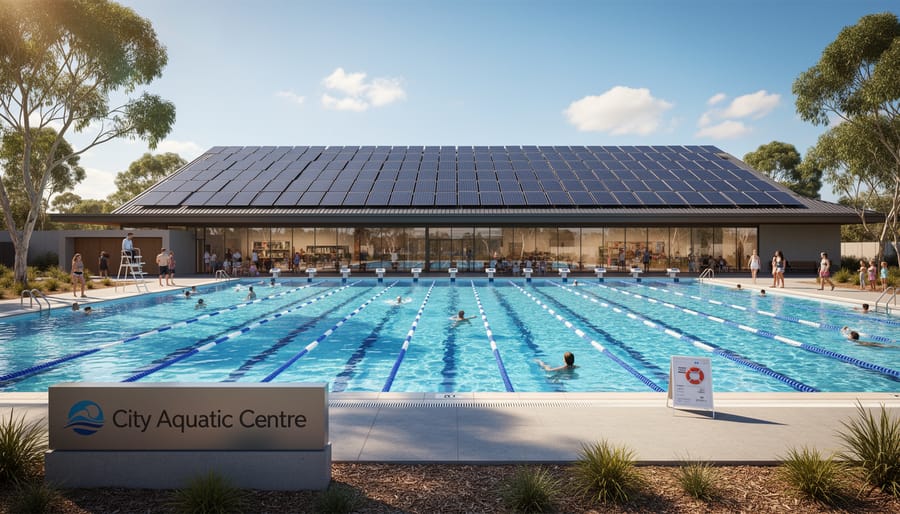
Australia’s abundant sunshine isn’t just for beach days – it’s a powerful resource that aquatic centres across the country are increasingly tapping into. Solar thermal heating systems, which directly convert sunlight into heat for pool water, offer one of the most cost-effective renewable solutions for Australian conditions.
The beauty of solar thermal lies in its simplicity. Unlike photovoltaic panels that generate electricity, these systems use collectors – typically mounted on roofs or nearby structures – to absorb heat and transfer it directly to pool water. Given Australia receives some of the world’s highest solar radiation levels, the technology is particularly well-suited to our climate.
Take the success story of Fairfield Leisure Centre in Sydney’s west, where a 400-square-metre solar thermal array now provides approximately 70 percent of their annual heating needs. The facility invested $85,000 in the installation and achieved payback within just 4.5 years through reduced gas consumption. That’s a compelling return on investment that’s convinced many other centres to follow suit.
In cooler Tasmania, Clarence Aquatic Centre demonstrates that solar thermal works beyond the sunshine states. Their hybrid system combines solar collectors with gas boosting, reducing fossil fuel dependency by 55 percent year-round. The key is proper system sizing and quality components designed for local conditions.
The Australian context makes solar thermal particularly attractive. Most outdoor pools need heating during shoulder seasons when solar availability peaks – a perfect match. Indoor pools benefit year-round, with typical payback periods ranging from 4 to 7 years depending on location and existing infrastructure.
Cost-benefit analysis consistently shows that solar thermal delivers the lowest cost per kilowatt-hour of any renewable heating technology. For centres spending $30,000 to $100,000 annually on pool heating, this represents significant long-term savings while dramatically reducing carbon footprints.
Heat Recovery: Capturing Energy You’re Already Paying For
Every day, Australian aquatic centres spend thousands heating pool water, only to watch that warmth literally go down the drain. But what if you could capture and reuse that energy?
Heat recovery systems do exactly that, transforming wasted thermal energy into substantial cost savings. These systems work by extracting heat from warm shower water, pool backwash, and even HVAC exhaust air, then redirecting it to preheat incoming cold water or supplement pool heating.
The numbers speak for themselves. The Cockburn ARC in Western Australia installed heat recovery technology that now captures warmth from shower water, reducing their gas consumption by 30 percent annually. That translates to savings of around $45,000 each year, with the system paying for itself in under four years.
Similarly, the Belgravia Leisure-managed Knox Leisureworks in Victoria implemented a comprehensive heat recovery solution that recycles energy from their pool filtration system. The facility now recovers approximately 60 percent of the heat that would otherwise be lost, dramatically cutting their carbon footprint while maintaining perfect water temperatures.
The beauty of heat recovery lies in its simplicity. You’re not generating new energy, you’re simply being smarter with what you’ve already purchased. For aquatic centres facing rising energy costs and sustainability targets, these systems offer a practical pathway to achieve both financial and environmental goals. It’s not just good practice, it’s good business sense for Australia’s pool operators.
Water-Saving Technologies That Cut Energy Too
Next-Generation Filtration Systems
Modern filtration technology is revolutionising how Australian aquatic centres manage water quality while slashing operational costs. These next-generation systems are proving that environmental responsibility and financial savings can swim in the same lane.
Traditional sand filters, while reliable, require frequent backwashing that can waste up to 5,000 litres of water per cycle. In contrast, cartridge and regenerative media filters are changing the game across Australia. The Penrith Aquatic Centre in New South Wales recently upgraded to advanced cartridge filtration, reducing their water consumption by 40% annually while maintaining crystal-clear pool conditions that swimmers love.
These innovative systems work by capturing finer particles, often down to 5 microns compared to the 20-40 microns typical of sand filters. This superior filtration means fewer chemicals are needed to maintain water quality, and the water stays cleaner for longer periods. What makes them particularly appealing is their lower energy requirements, as they operate at reduced pressure compared to conventional systems.
Variable-speed pumps paired with modern filters create an efficiency powerhouse. The City of Stirling Aquatic Centre in Western Australia documented a 65% reduction in pump energy consumption after implementing this combination, translating to savings of approximately $18,000 annually.
The upfront investment in next-generation filtration typically pays for itself within three to five years through reduced water, chemical, and energy costs. More importantly, these systems demonstrate to your community that sustainability isn’t just a goal but an active commitment, inspiring others to embrace innovative solutions for environmental challenges.
Pool Covers: The Simplest Game-Changer
Sometimes the most powerful solutions are surprisingly simple. Take pool covers – they’re arguably the easiest way to slash energy and water costs at your aquatic facility, yet they’re often overlooked.
Here’s the reality: an uncovered pool loses thousands of litres to evaporation weekly, especially during Australia’s warmer months. Every drop of evaporated water takes heat energy with it, meaning your heating system works overtime replacing both. It’s a double drain on resources that pool covers stop in their tracks.
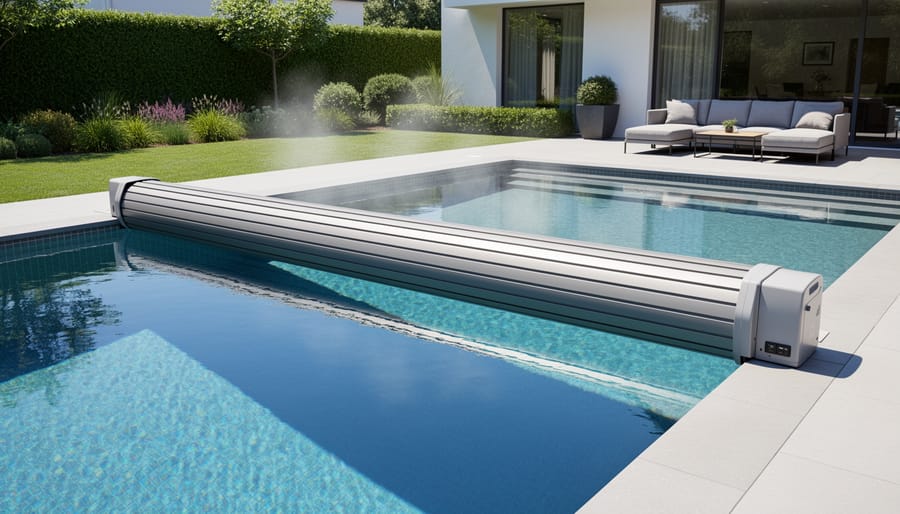
Australian facilities using automated covers report evaporation reductions of 90-95%, translating to annual savings of 30,000-50,000 litres per 25-metre pool. The Narrabeen Sports and Recreation Centre in Sydney documented a 40% reduction in heating costs after installing covers across their facilities.
You’ve got options to suit different budgets. Bubble covers offer affordable thermal insulation, while automated slatted covers provide premium convenience and durability. Many councils are discovering that automation, though pricier upfront, ensures covers actually get used consistently – the key to realising those impressive savings.
The beauty of pool covers lies in their immediate impact. Unlike complex retrofits, they deliver measurable results from day one, making them an ideal first step in your facility’s sustainability journey.
Smart Monitoring and Control Systems
Reading the Data: What to Track and Why
Understanding what to measure is the foundation of effective energy-water optimisation at your aquatic centre. Like many Australian facilities taking control of their resource use, the journey begins with knowing which metrics matter most.
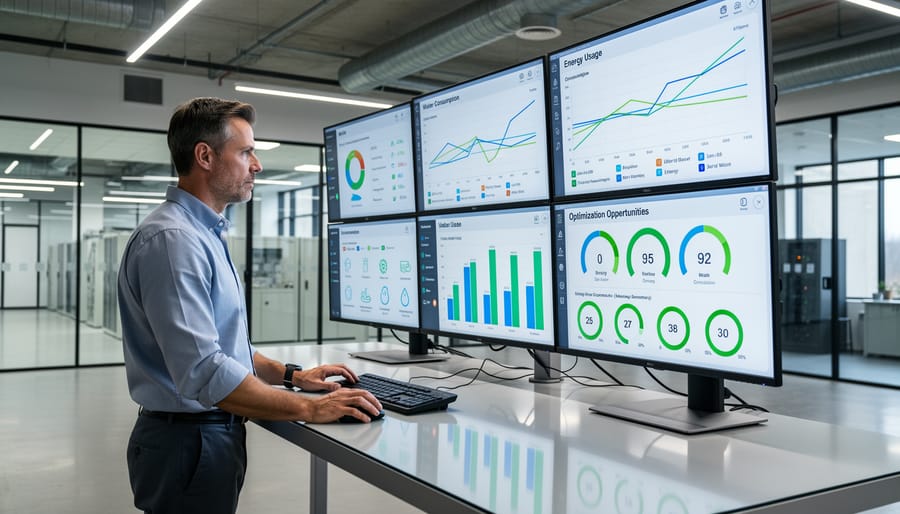
Start by tracking real-time energy consumption across heating, filtration, and lighting systems. These three areas typically account for 80% of an aquatic centre’s energy use, making them prime targets for efficiency gains. By implementing smart monitoring systems, facilities across Queensland and Victoria have identified heating losses of up to 30% during off-peak hours, discovering opportunities they never knew existed.
Water flow rates deserve equal attention. Monitor backwash frequency, evaporation levels, and chemical dosing patterns. These indicators reveal inefficiencies that drain both water supplies and the energy needed to treat and heat that water. One Melbourne aquatic centre discovered their filtration system was running unnecessarily for 6 extra hours daily, costing thousands annually.
Temperature differentials between pool areas tell stories too. Significant variations often signal heating system imbalances or insulation problems requiring attention before they become costly failures.
Don’t overlook occupancy data. Matching your energy and water intensity to actual usage patterns helps identify waste during quiet periods and justifies investment in automated systems that adjust resources according to demand.
The key is consistency. Regular data collection transforms numbers into actionable insights, helping you shift from reactive maintenance to predictive management while building a compelling case for future improvements.
Australian Centres Leading the Way
Across Australia, forward-thinking aquatic centres are proving that sustainability and exceptional service go hand in hand. These facilities are leading a quiet revolution, demonstrating that with the right approach, pools can dramatically reduce their environmental footprint while delivering better experiences for their communities.
In Melbourne’s western suburbs, the Maribyrnong Aquatic Centre has become a benchmark for urban pool sustainability. Facing soaring energy costs and pressure to reduce emissions, the centre implemented a comprehensive energy-water optimisation program in 2021. They installed variable speed drives on all major pumps, upgraded to a high-efficiency heat recovery system that captures waste heat from refrigeration equipment, and introduced smart automation to match heating and filtration to actual pool usage patterns. The challenge was maintaining service quality during the transition, but careful planning meant swimmers barely noticed the upgrades happening around them. The results speak volumes: a 42% reduction in energy consumption and savings of $87,000 annually. Perhaps most impressively, water heating costs dropped by 58%, and the recovered heat now provides warm water for showers and pre-heating pool water, creating a closed-loop system that wastes virtually nothing.
Further north in regional Queensland, the Mackay Aquatic and Recreation Complex tackled a different set of challenges. As a multipurpose facility serving a dispersed population, they needed solutions that worked for both busy weekend periods and quieter weekdays. Their approach focused on solar thermal collectors combined with intelligent scheduling software that learns usage patterns and adjusts operations accordingly. The regional context meant less access to specialized technicians, so they prioritised robust, maintainable technology and invested in staff training. Within eighteen months, they achieved a 35% reduction in grid electricity use and have inspired three neighbouring councils to explore similar upgrades.
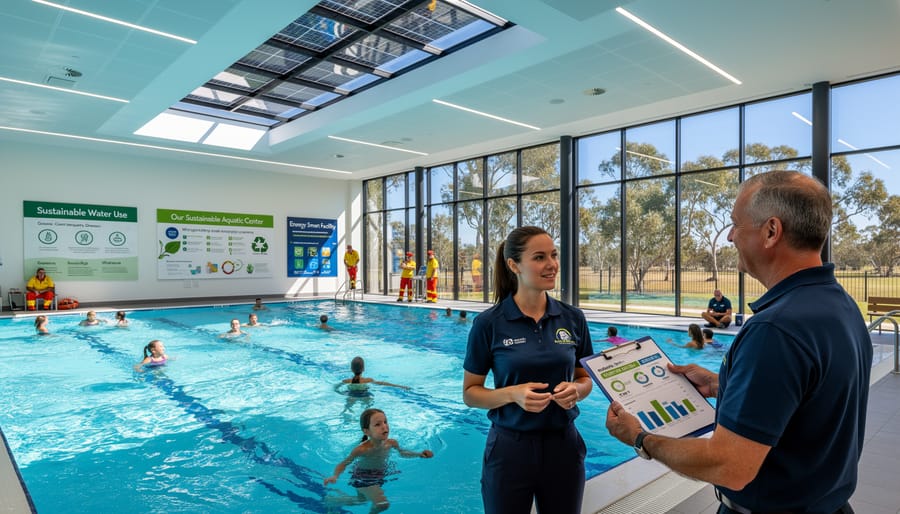
In South Australia, the Playford Aquatic Centre demonstrates what’s possible when community engagement meets technical innovation. They installed a 100-kilowatt solar PV system, upgraded pool covers to reduce evaporation by 90% overnight, and implemented LED lighting throughout. What sets Playford apart is their transparency, displaying real-time energy and water savings on lobby screens, turning their efficiency journey into an educational opportunity. Local schools now visit to learn about sustainability in action, and the centre has become a source of community pride, proving that aquatic facilities can be environmental leaders while remaining welcoming, affordable spaces for everyone.
Making the Business Case for Optimisation
Securing funding for energy-water optimisation might seem daunting, but Australian aquatic centres have access to numerous support mechanisms that make these projects financially viable. The key is presenting a compelling case that resonates with decision-makers while tapping into available resources.
Start by exploring government rebates and grants. The Victorian Energy Upgrades program, NSW Energy Savings Scheme, and similar state-based initiatives offer substantial rebates for energy-efficient equipment installations. The Clean Energy Finance Corporation provides low-interest loans for larger projects, while many local councils maintain community infrastructure grants specifically for public facilities. The Australian Government’s Business Energy Advice Program offers free energy assessments that can form the foundation of your business case.
When building your ROI framework, focus on the triple bottom line: financial savings, environmental impact, and community benefits. Most aquatic centres see payback periods of three to seven years, with ongoing savings that compound annually. For example, replacing a standard pool pump with a variable speed model typically costs between fifteen and twenty-five thousand dollars but saves up to sixty percent on pumping energy costs.
Present your case using tangible metrics that stakeholders understand. Calculate annual kilowatt-hour reductions, translate carbon savings into equivalent cars off the road, and emphasise reduced operational budgets that can be redirected to community programs. Include maintenance cost reductions, as modern efficient systems often require less upkeep than aging equipment.
Engage your community early. Survey patrons about their environmental values and share how optimisation projects align with community sustainability goals. When people understand their local pool is becoming a leader in resource efficiency, support naturally builds. This grassroots backing strengthens your position with funding bodies and council decision-makers who value community engagement.
Remember, you’re not just upgrading equipment; you’re investing in your facility’s future and demonstrating environmental leadership that inspires the broader community.
The journey toward energy-water optimisation in Australian aquatic centres isn’t just about installing solar panels or upgrading pumps—it’s about reimagining how these vital community spaces can operate sustainably for generations to come. When facilities reduce their energy consumption, they simultaneously decrease water waste, lower operational costs, and significantly cut greenhouse gas emissions. This interconnected approach creates a powerful ripple effect that benefits everyone from ratepayers to swimmers to our broader environment.
For aquatic centre operators ready to take action, start by conducting a comprehensive energy and water audit to identify your biggest opportunities for improvement. Engage with suppliers who understand Australian conditions and can provide tailored solutions. Explore available government rebates and incentives that can make sustainable upgrades more financially accessible. Most importantly, share your sustainability journey with your community—transparent communication builds support and inspires others to follow.
Community members have tremendous power to drive change too. Ask questions about energy and water practices at your local pool. Attend council meetings to advocate for sustainable investments. Support facilities that prioritise environmental responsibility through your membership and participation.
Looking ahead, Australian aquatic centres are poised to become models of sustainable infrastructure. As technology advances and community awareness grows, we’re moving toward a future where every pool operates efficiently, affordably, and in harmony with our environment. The transformation has already begun—now it’s time to dive in and be part of the solution.