
Australia’s water crisis has pushed desalination from controversial necessity to cornerstone of our water security strategy, but the real story isn’t about whether we need these plants. It’s about how we’re transforming them from energy-hungry environmental concerns into sustainable solutions that could define our climate future.
Across our sunburnt country, six major desalination plants now convert seawater into drinking water for millions of Australians. Perth has relied on desalinated water for nearly two decades, while Sydney, Melbourne, Adelaide, and the Gold Coast have their own facilities standing ready. Yet these technological marvels come with a significant catch: they consume enormous amounts of electricity, traditionally contributing substantial carbon emissions at a time when we’re racing toward net-zero targets.
Here’s what’s changing. Australian desalination facilities are pioneering energy-water optimisation approaches that weren’t imaginable a decade ago. From renewable energy integration to cutting-edge membrane technology that slashes power requirements, our plants are becoming testbeds for innovations that balance our fundamental need for water security with our environmental responsibilities.
This transformation matters to every Australian. Whether you’re a business owner calculating your water footprint, a concerned citizen wondering about infrastructure sustainability, or simply someone who turns on the tap each morning, understanding how desalination plants operate today and where they’re headed tomorrow affects your community and your future.
The journey from energy-intensive necessity to sustainable solution reveals how Australia tackles its toughest environmental challenges, not by choosing between water and climate action, but by reimagining how both can coexist.
The Real Story Behind Australia’s Desalination Investment
Between 2000 and 2009, Australia faced what became known as the Millennium Drought, a climate crisis that transformed how we think about water security. Rivers ran dry, dam levels plummeted to dangerous lows, and communities across the country confronted the very real possibility of running out of water. This wasn’t a distant threat happening elsewhere; it was unfolding in our backyards, prompting governments to make bold decisions about our water future.
The response was unprecedented. Australia invested over $10 billion in desalination infrastructure, building some of the world’s most advanced ocean-to-tap facilities. These plants weren’t merely expensive experiments; they represented climate insurance policies for millions of Australians facing increasingly unpredictable rainfall patterns and ongoing water security challenges.
Today, our major cities rely on a diverse network of desalination capacity. Perth’s two plants can produce up to 100 billion litres annually, supplying nearly half the city’s water needs. Sydney’s Kurnell facility adds 250 million litres daily when operating at full capacity. Melbourne’s Wonthaggi plant contributes approximately one-third of the city’s supply during drought conditions. Adelaide’s plant provides 100 billion litres annually, while the Gold Coast facility delivers 125 million litres per day to South East Queensland.
These facilities operate differently across cities, reflecting local water situations. Perth runs its plants continuously due to limited rainfall, while Sydney and Melbourne activate theirs strategically during droughts. This flexibility allows communities to balance environmental costs with immediate water needs.
The investment proved its worth during recent dry years. When dam levels dropped again between 2017 and 2020, desalination plants provided reliable water supplies without imposing severe restrictions on households and businesses. Communities could maintain gardens, businesses continued operating, and families avoided the anxiety of extreme water rationing.
Rather than viewing desalination as our only solution, these plants form part of a broader water security strategy alongside recycling, stormwater harvesting, and conservation efforts. They provide breathing room while we collectively develop more sustainable long-term approaches. As climate change intensifies, having diverse water sources isn’t just sensible planning; it’s essential for protecting our communities and Australian way of life.
The Energy Challenge Nobody Talks About
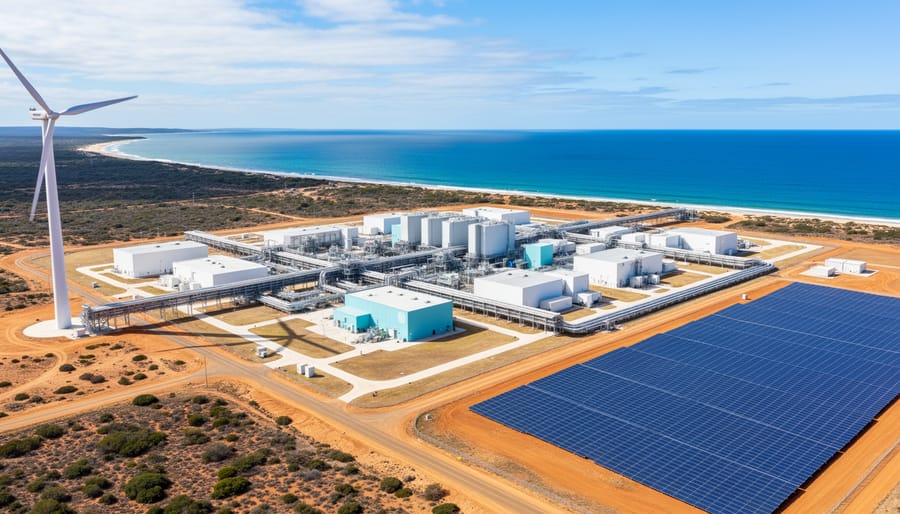
Here’s the reality that often gets glossed over in discussions about water security: desalination plants are energy-hungry operations. For every litre of drinking water produced through reverse osmosis, the most common desalination method in Australia, significant electrical power is required to force seawater through microscopic membrane filters at immense pressure.
To put this in perspective, traditional desalination plants can consume between 3 to 4 kilowatt-hours of electricity for every thousand litres of water produced. When you’re talking about facilities designed to produce hundreds of millions of litres daily, like Perth’s desalination plants, that energy demand adds up quickly. This has historically been the technology’s Achilles heel, raising legitimate questions about whether we’re solving one environmental problem while creating another.
The carbon footprint implications are substantial. When desalination plants run on fossil fuel-generated electricity, they contribute significantly to greenhouse gas emissions. For a nation like Australia, where reducing emissions is increasingly urgent, this presents a genuine dilemma. We need water security, but not at the expense of our climate commitments.
Then there’s the cost factor that hits closer to home. Energy consumption directly affects operational expenses, which ultimately flow through to water pricing for Australian households and businesses. Higher energy costs mean higher water bills, making affordability a real concern for families already navigating cost-of-living pressures.
This energy challenge has long been the subject of heated debate in Australian communities. Critics have pointed to desalination as an unsustainable quick fix, while proponents argue it’s a necessary insurance policy against drought. For years, this tension seemed irreconcilable, with desalination plants sometimes operating intermittently or remaining on standby to minimize energy use and costs.
But here’s where the story takes an encouraging turn: Australian innovation and renewable energy integration are fundamentally changing this equation, transforming desalination from an energy liability into a potentially sustainable solution.
How Australian Plants Are Cracking the Energy Code
Renewable Energy Integration That Actually Works
Australia is proving that desalination doesn’t have to come at the planet’s expense. Across the country, facilities are transforming how they power water production, and the results are genuinely exciting.
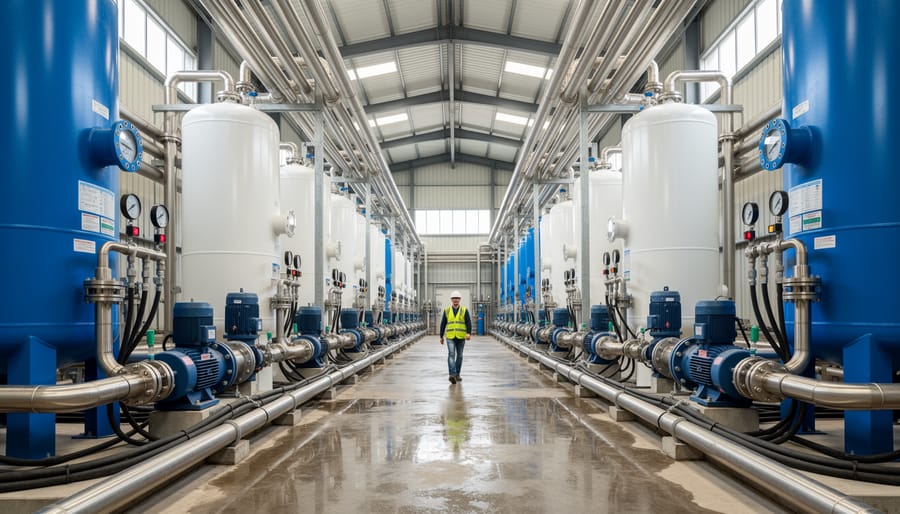
Perth’s Kwinana Desalination Plant stands as a shining example of what’s possible when renewable energy meets water security. Since 2007, this facility has been powered entirely by renewable energy certificates matched to a wind farm in Walkaway, about 300 kilometres north. Every drop of water produced is offset by clean wind power, making it one of the world’s first carbon-neutral desalination plants. The partnership generates enough renewable energy to power approximately 90,000 homes while producing 140 billion litres of water annually.
The Southern Seawater Desalination Plant in Binningup has taken this commitment even further. Operational since 2011, it’s backed by the Mumbida Wind Farm, which generates renewable energy credits equivalent to the plant’s entire electricity consumption. This arrangement prevents roughly 520,000 tonnes of carbon emissions annually, equivalent to taking 110,000 cars off the road.
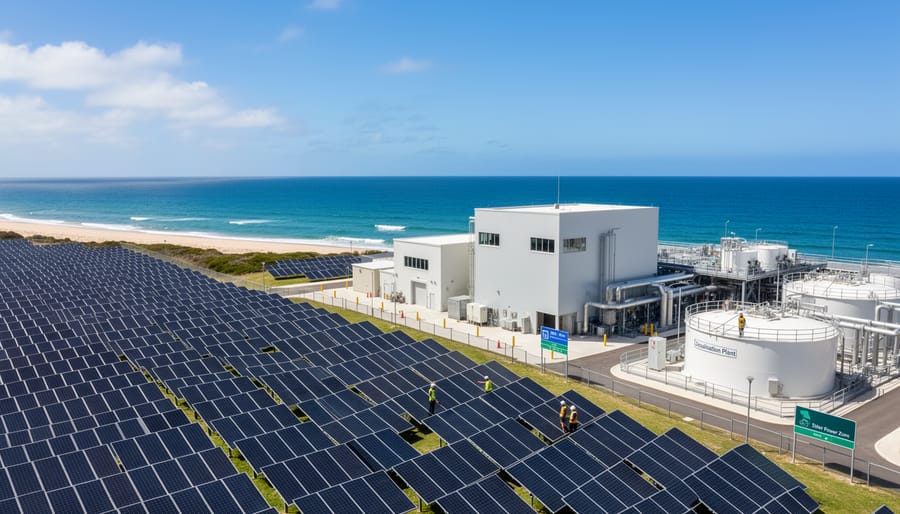
Solar integration is gaining momentum too. The Gold Coast Desalination Plant has incorporated rooftop solar panels to supplement its energy needs, while smaller facilities are exploring battery storage systems to maximise renewable energy use during peak production hours. These innovations demonstrate that solar technology can work alongside traditional power sources, gradually reducing reliance on the grid.
Victoria’s desalination plant has committed to operating on 100 percent renewable energy by 2028, setting an ambitious benchmark for the industry. This transition involves purchasing renewable energy certificates and investing in new wind and solar projects across the state.
These aren’t just environmental wins. They’re proof that Australian ingenuity can solve complex challenges without compromising on water security. When communities, government, and industry collaborate, we create solutions that protect both our water supply and our environment for generations to come.
Energy Recovery Systems Changing the Game
Here’s where Australian desalination technology gets genuinely exciting. Energy recovery devices, or ERDs, have transformed what was once an energy-intensive process into something remarkably efficient. Think of them as the regenerative braking system in a hybrid car, but for water pressure.
When seawater passes through reverse osmosis membranes at high pressure, that energy doesn’t just disappear. Modern ERDs capture the pressure from the concentrated brine leaving the system and transfer it to incoming seawater. It’s an elegant solution that’s changing the economics and environmental footprint of desalination across Australia.
The Perth Seawater Desalination Plant demonstrates this beautifully. By implementing advanced pressure exchangers, the facility recaptures up to 98% of the energy that would otherwise be lost. That’s not just impressive on paper. In practical terms, it means the plant uses roughly 3.5 kilowatt-hours per cubic metre of water produced, compared to older facilities that consumed nearly twice that amount.
The Gold Coast Desalination Plant tells a similar success story. Their energy recovery systems work continuously, transferring pressure energy with minimal loss. For every litre of drinking water produced, the energy required has dropped dramatically compared to desalination plants built just a decade earlier.
This efficiency gain matters beyond the technical specs. Lower energy consumption means reduced greenhouse gas emissions and more affordable water production. As communities across drought-prone regions consider desalination as part of their water security strategy, these recovery systems make the technology increasingly viable and sustainable. The devices themselves are relatively simple in concept but represent years of engineering refinement, proving that smart design can dramatically reduce environmental impact while meeting our essential water needs.
Smart Operations and Demand-Response Technology
Australia’s desalination facilities are embracing intelligent systems that dramatically cut energy use while maintaining reliable water production. These smart operations represent a significant shift in how we manage critical water infrastructure, moving beyond traditional round-the-clock operation to flexible, responsive approaches.
The Perth desalination plants lead this innovation with sophisticated monitoring systems that track energy consumption in real-time, adjusting operations based on grid conditions. When renewable energy from wind and solar floods the grid during peak production periods, the plants ramp up production. During evening peak demand when electricity costs soar and fossil fuel generation increases, they scale back operations. This approach, known as demand-response technology, allows plants to produce the same amount of water while significantly reducing both costs and carbon footprint.
Artificial intelligence now plays a crucial role in energy infrastructure optimisation across Australian desalination facilities. AI algorithms predict optimal operating schedules by analysing weather patterns, electricity prices, and water demand forecasts. The Gold Coast Desalination Plant, for instance, uses predictive maintenance technology that identifies potential equipment issues before they occur, preventing energy-wasting inefficiencies.
Advanced membrane monitoring systems detect when filtration membranes begin losing efficiency, allowing timely cleaning or replacement rather than forcing pumps to work harder. This seemingly simple innovation reduces energy consumption by up to fifteen percent compared to traditional reactive maintenance approaches.
Several coastal plants now participate in virtual power plant networks, essentially acting as flexible energy users that help stabilise the grid. When renewable generation exceeds demand, desalination plants increase production, storing extra water in reservoirs. This collaborative approach benefits everyone, supporting renewable energy integration while ensuring water security for our growing communities without the environmental guilt of wasteful practices.
The Water-Energy Nexus: Why This Balance Matters for Australia’s Future
The relationship between water and energy represents one of Australia’s most pressing sustainability challenges, and our desalination plants sit right at the heart of this connection. Understanding the water-energy nexus helps us see why getting desalination right matters far beyond simply producing drinking water.
When desalination plants operate efficiently, they support multiple sustainability goals simultaneously. Modern facilities in Perth and Adelaide demonstrate this beautifully. By integrating renewable energy sources, these plants provide reliable water supplies during droughts without adding pressure to our electricity grid during peak demand periods. This matters enormously as extreme weather events become more frequent and our climate continues shifting.
The energy optimisation happening at Australian desalination facilities directly supports our national carbon reduction targets. When the Perth Desalination Plant generates power from renewable sources, it avoids approximately 350,000 tonnes of greenhouse gas emissions annually. That’s equivalent to taking roughly 75,000 cars off our roads each year. These numbers show that water security and climate action don’t have to compete with each other.
For Australian communities, efficient desalination means resilience. Cities with modern, well-designed plants can weather extended droughts without implementing severe water restrictions that impact businesses, gardens, and daily life. This water security buffer allows regions to grow sustainably while protecting natural river systems and groundwater reserves that ecosystems depend upon.
The innovations emerging from Australian desalination projects also position our nation as a leader in solving global water challenges. As water scarcity affects more communities worldwide, the technologies and approaches developed here create opportunities for Australian expertise and sustainable solutions to reach far beyond our shores. Every efficiency gain and renewable integration at our plants builds knowledge that benefits water-stressed regions globally while strengthening our own future.
What This Means for Your Water Bill and Carbon Footprint
The efficiency improvements at Australia’s desalination plants aren’t just good news for the environment—they’re creating real benefits for households and businesses across the country. Understanding these impacts helps us see desalination as part of a sustainable water future rather than an environmental burden.
Currently, desalinated water in Perth costs around $2.40 per kilolitre to produce, while Sydney’s costs hover near $3.00. Energy accounts for approximately 44% of these operational expenses, making efficiency gains crucial for keeping water bills manageable. As plants integrate renewable energy and improve their reverse osmosis technology, these costs are trending downward. The Gold Coast Desalination Plant, for instance, has reduced energy consumption by 20% since initial operations, directly contributing to more stable water pricing for residents.
From a carbon perspective, the progress is equally encouraging. Traditional desalination produces roughly 1.5 to 2.5 kilograms of CO2 per kilolitre of water. However, renewable-powered facilities are dramatically cutting this figure. Perth’s plants, now running on wind energy, have slashed their carbon intensity by over 80%, demonstrating what’s possible when we prioritise clean energy integration alongside reducing energy costs.
For your household, every kilolitre of efficiently-produced desalinated water means lower bills and reduced environmental impact. A typical Australian family using 200 kilolitres annually could save $50-100 yearly as efficiency improvements continue, while collectively preventing tonnes of carbon emissions.
These facilities also provide drought security without the carbon guilt. When our dams run low, knowing we have backup water supplies that increasingly run on sunshine and wind power transforms desalination from a last resort into a smart, sustainable choice for Australia’s climate-challenged future.
Local Innovation: Australian Companies Leading the Charge
Australia’s leadership in desalination innovation isn’t just coming from large corporations—it’s being driven by a vibrant ecosystem of local companies, universities, and communities working together to reimagine water sustainability.
Melbourne-based companies are pioneering energy recovery systems that capture and reuse pressure from the desalination process, reducing overall energy consumption by up to 30%. These locally developed technologies are now being exported globally, positioning Australia as a leader in efficient water solutions while creating green jobs at home.
The University of New South Wales and Deakin University are at the forefront of breakthrough research, developing next-generation membranes that require significantly less energy to filter saltwater. Their collaboration with industry partners means these innovations move rapidly from lab to real-world application, benefiting communities across the country.
Community water cooperatives in regional areas are also making waves. In South Australia, local groups have partnered with technology providers to establish smaller-scale desalination units powered entirely by solar energy, demonstrating that sustainable water solutions can be tailored to local needs and resources.
What’s particularly exciting is the collaborative spirit driving these initiatives. Australian businesses are increasingly sharing knowledge and resources, recognizing that water security is a challenge we’ll solve together. Many companies offer site tours and educational programs, inviting community members to understand the technology firsthand.
This local innovation creates opportunities for all of us—whether through employment in growing green industries, investing in sustainable water technologies, or simply supporting businesses committed to environmental responsibility. By backing Australian innovators, we’re building a more resilient water future while strengthening our communities.
Australia’s desalination journey tells a story of transformation. What once seemed like an energy-intensive necessity has evolved into a sophisticated piece of our water security puzzle, where innovation meets environmental responsibility. The plants dotting our coastline aren’t just infrastructure, they’re testament to what’s possible when we commit to doing better.
The progress we’ve witnessed is remarkable. From early facilities consuming vast amounts of power to today’s operations increasingly powered by renewable energy, we’ve shown that meeting water needs doesn’t have to compromise climate goals. Perth’s desalination plants running on wind power and the Gold Coast’s solar integration prove that sustainable water solutions aren’t future dreams, they’re current reality. Yet this transformation isn’t complete, and we can’t afford complacency.
The urgency remains clear. As climate change intensifies droughts and strains traditional water sources, the pressure on desalination technology grows. This makes continued innovation not just beneficial but essential. Every efficiency gain, every renewable energy integration, every advancement in membrane technology brings us closer to truly sustainable water independence.
Here’s where each of us comes in. Community awareness drives change. When we understand the connection between our taps and these facilities, we become advocates for smarter water infrastructure. Support local initiatives exploring alternative water sources. Ask questions about your region’s water strategy. Encourage investment in research and renewable-powered facilities.
Australia has always been a land of adaptation and innovation. Our desalination story is far from finished. By championing sustainable water solutions, we’re not just securing our water future, we’re building a blueprint for responsible resource management that honours both our needs and our environment. The transformation continues, and you’re part of it.