
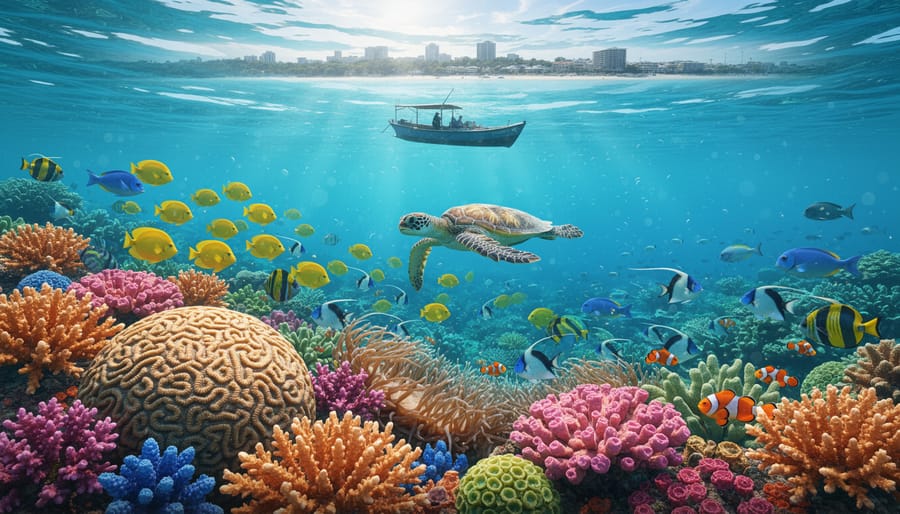
Right now, beneath the turquoise waters off Queensland’s coast, the world’s largest living structure faces a crisis that threatens not just marine life, but the future of every Australian. The Great Barrier Reef stretches 2,300 kilometres along our coastline, protecting 1,500 fish species, supporting 64,000 jobs, and generating $6.4 billion annually for our economy. Yet this natural wonder, visible from space and revered globally, is experiencing unprecedented decline due to deteriorating water quality washing from our rivers into the Coral Sea.
Understanding why the Reef matters goes far beyond tourism brochures and diving expedaries. This marine ecosystem acts as a massive carbon sink, absorbing climate-changing emissions while producing oxygen for millions. It serves as a natural breakwater, protecting coastal communities from cyclones and storm surges that would otherwise devastate properties worth billions. For Traditional Owners like the Yirrganydji and Mandingalbay Yidinji peoples, the Reef represents 60,000 years of cultural connection, knowledge, and spiritual identity.
The urgency becomes clear when you examine the numbers: coral bleaching events once occurred every few decades, but now strike almost annually. Sediment runoff from agriculture clouds the water, blocking sunlight essential for coral survival. Excess nutrients from fertilizers fuel algae blooms that suffocate marine life. Pesticides drift into the ecosystem, weakening coral resilience against disease. This isn’t just environmental decline; Australia’s water quality crisis directly threatens our national identity, economic stability, and the inheritance we leave future generations.
The encouraging news? Communities across Queensland are already implementing solutions that work, and every Australian can contribute to turning this crisis around.
The Great Barrier Reef: More Than Just Pretty Coral
Economic Lifeline for Queensland and Beyond
The Great Barrier Reef isn’t just a natural wonder—it’s a powerhouse driving Queensland’s economy and supporting livelihoods across Australia. The Reef generates approximately $6.4 billion annually for the Australian economy, with tourism accounting for the lion’s share of this contribution. This remarkable ecosystem supports around 64,000 jobs, from dive operators in Cairns to marine researchers in Townsville, creating employment opportunities that ripple through regional communities.
Tourism alone attracts more than 2 million visitors each year, bringing vital income to coastal towns and cities. The commercial fishing industry, valued at roughly $150 million annually, depends entirely on the Reef’s healthy ecosystems to sustain fish populations. Beyond the immediate economic returns, the Reef supports a thriving research sector that positions Australia as a global leader in marine science, attracting international collaboration and funding.
For every dollar invested in Reef protection, communities see returns through sustained tourism, protected fisheries, and preserved coastal infrastructure. When we consider water quality threats to the Reef, we’re not just talking about coral and fish—we’re talking about the economic security of thousands of Australian families and the prosperity of our coastal communities for generations to come.
Nature’s Shield: How the Reef Protects Our Coastline
The Great Barrier Reef functions as a massive natural breakwater, protecting coastal communities along Queensland’s shoreline from the full force of tropical storms, cyclones, and daily wave action. This living barrier absorbs up to 97% of wave energy before it reaches the coast, significantly reducing erosion and storm surge impacts that would otherwise threaten towns like Cairns, Townsville, and the Whitsunday communities.
Without the Reef’s protective structure, coastal infrastructure worth billions of dollars would face severe damage during cyclone season. Local councils in reef-adjacent regions report substantially lower coastal maintenance costs compared to unprotected shorelines elsewhere in Australia. The Reef’s complex three-dimensional structure dissipates wave energy far more effectively than artificial barriers, while simultaneously providing the ecosystem services that support our fishing industries and tourism economy.
As climate change intensifies storm frequency and severity, maintaining a healthy Reef becomes increasingly critical for coastal resilience. Communities are recognizing that every dollar invested in reef conservation delivers multiple returns through avoided damage costs, making reef protection not just an environmental priority but sound economic planning for Queensland’s coastal future.
The Water Quality Crisis Threatening Our Reef
Agricultural Runoff: The Invisible Killer
Behind every vibrant coral community lies an invisible threat flowing from our farmlands. Each year, thousands of tonnes of nitrogen, phosphorus, and pesticides make their journey from Queensland’s agricultural heartland to the Great Barrier Reef through major river systems, fundamentally altering the marine ecosystem we’re working to protect.
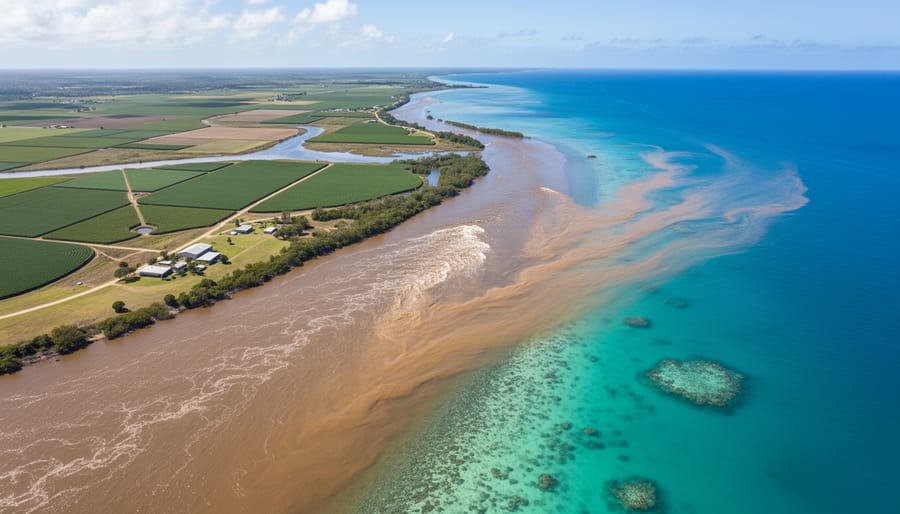
The Burdekin and Fitzroy river catchments tell a particularly concerning story. These waterways drain some of Australia’s most productive agricultural regions, carrying fertiliser runoff from sugarcane farms, grazing lands, and cropping areas directly into Reef waters. During the wet season, this problem intensifies dramatically. Heavy rainfall washes accumulated nutrients and chemicals from fields into creeks and rivers, creating massive plumes that can extend kilometres offshore.
Nitrogen and phosphorus, essential for growing crops, become devastating pollutants in marine environments. These nutrients fuel explosive algae growth, blocking sunlight that corals desperately need. The algae also feeds crown-of-thorns starfish populations, which devastate coral colonies. Meanwhile, pesticides like those used in sugarcane farming have been detected at levels that impair coral reproduction and stress already vulnerable reef systems.
The encouraging news is that Australian farmers are increasingly embracing improved agricultural water management practices. Programs like Reef Trust are helping landholders adopt precision farming techniques, reducing fertiliser application while maintaining productivity. Riparian vegetation buffers are being restored, acting as natural filters before runoff reaches waterways. These community-led initiatives demonstrate that protecting the Reef and supporting productive agriculture aren’t competing interests but shared responsibilities we can tackle together.
Sediment Smothering and Light Reduction
When we clear land for development or farming across Queensland and northern New South Wales, sediment-laden runoff doesn’t simply disappear. It flows through our river systems and settles over the Great Barrier Reef like a heavy blanket, creating challenges that many coral communities simply cannot overcome.
The impact works on two critical levels. First, suspended sediment particles cloud the water, blocking sunlight that coral polyps and their symbiotic algae desperately need for photosynthesis. Corals rely on this process for up to 90% of their energy. When light penetration drops, corals essentially begin to starve, weakening their ability to grow, reproduce, and resist other stressors like warming waters.
Second, when sediment physically settles on coral surfaces, it smothers the living polyps beneath, preventing them from feeding and breathing properly. Young coral recruits trying to establish themselves are particularly vulnerable, as even a thin layer of sediment can be fatal to these tiny organisms.
Community groups along the Queensland coast are already responding. Land management programs focused on maintaining vegetation buffers and reducing erosion are making measurable differences in sediment loads reaching reef waters, demonstrating that practical action at the local level truly matters for reef protection.
The Crown-of-Thorns Starfish Connection
Here’s a story that connects the dots between what flows from our farms and a natural predator gone rogue. The crown-of-thorns starfish naturally feeds on coral, but when nutrient pollution from agricultural runoff reaches the Reef, it creates an unexpected chain reaction. These excess nutrients, particularly nitrogen from fertilisers, fuel massive phytoplankton blooms in coastal waters. The starfish larvae feast on this abundant food source, and their survival rates skyrocket.
What would normally be a balanced population becomes an outbreak, with these coral-eating starfish devastating reef systems. A single starfish can consume up to 10 square metres of coral per year, and during outbreaks, their numbers explode into the millions. Scientists have documented that areas receiving higher nutrient loads experience more frequent and severe outbreaks.
The good news? Australian farming communities are already tackling this challenge. Across Queensland, innovative farmers are adopting precision agriculture techniques that reduce fertiliser runoff by up to 80 percent. These practices aren’t just protecting the Reef – they’re saving farmers money and improving soil health. It’s a powerful reminder that solutions benefiting both the environment and local economies are within reach when we work together.
Current Policy Responses: Progress and Pitfalls
The Reef 2050 Water Quality Improvement Plan
Australia’s commitment to protecting the Great Barrier Reef comes alive through the Reef 2050 Water Quality Improvement Plan, a collaborative framework that brings together governments, farmers, industries, and communities across Queensland. Launched to reverse decades of pollution impacts, this plan sets ambitious targets for reducing sediment, nutrients, and pesticides flowing from six priority catchments into Reef waters.
The investment backing this effort is substantial, with over $2 billion committed since 2015 through various funding streams, including the Reef Trust and partnerships between state and federal governments. These funds support farmers in adopting better land management practices, wetland restoration projects, and innovative technologies that keep pollutants out of waterways before they reach the Reef.
Current progress shows encouraging momentum in some areas. Between 2013 and 2022, dissolved inorganic nitrogen loads dropped by approximately 22 percent in priority areas, demonstrating that targeted interventions work. Several catchments, particularly in the Wet Tropics region, have exceeded their interim targets through community-led initiatives and farmer stewardship programs. Queensland cane farmers have been champions of change, with many transitioning to precision agriculture techniques that use fewer chemicals while maintaining productivity.
However, challenges remain. Sediment reduction targets continue to lag behind expectations, particularly in the Burdekin and Fitzroy catchments where erosion from grazing lands persists. The 2022 progress report revealed we’re about halfway toward the plan’s 2025 targets, highlighting the need for accelerated action and continued investment in proven solutions that benefit both the Reef and agricultural communities.
What’s Working and What’s Not
Here’s the encouraging reality: some initiatives are genuinely making a difference for the Reef, while others reveal where we need to strengthen our collective efforts.
The Reef 2050 Plan represents Australia’s primary framework for protection, bringing together federal and state governments, Traditional Owners, scientists, and industry partners. Within this, the Reef Trust has invested over $500 million in water quality improvements, creating tangible results. Farmers across Queensland catchments have adopted improved fertilizer practices, with some regions showing a 20 percent reduction in nutrient runoff since 2015. These aren’t abstract statistics; they represent real Queensland farming families changing practices for future generations.
Community-driven programs have shown remarkable success. The Reef Guardians initiative has engaged over 500 schools, businesses, and community groups in practical conservation actions. Traditional Owner-led ranger programs combine ancient knowledge with modern science, monitoring water quality through Indigenous eyes that have watched over these waters for 60,000 years.
Yet honesty requires acknowledging the gaps. Despite improvements, current policies aren’t reducing pollution fast enough to meet Reef 2050 targets. Agricultural runoff still exceeds safe levels in key catchments, and sediment pollution remains stubbornly high. Climate change compounds every water quality issue, making the Reef more vulnerable to pollutants while warming waters simultaneously.
The Queensland government’s regulations on fertilizer use show promise but lack the enforcement teeth needed for widespread compliance. Funding for landholder support programs, while substantial, doesn’t match the scale of transformation required.
Here’s what this means: we’ve proven change is possible through the successful programs already working. Now we need to amplify what’s effective, accelerate adoption, and strengthen commitments. The foundations exist; building urgently upon them determines whether our children inherit a thriving Reef or merely its memory.
The Science Behind Saving the Reef
How Scientists Track Water Quality
Australian scientists are leading the charge in protecting our Reef through innovative water quality monitoring techniques. The Australian Institute of Marine Science (AIMS), CSIRO, and university research teams work together to create a comprehensive picture of reef health.
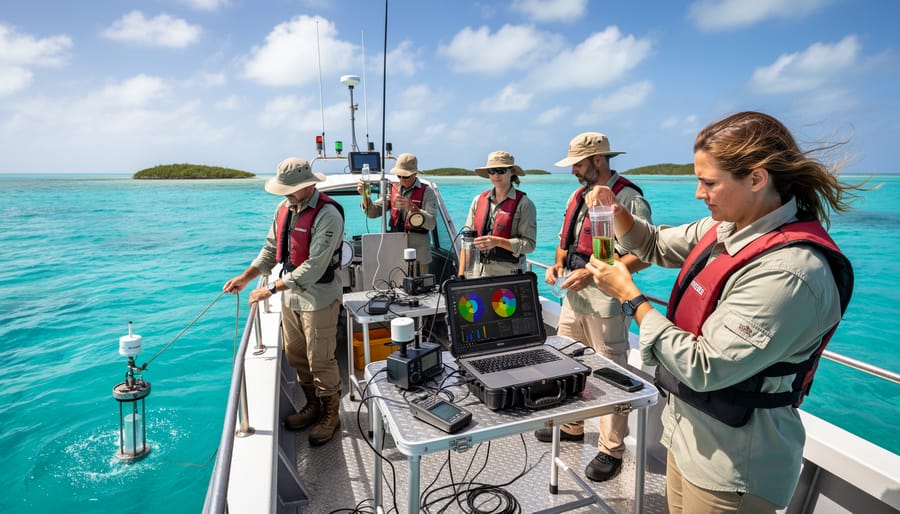
Regular water sampling missions collect data on sediment levels, nutrients, and pesticides at key locations along the coastline and reef zones. Scientists analyse these samples to track pollutant concentrations and identify problem areas requiring immediate attention. Satellite imaging technology has revolutionised monitoring efforts, allowing researchers to observe water clarity, algal blooms, and sediment plumes across vast reef areas in real-time, particularly during flood events when runoff peaks.
Coral health assessments involve divers and underwater cameras documenting bleaching events, coral cover, and species diversity. These physical surveys complement water testing by revealing how pollution directly impacts marine life. Research stations positioned throughout the reef provide continuous data on temperature, salinity, and chemical composition.
This collaborative monitoring network enables scientists to detect changes quickly and inform management decisions. The data collected helps Australian communities understand which land-based practices most affect reef health, empowering targeted action where it matters most.
Breakthrough Discoveries Changing Our Approach
There’s genuine reason for optimism emerging from Australian research institutions right now. Scientists at the Australian Institute of Marine Science have discovered that some coral species possess remarkable heat tolerance genes, essentially nature’s own survival toolkit. These resilient corals are being carefully mapped across the Reef, with researchers identifying genetic traits that help them withstand warming waters and recover faster from bleaching events.
Meanwhile, groundbreaking work at James Cook University has pinpointed exactly how sediment and agricultural runoff affect coral health at the cellular level. This precision understanding means we can now target restoration efforts more effectively. Farmers in Queensland’s Wet Tropics are already using these insights to modify practices, reducing nutrient runoff by up to 30 percent in some catchments.
The real game-changer is collaborative restoration. Community groups, Indigenous rangers, and marine scientists are working together to propagate these heat-resistant corals in underwater nurseries before transplanting them onto damaged reef sections. Early results from Cairns-based projects show survival rates exceeding 70 percent, even during warmer months.
These discoveries prove the Reef isn’t a lost cause. With science-backed action and community commitment, we’re learning how to work with nature’s resilience rather than simply watching decline unfold.
Community Action Making a Real Difference
Farmers Leading the Charge
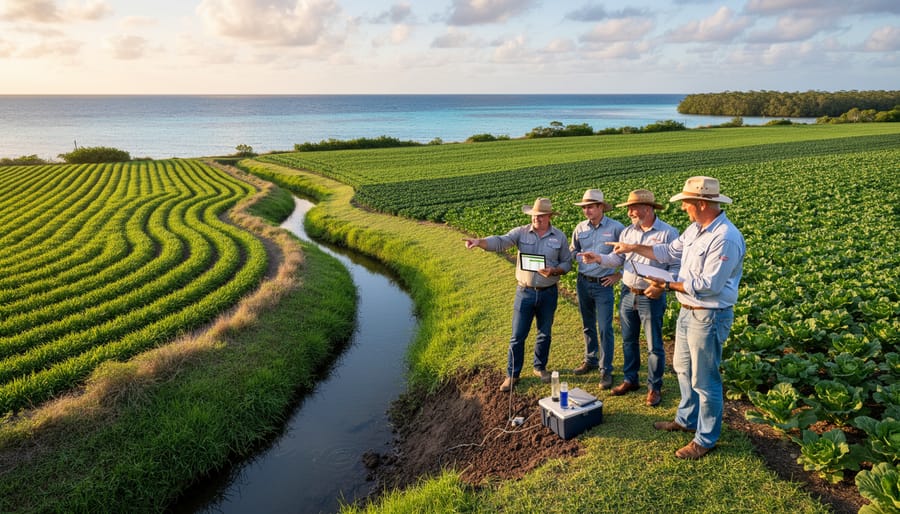
Across Queensland’s sugarcane fields and grazing properties, farmers are proving that productivity and Reef protection can go hand in hand. These agricultural pioneers are adopting practices that dramatically reduce the nitrogen, pesticides, and sediment flowing into Reef catchments.
Take the Mackay Whitsunday region, where sugarcane grower Steve Calcino has transformed his operation through precision agriculture. By using GPS-guided technology and soil testing, he’s reduced fertiliser application by 30% while maintaining crop yields. “We’re saving money and protecting the Reef our kids will inherit,” Steve explains. His farm now contributes significantly less nitrogen runoff to local waterways that feed into the Great Barrier Reef.
In the Wet Tropics, cattle graziers like the Tully River’s Collins family have revegetated stream banks and installed wetlands that filter sediment before it reaches the ocean. Their efforts have reduced soil loss by up to 80% during heavy rainfall events.
These innovations aren’t just environmental wins. They’re economically smart too. The Queensland Reef Water Quality Program reports that farmers adopting best management practices save an average of $15,000 annually in input costs while improving soil health and long-term productivity.
Their leadership demonstrates that protecting our Reef starts on the land, with everyday Australians making extraordinary changes.
Traditional Owners Protecting Country
For over 60,000 years, Traditional Owners have cared for the lands and waters that feed the Great Barrier Reef. Today, Indigenous communities are leading the way in protecting the Reef through innovative programs that blend ancient wisdom with contemporary science.
Across Queensland’s coastal catchments, Indigenous ranger groups are implementing sophisticated water quality monitoring programs. The Girringun Aboriginal Corporation in the Wet Tropics, for example, manages over 24,000 hectares of rainforest country, preventing erosion and sediment runoff that would otherwise smother coral reefs downstream. Their rangers combine traditional burning practices with modern land management techniques to maintain healthy vegetation that filters water naturally before it reaches the ocean.
In the Mackay-Whitsunday region, the Yuibera and Yuwibara peoples are working alongside scientists to restore coastal wetlands that act as natural water filters. These wetlands capture agricultural runoff and trap sediments, significantly improving the quality of water flowing onto the Reef.
These Indigenous-led initiatives demonstrate remarkable success, with monitored sites showing measurable improvements in water clarity and reduced pollutant loads. The programs also create meaningful employment for Indigenous Australians while protecting Country for future generations. Supporting Indigenous land and sea management isn’t just culturally important – it’s proving essential for the Reef’s survival, offering practical solutions grounded in millennia of environmental stewardship.
How Every Australian Can Help Protect the Reef
You don’t need to live on the coast to make a meaningful difference to the Great Barrier Reef. Every Australian, whether in Brisbane, Canberra, or the inland farming communities of Queensland, sits within a catchment that eventually flows to our ocean. The good news? Small changes add up to massive impact when we all pitch in.
Start in your own backyard by reducing chemical runoff. Choose organic fertilisers over synthetic ones, and apply them sparingly during dry weather to prevent them washing into stormwater drains. If you’re maintaining a lawn, leave grass clippings to naturally fertilise rather than adding extra products. Install a rain garden with native plants to filter runoff before it enters waterways. These plants act as natural sponges, capturing sediment and nutrients that would otherwise travel downstream.
For households, simple swaps create ripples of change. Switch to reef-safe, biodegradable cleaning products and detergents. Reduce single-use plastics that often end up in our oceans. Fix leaking taps promptly, as every drop saved reduces the energy needed for water treatment and pumping. Consider installing a greywater system to reuse household water for your garden, cutting both waste and chemical runoff.
Australian businesses have enormous potential to drive change through sustainable business practices. Conduct a water quality audit to identify improvement opportunities. Implement green infrastructure like permeable paving and bioswales in car parks. Choose suppliers committed to reducing agricultural runoff, and showcase these partnerships to inspire others.
Support Reef-positive agriculture by choosing products certified for sustainable farming practices. When you buy Queensland produce displaying reef-friendly credentials, you’re backing farmers who’ve invested in better land management.
Finally, amplify your impact through community action. Join local Landcare groups organising tree planting days along waterways. These riparian zones act as crucial buffers, filtering runoff before it reaches rivers. Share your sustainable practices with neighbours, creating a groundswell of collective action.
Remember, protecting the Reef isn’t about perfection; it’s about progress. Each positive choice you make joins thousands of others across Australia, creating a wave of change powerful enough to safeguard this irreplaceable wonder for generations to come.
The Great Barrier Reef stands at a crossroads, and we as Australians hold the compass that determines which path it takes. While the challenges facing our Reef are significant, particularly from declining water quality, the solutions are within our reach. This isn’t just an environmental issue; it’s about preserving a natural wonder that defines our coastline, supports thousands of livelihoods, and generates billions for our economy.
The good news is that water quality improvements show measurable results. When sediment runoff decreases, corals respond. When fertilizer application becomes more targeted, seagrass meadows recover. These aren’t hypothetical scenarios but documented outcomes from communities already taking action across Queensland’s catchments.
Every Australian has a role to play, regardless of where you live. If you’re in agricultural regions, adopting practices that reduce runoff directly benefits the Reef. Urban dwellers can support businesses committed to sustainable practices and make informed choices about the products they buy. Businesses across all sectors can invest in technologies and processes that minimize their environmental footprint.
The Reef Restoration Foundation, Reef Check Australia, and countless local groups have shown us that collective action creates real change. Join a citizen science program, support reef-positive businesses, or simply share knowledge with your community. Time is pressing, but despair serves no purpose.
Our generation faces a unique responsibility and privilege: we possess both the knowledge and technology to save the Great Barrier Reef. The question isn’t whether we can make a difference, but whether we will. Start today, because tomorrow’s Reef depends on the choices we make right now.